Dispersion of Light through a Prism (original) (raw)
Last Updated : 9 Apr, 2026
Dispersion of light is the phenomenon in which white light splits into its constituent colors when it passes through a prism. This happens because each color of light has a different wavelength and bends by a different amount upon refraction. As a result, the colors spread out to form a visible spectrum, commonly known as VIBGYOR (Violet, Indigo, Blue, Green, Yellow, Orange, Red). Dispersion is the reason we see rainbows in nature and is widely used in optics to study the properties of light.
.webp)
Angle of Deviation
The bending of light as it passes through a prism is measured by the angle of deviation, which is defined as the angle between the incident ray entering the prism and the emergent ray leaving it. The amount of deviation depends on the wavelength of the light: shorter wavelengths bend more, while longer wavelengths bend less. Therefore, violet light, having the shortest wavelength, is deviated the most, whereas red light, having the longest wavelength, is deviated the least.
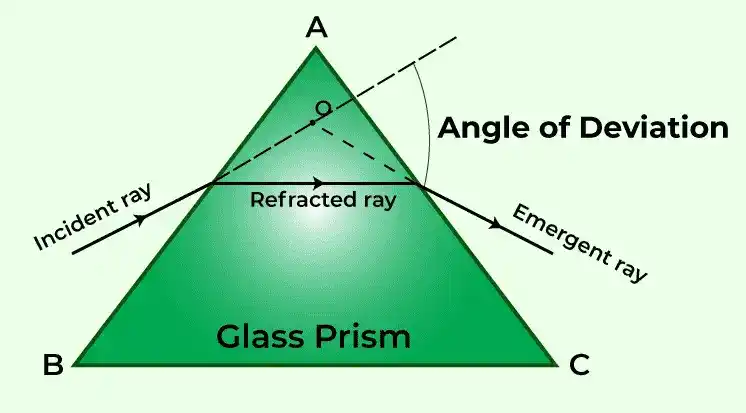
This variation in deviation causes the dispersion of white light, and the visible pattern of colors, or the spectrum, that we observe is due to the different wavelengths of the constituent colors being separated by the prism.
**Visible Light Spectrum
The light disperses into a wide range of colors after passing through a glass prism. We can see the spectrum by looking at it from a different perspective. The refractive index associated with a material is not fixed; it varies with the frequency of the light used.
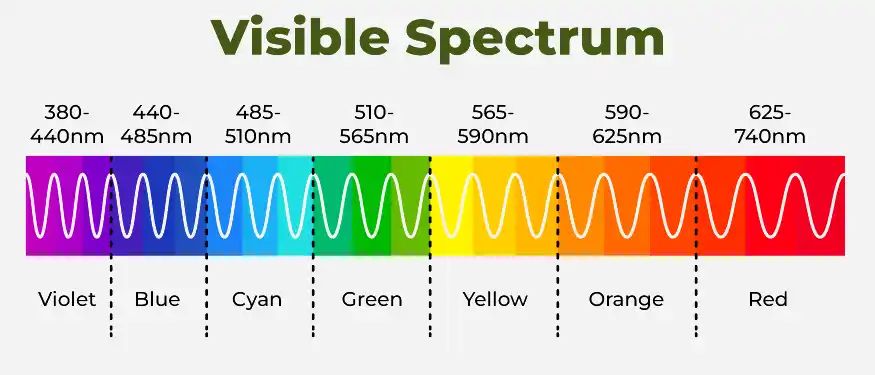
- If white light passes a glass prism, it gets refracted twice; first, when the light strikes the prism, the light ray gets deviated from the air to the glass surface, and its speed decreases, whereas when the light ray leaves the glass prism, it again gets deviated from the glass to the air surface, and its speed is increased.
- Inside the glass prism, the speed of the light rays remains constant.
- The surface of the prism is not parallel, and hence, the light ray does not follow the same path and gets deviated.
This deviation in the white lights makes the spectrum of the light visible, and we observe the visible spectrum of the light. For example, the spectrum observed on the oil drop is the visible spectrum of the light.
**Prism Experiment
The first experiment of light passing through the prism was conducted by the great scientist, Newton. He allows white light to pass through a prism, hoping to get white light to the other end. But to his surprise, he found that white light gets changed to the spectrum of the seven colors. He named this phenomenon the dispersion of light.
Through this experiment, he concluded that light is made up of a spectrum of light. To further prove his experiment, he conducted some other tests as
- He allows the light of only one wavelength to pass through the prism and observes the light ray coming out of the prism and finds that this ray only gets refracted, and so there is no sign of dispersion.
- He realized that only white light shows dispersion, as it is made of several colors of light, and all these colors of light have different wavelengths; thus, their refraction is not the same they all get deviated differently passing through the prism and allowing them to form the spectrum of light.
- He concludes that violet light has the shortest wavelength, and hence it deviates the most, whereas red light has the highest wavelength, and hence it deviates the least.
**Examples
**Formation of a Rainbow: The phenomenon of dispersion is responsible for the formation of a rainbow. During rainfall, tiny water droplets remain suspended in the air. When sunlight passes through these droplets, it is refracted, dispersed, and internally reflected, resulting in the separation of white light into its constituent colors. This dispersed light appears to us as a beautiful rainbow in the sky.
**Spectrum observed on Oil Droplets in Water: When oil droplets float on water, a similar effect occurs. Light passing from air to oil or from oil to water undergoes refraction and dispersion due to the difference in optical densities of the media. As a result, the white light splits into its constituent colors, and we observe a spectrum of colors on the surface of the oil droplets.
Related Articles:
Solved Problems
**Question 1: A prism has an angle of prism (A) = 60°. The angle of incidence is 50° and the angle of emergence is 40°. Find the angle of deviation.
**Solution: \delta = i + e - A
\delta = 50^\circ + 40^\circ - 60^\circ
\delta = 30^\circ
**Question 2: A light ray travels from air into glass. The angle of incidence is 30° and the angle of refraction is 19°. Find the refractive index of glass.
**Solution: n = \frac{\sin i}{\sin r}
n = \frac{\sin 30^\circ}{\sin 19^\circ}
n = \frac{0.5}{0.325}
n \approx 1.54
**Question 3: The refractive index of glass is 1.5. Find the speed of light in glass. (Speed of light in vacuum c = 3 × 10⁸ m/s)
**Solution: n = \frac{c}{v}
v = \frac{c}{n}
v = \frac{3 \times 10^{8}}{1.5}
v = 2 \times 10^{8}\, m/s
**Question 4: The wavelength of violet light is 400 nm, and red light is 700 nm. Which color will deviate more in a prism?
**Solution: Smaller wavelength bends more in a prism.
\lambda_{violet} = 400\,nm < \lambda_{red} = 700\,nm
Therefore, violet light deviates more than red light.
Unsolved Problems
Question 1: A prism has a prism angle of 55°. The angle of incidence is 45° and the angle of emergence is 35°. Find the angle of deviation.
Question 2: A ray of light travels from air into glass. The angle of incidence is 40° and the angle of refraction is 25°. Calculate the refractive index of glass.
Question 3: The refractive index of a medium is 1.33. If the speed of light in vacuum is 3×1083 × 10^83×108 m/s, find the speed of light in the medium.
Question 4: In a prism experiment, the angle of the prism is 60°. If the angle of incidence is 50° and the angle of deviation is 30°, find the angle of emergence.
Question 5: The wavelength of violet light is 420 nm, and the wavelength of red light is 680 nm. Which color will deviate more in a prism? Explain briefly.