Doppler Effect (original) (raw)
Last Updated : 10 Mar, 2026
The Doppler Effect is the phenomenon in which the observed frequency (or pitch) of a wave changes due to the relative motion between the source of the wave and the observer. The observed frequency goes up when the source and observer get closer to each other, and it goes down when they move away from each other. This effect occurs for all types of waves, including sound and electromagnetic waves.
It is a wave phenomenon; it doesn't hold only for sound waves. It holds for all the waves. There are three possible cases that should be analyzed while studying the Doppler effect:
- The observer is stationary, but the source is moving.
- The observer is moving, but the source is stationary.
- Both source and observer are moving.
**Note: Most waves require a medium for propagation, however electromagnetic waves do not require any medium. In that case, these case of observer moving and source stationary and vice-versa are same.
Source moving but observer stationary
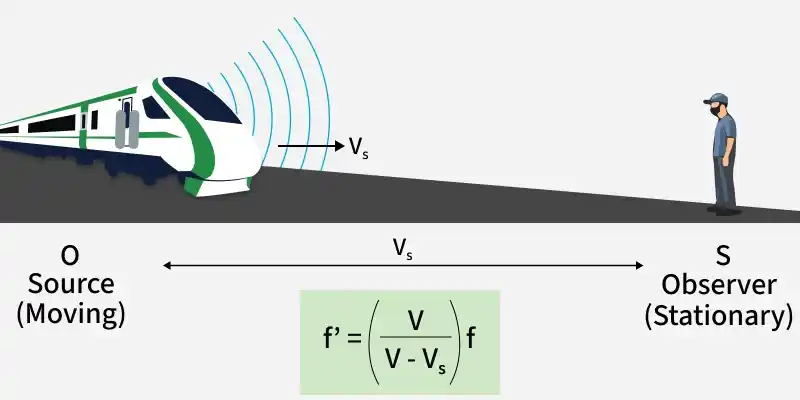
A train approaching a station is an example of a sound source approaching a stationary observer. The figure given below shows a situation in which the source is moving while the observer remains stationary. The velocity of the source is denoted by vs. If the actual frequency of the source is f and the observed frequency is f′ and v represents the velocity of sound in the medium, then the observed frequency is given by:
f' = \frac{V}{V - V_s}f
Source Stationary but Observer Moving
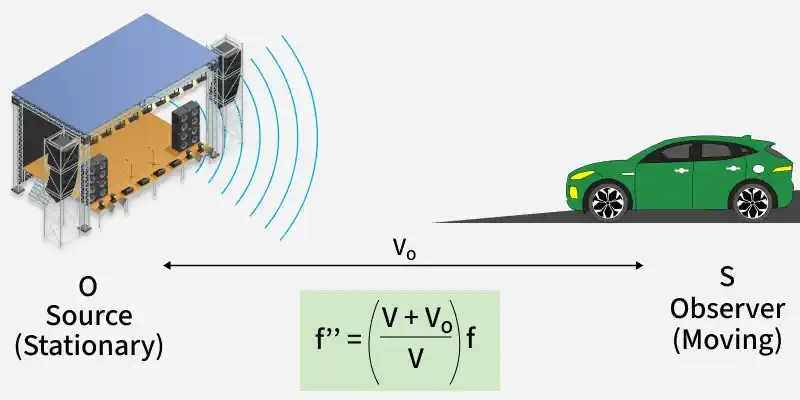
An observer sitting in the car is approaching the stadium where a concert is happening. This is an example of a situation where the observer moves and approaches the source. In a situation where the source is stationary and the object is moving. The velocity of the object is denoted by vo. If the actual frequency of the source is denoted by f and f' denotes the observed frequency. If "v" denotes the velocity of the sound wave. Then the observed frequency, in this case, is given by,
f' = \frac{V + V_o}{V}f
Both Source and Observer Moving
The figure given below shows the situation in which both the source and the observer are moving. The velocity of the observer is denoted by vo, while the velocity of the source is denoted by vs. If the actual frequency of the source is f and the observed frequency is f′, and if v represents the velocity of sound in the medium, then the observed frequency is given by:
f' = \frac{V + V_s}{V - V_o}f
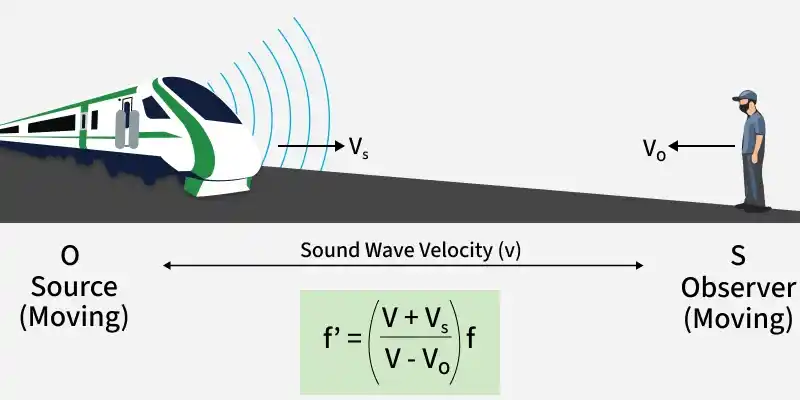
This third case is a combination of the previous two cases and hence represents a general case of the Doppler effect. If the direction of motion of either the source or the observer is reversed, the corresponding velocity term changes its sign accordingly.
Limitations of Doppler Effect
Even though the Doppler effect has applications in almost every field where waves are present, it has certain limitations. It is applicable only when the velocities of the source and the observer are much smaller than the velocity of sound in the medium. Moreover, in the formulation of the Doppler effect, the motion of the source and the observer must be along the same straight line.
Applications of Doppler Effect
- Used in estimating the speed of distant stars, planets, and other celestial bodies.
- Used in finding the velocities of airplanes and submarines.
- In police radar systems, it is used to measure the speed of automobiles.
Sample Problems
**Question 1: An ambulance is approaching a person at a speed of 3 m/s. Assuming that the frequency of the siren of the ambulance is 440 Hz. Find out the frequency at which the observer hears the siren. (Velocity of the sound in air = 360 m/s).
**Answer:
In this case, the source is moving towards the observer.
f' = \frac{V}{V - V_s}f
Given: f = 440Hz, V = 360 m/s and Vs = 3 m/s
Plugging the values in the equation,
f' = \frac{V}{V - V_s}f
⇒ f' = \frac{360}{360 - 3}440
⇒ f' = \frac{360}{357}440
⇒ f' = \frac{360}{357}440
⇒ f' = 443 Hz .
**Question 2: An ambulance is receding away from a person at a speed of 6 m/s. Assuming that the frequency of the siren of the ambulance is 440 Hz. Find out the frequency at which the observer hears the siren. (Velocity of the sound in air = 360 m/s).
**Answer:
In this case, the source is moving towards the observer.
f' = \frac{V}{V - V_s}f
Given: f = 440Hz, V = 360 m/s and Vs = 6 m/s
Plugging the values in the equation,
f' = \frac{V}{V - V_s}f
⇒ f' = \frac{360}{360 - (-6)}440
⇒ f' = \frac{360}{366}440
⇒ f' = 432.7 Hz .
**Question 3: A person is approaching a stadium on a motorcycle at a speed of 10 m/s. Assuming that the frequency of the sound coming out of the stadium is 400 Hz. Find out the frequency that the person hears in the sound. (Velocity of the sound in air = 360 m/s).
**Answer:
In this case, the observer is moving towards the source.
f' = \frac{V + V_o}{V}f
Given: f = 400Hz, V = 360 m/s and Vo =10 m/s
Plugging the values in the equation,
f' = \frac{V + V_o}{V}f
⇒ f' = \frac{360 + 10}{360}400
⇒ f' = \frac{370}{360}400
⇒ f' = 411 Hz .
**Question 4: A person is approaching a van moving at a speed of 20 m/s on a motorcycle at a speed of 10 m/s. Assuming that the frequency of the sound of the horn coming out from the van is 400 Hz. Find out the frequency that the person hears in the sound. (Velocity of the sound in air = 360 m/s).
**Answer:
In this case, both the observer and source are moving. .
f' = \frac{V + V_s}{V - V_o}f
Given: f = 400Hz, V = 360 m/s, Vo =10 m/s and vs = 20m/s
Plugging the values in the equation,
f' = \frac{V + V_s}{V - V_o}f
⇒ f' = \frac{360 + 20}{360 - 10}400
⇒ f' = \frac{380}{350}400
⇒ f' = 434 Hz.
**Question 5: A person is approaching a van moving away at a speed of 20 m/s on a motorcycle at a speed of 10 m/s. Assuming that the frequency of the sound of the horn coming out from the van is 400 Hz. Find out the frequency that the person hears in the sound. (Velocity of the sound in air = 360 m/s).
**Answer:
In this case, both the observer and source are moving. .
f' = \frac{V + V_s}{V - V_o}f
Given: f = 400Hz, V = 360 m/s, Vo =10 m/s and vs = 20m/s
Plugging the values in the equation,
f' = \frac{V + V_s}{V - V_o}f
⇒ f' = \frac{360 - 20}{360 + 10}400
⇒ f' = \frac{340}{370}400
⇒ f' = 367 Hz.
Unsolved Problems
**Question 1: A car moving at a speed of 15 m/s approaches a stationary observer. The frequency of the horn of the car is 500 Hz. If the velocity of sound in air is 340 m/s, find the frequency heard by the observer.
**Question 2: A stationary siren emits sound of frequency 600 Hz. An observer moves away from the siren with a speed of 8 m/s. Calculate the frequency observed. (Velocity of sound = 360 m/s)
**Question 3: An observer moves towards a stationary source of sound with a speed of 12 m/s. If the observed frequency is 480 Hz and the velocity of sound is 360 m/s, find the actual frequency of the source.
**Question 4: A source of sound moving with a speed of 25 m/s emits sound of frequency 700 Hz. An observer moves towards the source with a speed of 10 m/s. Find the observed frequency. (Velocity of sound = 350 m/s)
**Question 5: A train moving at a speed of 30 m/s emits a whistle of frequency 800 Hz. A cyclist moving in the same direction as the train with a speed of 12 m/s hears the sound. Find the frequency heard by the cyclist. (Velocity of sound = 340 m/s)
**Question 6: An observer and a source are moving towards each other with speeds of 15 m/s and 20 m/s, respectively. The observer hears a frequency of 520 Hz. If the velocity of sound is 360 m/s, determine the actual frequency of the source.