Electric Potential Due to a Point Charge (original) (raw)
Last Updated : 30 May, 2026
Electric forces are responsible for many chemical reactions in the human body. Charged particles experience forces when they are placed in an electric field. When a charge moves in an electric field, work is done on it, and energy is stored as electrostatic potential energy.
Electric Potential Energy
Electric potential energy is the energy required to move a charge against an electric field. When a charge is placed in an electric field, it experiences a force, and work done against this force is stored as electric potential energy.
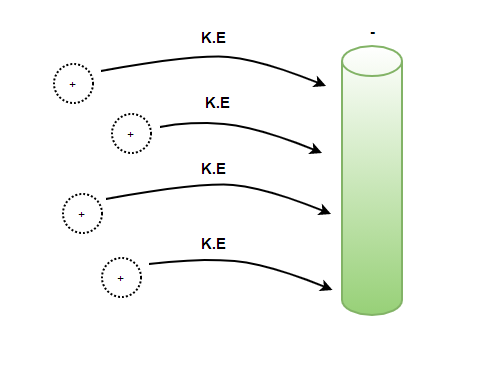
When positive charges are separated from a negatively charged plate, work is done against the attractive force, storing potential energy in the charges. When released, the charges move toward the plate, converting potential energy into kinetic energy.
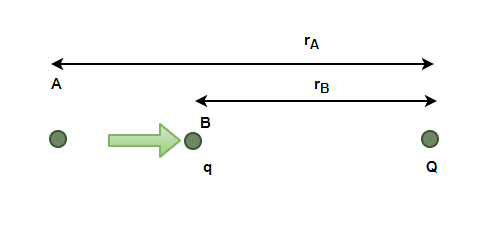
For a two-charge system with charges q and Q given in the figure above, the change in electric potential energy in taking the charge q, from A to B is given by,
W_{AB}=\frac{Qq}{4 \pi \epsilon}(\frac{1}{r_B} - \frac{1}{r_A})
Electric Potential
Electric potential is the potential energy per unit charge between two points in an electric field. It tells how much the potential energy of a unit positive charge changes when moved from one position to another and is denoted by V.
V = \frac{\text{P.E}}{q}
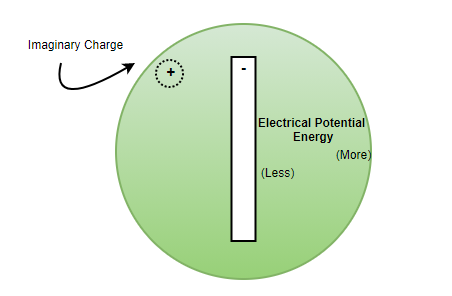
When a positive charge is moved farther from a negatively charged plate, more work is done on the charge, so the potential increases with distance from the plate, while the potential near the negatively charged plate is low.
Derivation of Electric Potential Due to a Point Charge
Consider a point charge as shown in the figure. In the figure, there are several concentric circles, which represent equipotential contours. This means that all the points on a single contour have the same electric potential.
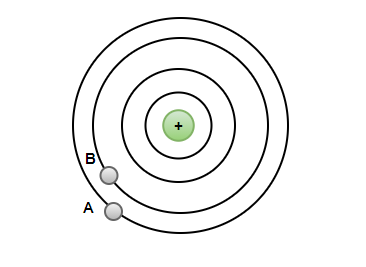
The aim is to calculate the electric potential due to this point charge between two points A and B. The electric potential difference is also called voltage, and it is measured in volts (V). Electric potential difference between A and B is given by:
V_{AB} = \frac{U_B}{q} - \frac{U_A}{q}
\frac{1}{4\pi \epsilon} \frac{q}{r_A} - \frac{1}{4\pi \epsilon} \frac{q}{r_B}
Now, if rB = \infty
\frac{1}{4\pi \epsilon} \frac{q}{r_A} - \frac{1}{4\pi \epsilon} \frac{q}{\infty}
Since \frac{1}{\infty} = 0
V = \frac{1}{4\pi \epsilon} \frac{q}{r}
The electric potential at a distance r from a point charge q is
Superposition of Electric Potential
For a system of point charges, the total electric potential at a point is equal to the algebraic sum of the potentials due to each individual charge at that point. Example: consider a system containing three charges Q1 Q2, and Q3. Let the distances of these charges from a point P be r1, r2 and r3 respectively. Then, the total electric potential at point P is given by:
V = \frac{1}{4\pi \epsilon }(\frac{Q_1}{r_1} + \frac{Q_2}{r_2} + \frac{Q_3}{r_3} )
Sample Problems
**Question 1: Find the potential at a distance of 1 m due to a charge of 2pC.
**Solution: The potential due to a point charge is given by,
\frac{1}{4\pi \epsilon }\frac{q}{r}
Here, q = 2 pC = 2 x 10-12C and r = 1 m.
Plugging the values into this equation,
V = \frac{1}{4\pi \epsilon }\frac{q}{r}
⇒ V = 9 \times 10^{9} .\frac{2 \times 10^{-12}}{1}
⇒ V= 9 × 109 × 2 x 10-12
⇒ V= 18 × 10-3
⇒ V = 0.018 V
**Question 2: Find the potential at a distance of 0.5 m due to a charge of 10pC.
**Solution: The potential due to a point charge is given by,
\frac{1}{4\pi \epsilon }\frac{q}{r}
Here, q = 10 pC = 10 x 10-12C and r = 0.5m.
Plugging the values into this equation,
V = \frac{1}{4\pi \epsilon }\frac{q}{r}
⇒ V = 9 \times 10^{9} .\frac{10 \times 10^{-12}}{0.5}
⇒ V= 9 × 109 × 2 x 10-11
⇒ V= 18 x 10-2
= 0.18 V
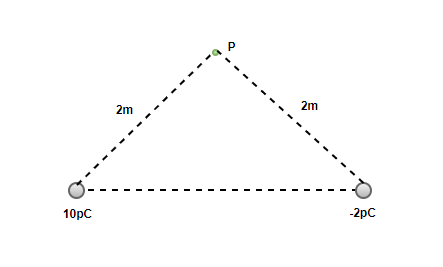
**Question 3: Find the electric potential at a distance of 2 m due to charges 10 pC and −2 pC.
**Solution: The potential due to a point charge is given by,
\frac{1}{4\pi \epsilon }\frac{q}{r}
Here, q1 = 10 pC = 10 x 10-12C
q2 = -2 pC = -2 x 10-12C and r = 2 m.
Since there are two charges in the system, the total potential will be given by the superposition equation.
V = \frac{1}{4\pi \epsilon }(\frac{Q_1}{r_1} + \frac{Q_2}{r_2} + \frac{Q_3}{r_3} )
For two charges,
V = \frac{1}{4\pi \epsilon }(\frac{Q_1}{r_1} + \frac{Q_2}{r_2} )
Plugging the values into this equation,
V = \frac{1}{4\pi \epsilon }(\frac{Q_1}{r_1} + \frac{Q_2}{r_2} ) \\ = V = 9 \times 10^9(\frac{10 \times 10^{-12}}{2} - \frac{2 \times 10^{-12}}{2}) \\ = V = 9 \times 10^9(4 \times 10^{-12}) \\ = V = 36 \times 10^{-3}
⇒ V= 36 × 10-3 V
V = 0.036V
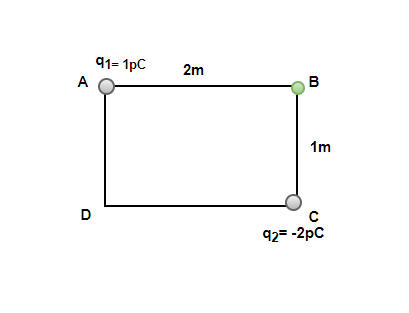
**Question 4: Two charges are kept at opposite corners of rectangles as shown in the figure. Find the potential at the corner between them.
**Solution: The potential due to a point charge is given by,
\frac{1}{4\pi \epsilon }\frac{q}{r}
Here, q1 = 1 pC = 10-12C,
q2 = -2 pC = -2 x 10-12C
r1 = 2 m and r2 = 1 m.
Since there are two charges in the system, the total potential will be given by the superposition equation.
V = \frac{1}{4\pi \epsilon}\left(\frac{Q_1}{r_1} + \frac{Q_2}{r_2}\right)
Substituting the values
V = 9 \times 10^9 \left(\frac{1 \times 10^{-12}}{2} - \frac{2 \times 10^{-12}}{1}\right)
V = 9 \times 10^9 \left(0.5 \times 10^{-12} - 2 \times 10^{-12}\right)
V = 9 \times 10^9 \left(-1.5 \times 10^{-12}\right)
V = -13.5 \times 10^{-3} \, V
V = -0.0135 \, V
Unsolved Problems
**Question 1: Find the electric potential at a distance of 3 m due to a charge of 5 pC.
**Question 2: Two charges 4 pC and -6 pC are placed at distances 2 m and 4 m respectively from a point P. Find the net electric potential at P.
**Question 3: Calculate the electric potential energy of a system containing charges 8 pC and 2 pC separated by a distance of 1.5 m.
**Question 4: A charge of 12 pC is placed at the center of a circle of radius 0.2 m. Find the electric potential on the circumference of the circle.
**Question 5: Three charges 2 pC, 3 pC, and -1 pC are placed at distances 1 m, 2 m, and 0.5 m respectively from a point P. Calculate the total electric potential at P.