Electrical Energy and Power (original) (raw)
Last Updated : 3 Jun, 2026
Electric energy, produced by the movement of charged particles, is one of the most essential forms of energy used in electrical devices. Each device has a power rating in watts indicating its energy consumption, with high-power devices like air conditioners and refrigerators having higher ratings. When current flows through a conductor from point A to B, the electric potential decreases from V(A) to V(B), converting electrical potential energy into useful forms such as light or heat.
V = V(A) - V(B)
V > 0
In time "t", the charge Q travels from point A to point B.
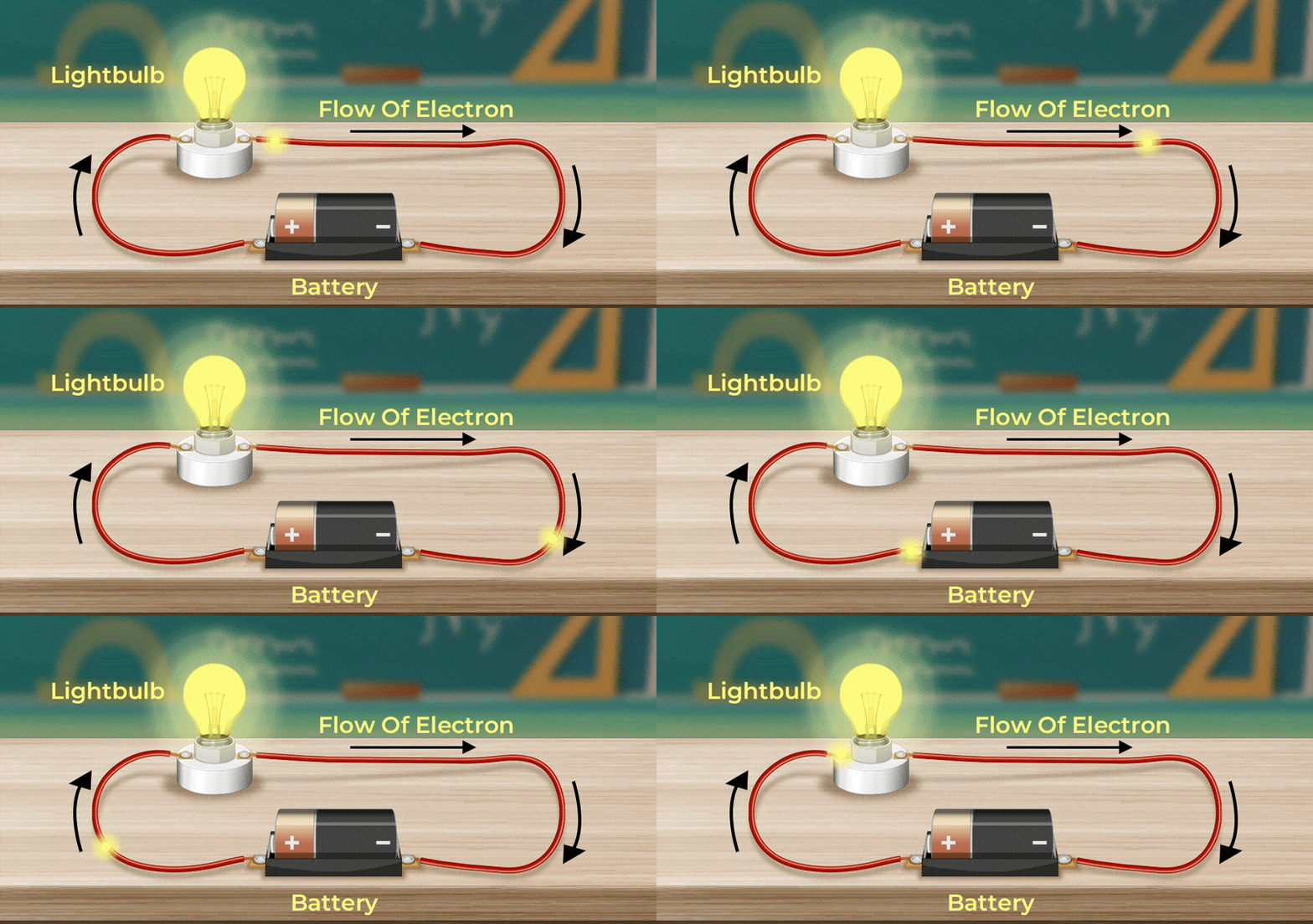
Formula of Electrical Energy
Let's say the potential energy at point A is denoted by UA, while the potential energy at point B is denoted by UB.
Potential Energy at points:
UA = Q × VA
UB = Q × VB
Let the change in potential energy be denoted by Unet
Unet = Final Potential Energy - Initial Potential Energy
Unet = UB - UA
Unet = Q × VB - Q × VA
Unet = - ∆Q.V (Now, I = ∆Q/∆t)
Unet = - I × ∆ t × V
If charges moved freely inside the conductor, the loss in potential energy would convert entirely into kinetic energy, keeping total energy conserved.
∆K = -∆U
In real conductors, electrons collide with ions and move slowly (drift velocity). Due to this, energy is lost as heat in the conductor.
The work done is:
∆ W = I × V × ∆ t
Units
- Electrical energy tells us how much electricity a device uses, and it is measured in joules. If a current of 1 ampere flows for 1 sec with a voltage of 1 volt, the energy used is 1 joule.
- The standard (SI) unit of electrical energy is the joule, and for minimal energies, another simple unit called the electron-volt (eV) is also used.
Commercial Unit
The commercial unit for measuring Electrical Energy is the kilowatt-hour (kWh), which is also known as the Board of Trade Unit (B.O.T.).
- 1 kWh = 1000 × 60 × 60 watt-seconds
- 1 kWh = 3.6 × 10⁶ Ws or Joules
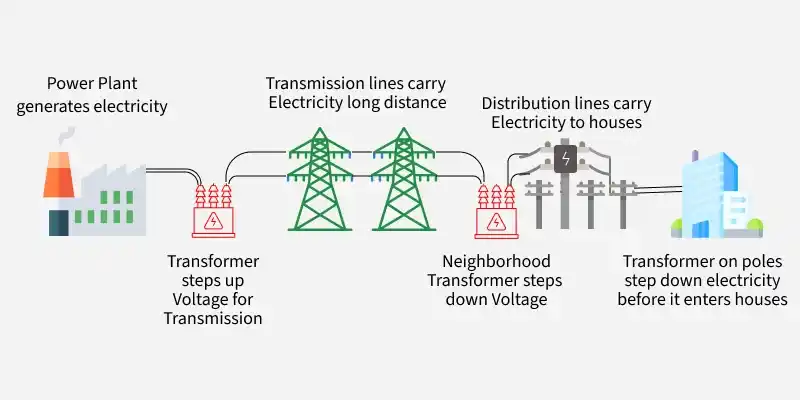
The image shows how the electric power is transmitted.
**Note: One kWh is also called one unit
Examples
- Electrical energy is produced in batteries using chemical energy.
- Electric energy is produced during Lightning and thunderstorms.
- Some animals, like electric eels and others, generate electrical energy in their bodies and use it against predators for defense.
Electrical Energy Into Mechanical Energy
Electrical energy can easily be converted into mechanical energy using Faraday's law of electromagnetism.
An electric motor is the best device that converts electrical energy into mechanical energy.
Electric Power
Power is the rate of doing work. In an electric circuit, it represents the energy converted into heat when current flows through a conductor. This heat produced in electrical appliances due to resistance is called power loss or ohmic loss.
Rewriting the previous equation,
P = ∆W / t
P = I × V
Using ohm's law relation V = IR for substituting the values inside the above equation,
P = I × V
P = I × I × R
P = I2R
It can also be written as,
P = I × V
P = (V/R) × V
P = V2/R
Thus, the power dissipated in a conductor can be written as,
P = V \times I
P = \frac{V^2}{R}
P = \frac {I^2}{R}
where,
- P is the Power
- V is the voltage applied
- R is the resistance of the material
- I is the current supplied
Rating of Electrical Appliances
Every electrical appliance carries a power rating.
For example:
- 100W bulb,
- 1000W heater.
Power rating indicates electrical power consumed at rated voltage.
Meaning of Power Rating
Suppose a bulb is rated:
100W, 220V
This means:
- bulb consumes 100J energy every second,
- when connected across 220V.
Electrical Energy vs Electric Power
| Factors | Electrical Energy | Electric Power |
|---|---|---|
| Definition | The capacity of an electric circuit to do work is called electric energy. | The rate of electric energy per unit of time is called Electric power. |
| Symbol | It is represented by the symbol ‘W’ | It is represented by the symbol ‘P’ |
| Formula | The formula for electric energy is W = Work × Time | The formula for electric power is P = Work/Time |
| Unit | The S.I unit for measuring Electrical Energy is the joule (J) or watt-second (Ws).The commercial unit of Electrical Energy is Kilowatt-hours (kWh). | The S.I unit for measuring Electric Power is Watt (W) or Joule/Sec (J/s) |
| Storage Medium | Electrical energy can easily be stored in various devices. E.g., batteries, cells, capacitors, and others | Power cannot be stored in any device. |
Solved Problems
**Example 1: Find the power dissipated in a conductor with a 10V potential difference and a current of 5A.
**Solution: P = VI
Given,
V = 10
I = 5P = VI
P = (10)(5)
P = 50 W
The power dissipated is 50 W
**Example 2: Determine the power dissipated in a conductor with a 5V potential difference and a current of 2A.
**Solution: P = VI
Given
V = 5
I = 2P = VI
P = (5)(2)
P = 10 W
The power dissipated is 10 W
**Example 3: An electric heater is connected to a battery with a 5V potential difference. The heater has a total resistance of 50 ohms. Find the power dissipated by the electric heater.
**Solution: P = V2/R
Given,
V = 5
R = 50P = (52)/(50)
P = 0.5 W
The power dissipated is 0.5 W
**Example 4: An electric fan is connected to a battery with a potential difference of 20 volts. Assume that the fan has a total resistance of 15 ohms. Find the power dissipated by the electric fan.
**Solution: P = V2/R
Given,
V = 20
R = 15P = V2/R
P = (202)/(15)
P = 400/15
P = 26.67 W
The power dissipated is 26.67 W
**Example 5: An electrical appliance is connected to a battery, due to which a current of 5A flows through it. The appliance has a total resistance of 10 ohms. Find the power dissipated by the appliance.
**Solution: P = I2R
Given:
I = 5
R = 10P = (52)(10)
P = (25)(10)
P = 250 W
The power dissipated is 250 W
**Example 6: An electrical appliance is connected to a battery, due to which a current of 10A flows through it. The appliance has a total resistance of 20 ohms. Find the power dissipated by the appliance.
**Solution: P = I2R
Given,
I = 10
R = 20P = (102)(20)
P = (100)(20)
P = 2000 W
The power dissipated is 2000 W
Unsolved Problems
**Question 1: A resistor of 25 Ω is connected to a 100 V power supply. Find the electrical energy consumed in 10 minutes.
**Question 2: An electric iron draws a current of 3 A when connected to a 220 V supply. Calculate the power consumed and the energy used in 5 minutes.
**Question 3: A device works on a 12 V battery and consumes 1800 J of energy. Find the current drawn if it operates for 5 minutes.
**Question 4: Two resistors of 10 Ω and 20 Ω are connected in series to a 120 V supply. Calculate the total power consumed and energy dissipated in 15 minutes.
**Question 5: An electric heater is connected to a 220 V supply and consumes 2 kWh of energy in 1 hour. Find the resistance of the heater.