Electron Emission (original) (raw)
Last Updated : 27 May, 2026
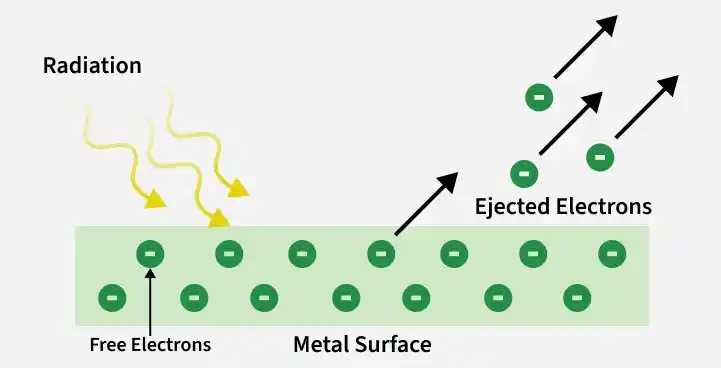
Electron emission is the process by which electrons escape from the surface of a material (generally a metal) when sufficient energy is supplied to overcome the attractive forces binding them. Inside a metal, electrons are free to move but cannot leave the surface because they are held by a potential barrier. To escape, they must gain at least a minimum energy known as the work function.
**Work Function
The work function (ϕ) is defined as the minimum energy required to remove an electron from the surface of a metal to just outside it (with zero kinetic energy).
- It depends on the nature of the material and surface conditions.
- It is usually expressed in electron volts (eV).
If the energy supplied to an electron is greater than the work function, the excess energy appears as kinetic energy of the emitted electron.
Types of Electron Emission
1. Photoelectric Emission
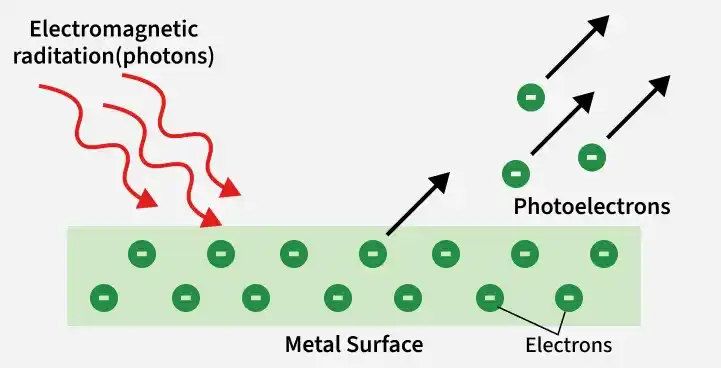
When electromagnetic radiation of sufficiently high frequency falls on a metal surface, electrons are emitted. This phenomenon is called photoelectric emission.
The energy transfer in this process is governed by the relation: h\nu = \phi + K_{\max}
This equation shows that:
- Energy of the incident photon _hν is partly used to overcome the work function _ϕ.
- The remaining energy appears as the maximum kinetic energy __K_max of the emitted electron.
Thus, K_{\max} = h\nu - \phi
Another important form relates kinetic energy to stopping potential: K_{\max} = eV_0
Combining both: \boxed {eV_0 = h\nu - \phi}
This explains experimental observations:
- Increasing frequency increases kinetic energy.
- Increasing intensity increases number of emitted electrons but not their energy.
The minimum frequency required to just eject electrons is called the threshold frequency, given by: \nu_0 = \frac{\phi}{h}
2. Thermionic Emission (Temperature-Based Emission)
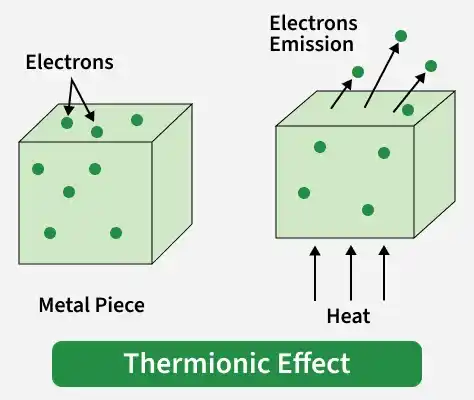
When a metal is heated, electrons gain thermal energy. If this energy exceeds the work function, electrons escape from the surface. This is called thermionic emission.
The current density of emitted electrons is given by Richardson’s equation:
J = A T^2 e^{-\frac{\phi}{kT}}
This equation shows:
- Emission increases with temperature (T2 factor).
- There is an exponential dependence on -__ϕ_ /kT, meaning even small increases in temperature cause large increases in emission.
This is why heated cathodes are used in vacuum tubes.
3. Field Emission (Cold Emission)
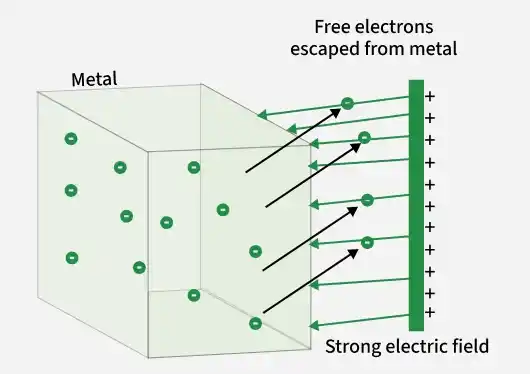
In extremely strong electric fields, electrons can escape from a metal surface even at low temperatures. This occurs due to quantum tunneling, where electrons penetrate the potential barrier without needing full energy equal to the work function.
- No heating required
- Used in electron microscopes and nanotechnology devices
4. Secondary Emission
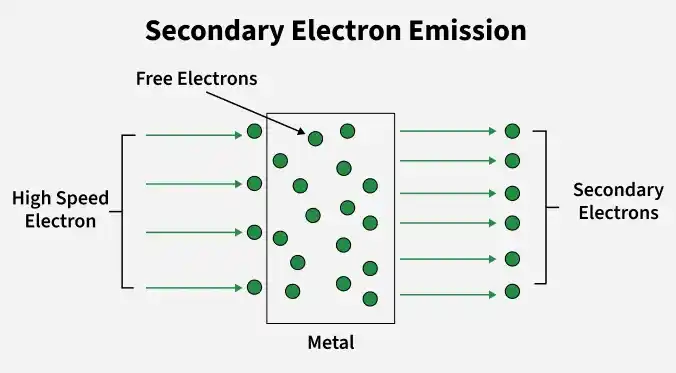
When high-energy particles (like electrons or ions) strike a surface, they can knock out electrons from the material. This is known as secondary emission.
- Used in devices like photomultiplier tubes
- Amplifies electron signals
Energy Distribution and Surface Effects
- Not all emitted electrons have the same energy; they follow a distribution.
- Surface impurities and oxidation can change the work function.
- Polished and clean surfaces emit electrons more easily.
Applications of Electron Emission
- **Cathode Ray Tubes (CRTs): Used in older television sets and computer monitors.
- **Vacuum Diodes: Used in early electronics for rectification and amplification of electrical signals.
- **Magnetrons: Used in microwave ovens to generate microwaves for cooking food.
- **Electron Microscopes: Provide high-resolution imaging capabilities for scientific research and medical diagnostics.
- **Particle Detectors: Utilized in scientific research to detect and analyze subatomic particles in particle physics experiments.
Solved Problems
**Problem 1: Light of frequency 1 x 10¹⁵ Hz falls on a metal with work function 4 x 10-19 J. Find maximum kinetic energy. (h = 6.6 x 10⁻³⁴ Js) ?
**Solution: Kmax = h𝜈 - Φ
= (6.6 \times 10^{-34})(1 \times 10^{15}) - 4 \times 10^{-19}\newline = 6.6 \times 10^{-19} - 4 \times 10^{-19}\newline = 2.6 \times 10^{-19}J
**Problem 2: Find threshold frequency if work function is 3.3 x 10⁻¹⁹ J.
**Solution: \nu_0 = \frac{\phi}{h}\newline = \frac{3.3 \times 10^{-19}}{6.6 \times 10^{-34}}\newline = 5 \times 10^{14} Hz
**Problem 3: Stopping potential is 2V. Find maximum kinetic energy.
**Solution: K_{\max} = eV \newline= (1.6 \times 10^{-19})(2)\newline = 3.2 \times 10^{-19} J
**Problem 4: Ultraviolet light of wavelength (300,nm) falls on a metal with work function (2 \times 10^{-19},J). Find kinetic energy.
**Solution
\nu = \frac{c}{\lambda} = \frac{3 \times 10^8}{300 \times 10^{-9}} \newline \nu = 1 \times 10^{15} Hz\newline \newline K_{\max} = h\nu - \phi\newline = (6.6 \times 10^{-34})(1 \times 10^{15}) - 2 \times 10^{-19}\newline = 6.6 \times 10^{-19} - 2 \times 10^{-19}\newline = 4.6 \times 10^{-19} J
Unsolved Problems
**Problem 1: Light of wavelength 500nm is incident on a metal with work function 2.5 x 10⁻¹⁹ J. Find maximum kinetic energy.
**Problem 2: If stopping potential is 3V , calculate the frequency of incident light. Φ = 2 x 10-19J.
**Problem 3: A metal has threshold frequency 7 x 10¹⁴ Hz. Calculate its work function.
**Problem 4: Explain how current changes with temperature using Richardson’s equation when temperature increases slightly.