First Law of Thermodynamics (original) (raw)
Last Updated : 10 Jun, 2026
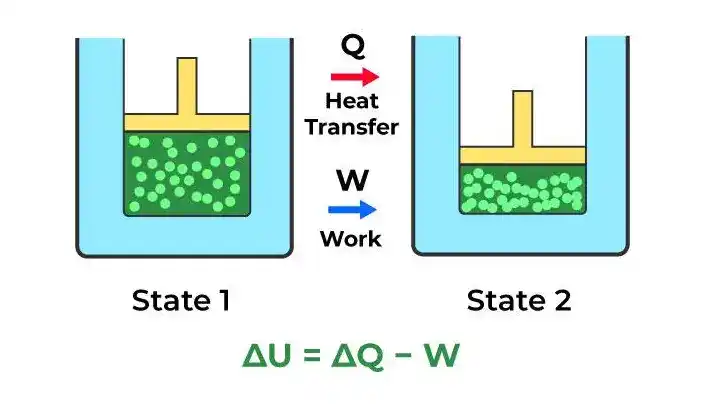
The First Law of Thermodynamics states that energy can neither be created nor destroyed; it can only change from one form to another. In any thermodynamic system, the change in internal energy is equal to the heat supplied to the system minus the work done by the system.
- Based on the Law of Conservation of Energy.
- Energy of an isolated system remains constant.
- Heat and work are two different modes of energy transfer.
- Internal energy depends only on the present state of the system.
- Applies to all thermodynamic processes, like isothermal, adiabatic, isobaric, and isochoric processes.
Formula
According to this law, some heat supplied to the system is used to change the internal energy, while the remaining is used by the system to perform work. The mathematical expression of the first law of thermodynamics is given by:
Q = ΔU + W
Where:
- Q = Heat supplied to the system
- ΔU = Change in internal energy of the system
- W = Work done by the system
Limitations of First Law of Thermodynamics
- The First Law of Thermodynamics does not give any information about the direction of heat flow (i.e., heat flows naturally from hot to cold, but this is not explained by the first law).
- It does not state whether a process is spontaneous or non-spontaneous.
- It does not explain the irreversibility of natural processes. In reality, heat cannot be completely converted into work in a cyclic process.
- It does not set any limit on the efficiency of heat engines.
Perpetual Motion Machine of First Kind (PMM-1)
A Perpetual Motion Machine of the First Kind is a hypothetical device that can produce continuous work without any energy input.
- Such a machine violates the First Law of Thermodynamics (law of conservation of energy).
- It would create energy out of nothing, which is impossible in nature.
- Therefore, PMM-1 cannot exist in reality.
**First Law of Thermodynamics for a Closed System
A closed system is one in which no mass enters or leaves, but energy can be exchanged with the surroundings in the form of heat and work. The First Law of Thermodynamics describes how these energy transfers affect the internal energy of the system. It states that the change in internal energy of a system is equal to the heat supplied to the system minus the work done by the system.
Pressure–Volume (P–V) Work
When a gas expands or compresses against an external pressure, work is done either by the system or on the system. This work is called pressure–volume work (P–V work).
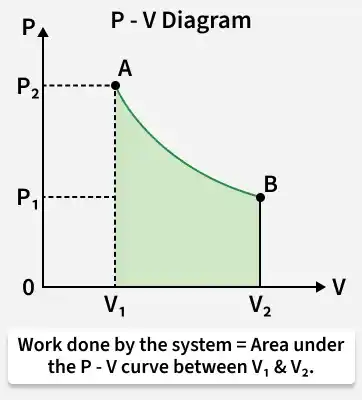
The work done is given by:
W = − P ΔV
Where:
- P = external pressure acting on the system
- ΔV = change in volume of the system
**Sign Convention
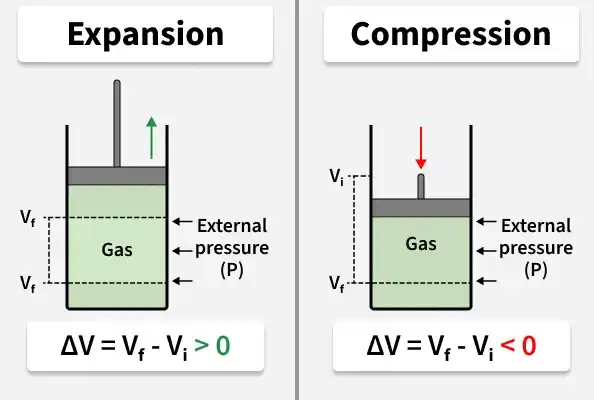
- If ΔV is positive (expansion), work is done by the system.
- If ΔV is negative (compression), work is done on the system
Change in Internal Energy
The change in internal energy of a system is defined as the difference in its total internal energy when the system undergoes a thermodynamic process due to the exchange of heat and work with its surroundings. It represents how much the internal energy of a system increases or decreases as a result of energy transfer across its boundary.
- Heat supplied to the system increases its internal energy, while heat lost decreases it
- Work done by the system decreases its internal energy
- Work done on the system increases its internal energy
- Internal energy is a state function and depends only on the initial and final states of the system
**Energy Conservation
The First Law of Thermodynamics is based on the principle of conservation of energy, which states that energy can neither be created nor destroyed, only transformed from one form to another.
- Energy is exchanged between system and surroundings as heat and work
- The total energy of the universe (system + surroundings) remains constant
Solved Examples
**Example 1: Find out the internal energy of a system that has a constant volume and the heat around the system is increased by 30 J.
**Solution:
Given that,
Heat Transfer, ΔQ = 30 J
For constant volume, ΔV = 0
W = P ΔV = 0
The formula for internal energy is given as:
ΔU = ΔQ - W
⇒ ΔU = 30 J - 0
⇒ ΔU = 30 J
Hence, the change in internal energy of the system is **30 J.
**Example 2: Calculate the change in the internal energy of the system if 2000 J of heat is added to a system and work of 1500 J is done.
**Solution: Given
Heat added to a system, ΔQ = 2000 J
Work done on the system, W = 1500 J
The formula for internal energy is given as:
ΔU = Q + W
⇒ ΔU = 2000 J + 1500 J
⇒ ΔU = 500 J
Hence, the change in internal energy of the system is 3500 J.
**Example 3: A gas in a closed container is heated with 20 J of energy, causing the lid of the container to rise 3 m with 4 N of force. What is the total change in energy of the system?
**Solution: Given
Heat supplied to the container, ΔQ = 20 J
Rise in lid of the container, Δx = 3 m
Force applied on the container, F = 4 N
We are not given a value for work, but we can solve for it using the force and distance. Work is the product of force and displacement.
W = F Δx
⇒ W = 4 N × 3 m
⇒ W = 12 J
The formula for internal energy is given as:
ΔU = ΔQ - W
⇒ ΔU = 20 J - 12 J
⇒ ΔU = 8 J
Hence, the change in internal energy of the system is 8 J.
**Example 4: Determine the change in the internal energy of the system when gas in a cylinder fitted with a frictionless piston expands against a constant external pressure of 1 atm from a volume of 2 liters to a volume of 5 liters. So it absorbs 100 J of thermal energy from its surroundings.
Solution: Given
Q = 100 J
V1 = 2 L
V2 = 5 L
Then, according to the formula:
ΔU = Q - PΔV
⇒ ΔU = Q - P(V2 - V1)
Therefore,
ΔU = Q - P(V2 - V1)
⇒ ΔU = 100 J - 1 (5 - 2) 101.33 J
⇒ ΔU = -203.99 J
Unsolved Problems
**Question 1: A system absorbs 200 J of heat and does 60 J of work. Find the change in internal energy.
**Question 2: A gas expands at a constant pressure of 1 atm from 3 L to 8 L and absorbs 180 J of heat. Find ΔU. (Use 1 L·atm = 101.33 J.)
**Question 3: A gas is compressed from 9 L to 4 L at a constant pressure of 2 atm. During the process, it releases 250 J of heat. Find the change in internal energy.
**Question 4: A system has its internal energy increased by 500 J while it absorbs 700 J of heat. Find the work done by the system.
**Question 5: A gas expands from 6 L to 14 L at constant pressure of 1.5 atm and absorbs 900 J of heat. Find ΔU. (Use 1 L·atm = 101.33 J)