Heisenberg Uncertainty Principle (original) (raw)
Last Updated : 8 May, 2026
The Heisenberg Uncertainty Principle is an important concept in quantum mechanics that explains the limitations in measuring the exact position and motion of tiny particles such as electrons. According to this principle, it is impossible to determine both the exact position and the exact momentum (velocity × mass) of a moving particle at the same time.
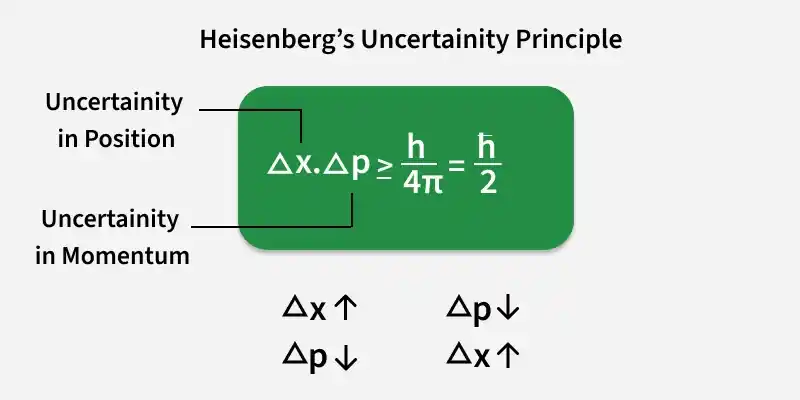
where:
- Δx = particle’s position uncertainty.
- Δp = signify the momentum uncertainty of a particle.
- ℏ = reduced Planck constant given by ℏ = h/2π, which approximately equals 1.054 × 10⁻³⁴ Js.
Reason for the Impossibility of Measuring Position and Momentum Simultaneously
- According to the Heisenberg Uncertainty Principle, it is impossible to determine the exact position and momentum of a very small particle, such as an electron, at the same time.
- This happens because the process of observing the particle itself disturbs its motion.
- If we use light of very short wavelength, we can determine the position of the electron more accurately.
- However, short-wavelength light has high-energy photons, which disturb the electron strongly and make its momentum uncertain.
- On the other hand, if we use light of a longer wavelength, the disturbance is smaller, but the exact position of the electron cannot be determined accurately.
- This limitation can be expressed mathematically by the uncertainty relation:
**Heisenberg Uncertainty Principle Equation
The Heisenberg Uncertainty Principle can be expressed using mathematical equations that show the relationship between the uncertainties in different physical quantities of microscopic particles.
The equations are:
**1. Position and Momentum Uncertainty Equation
This equation states that the uncertainty in position and uncertainty in momentum cannot both be very small at the same time.
\Delta x \, \Delta p \geq \frac{h}{4\pi}
where:
- Δx = uncertainty in position
- Δp = uncertainty in momentum
- ℏ = 1.054 × 10⁻³⁴ Js
**2. Energy–Time Uncertainty Equation
Another form of the uncertainty principle relates energy and time. This equation means that the uncertainty in the energy of a system and the uncertainty in time cannot both be very small simultaneously.
It is given by:
\Delta E \, \Delta t \geq \frac{h}{4\pi}
where:
- ΔE = uncertainty in energy
- Δt = uncertainty in time
**3. Equation in Terms of Velocity
Since momentum is given by:
p = mv
The uncertainty in momentum becomes:
Δp = mΔv
Substituting this in the main equation:
\Delta x .\, m \Delta v \geq \frac{h}{4\pi}
or
\Delta x \, \Delta v \geq \frac{h}{4\pi m}
Heisenberg’s γ-ray Microscope
The Gamma-ray microscope is a thought experiment used to explain the Heisenberg Uncertainty Principle. It was proposed by Werner Heisenberg to show why it is impossible to determine the exact position and momentum of an electron at the same time.
**Basic Idea
To observe a very small particle such as an electron, we must use a microscope. The accuracy with which we can see the particle depends on the wavelength of the light used in the microscope.
- Shorter wavelength → position of electron becomes more accurate, but the photon collision changes its momentum greatly.
- Longer wavelength → momentum disturbance becomes smaller, but the position of the electron becomes uncertain.
Thus, both quantities cannot be measured exactly at the same time. Since electrons are extremely small, ordinary visible light is not sufficient to locate them accurately. Therefore, very short wavelength radiation such as gamma rays is required. This leads to the concept of the gamma-ray microscope.
**Working
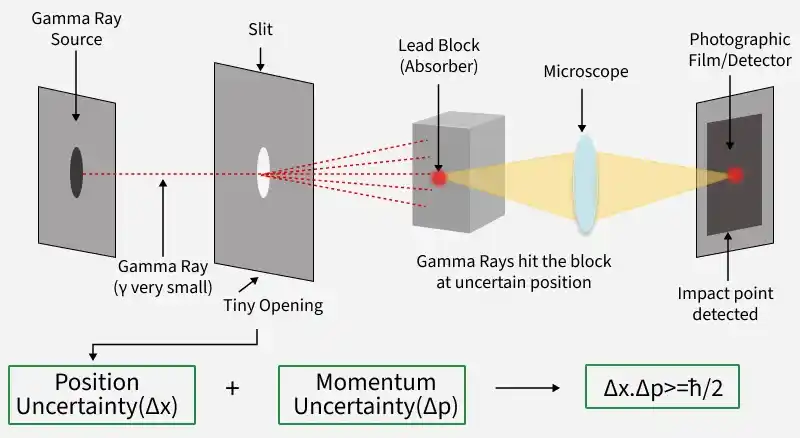
The gamma-ray microscope experiment proposed by Werner Heisenberg explains why the exact position and momentum of an electron cannot be measured at the same time.
The working process can be understood step-by-step from the diagram:
**1. Emission of Gamma Rays
- A radioactive source produces gamma rays (γ-rays).
- These rays have very short wavelengths, which allow scientists to observe extremely small particles such as electrons.
**2. Passing Through Narrow Slits
- The gamma rays pass through very narrow lead slits (S₁ and S₂) or a tiny opening.
- The slits focus the beam of gamma rays.
- This produces a thin and directed beam that can strike the electron accurately.
**3. Interaction with the Electron
- The focused gamma-ray photon hits the electron.
- The photon collides with the electron.
- After the collision, the photons are scattered in different directions.
- The scattered photon enters the microscope lens.
- Because of this scattering, the position of the electron can be detected.
**4. Detection on the Screen
- The scattered photons are collected by the microscope lens and form an image or bright spot on the detector screen or photographic film.
- The position of the spot on the screen tells the location of the electron.
- Sometimes two possible scattered paths appear, producing two spots on the screen.
**5. Disturbance of Electron Momentum
Gamma-ray photons have very high energy and momentum. When the photon strikes the electron:
- It transfers momentum to the electron.
- The velocity and direction of the electron change.
- Therefore, the momentum of the electron becomes uncertain.
**6. Uncertainty
- If we use short-wavelength gamma rays, we get a more accurate position of the electron, but the collision causes large uncertainty in momentum.
- If we use longer wavelength radiation, the disturbance decreases, but the position becomes uncertain.
Applications of Heisenberg Uncertainty Principle
The Heisenberg Uncertainty Principle is used in several fields of physics, technology, and even philosophy nowadays. Here are some notable applications:
- **Quantum Mechanics: The Uncertainty Principle is a fundamental principle of quantum mechanics. It provides an idea for describing the probabilistic nature of quantum systems and the limitations of classical physics in predicting the behavior of particles.
- **Atomic and Molecular Physics: In atomic and molecular physics, the Uncertainty Principle is used to understand the behavior of electrons within atoms and molecules. It provides details on electron orbitals, energy levels, and chemical bonding, which helps to explain the stability and structure of atoms and molecules.
- **Electron Microscopy: In electron microscopy, the Uncertainty Principle sets limits on the spatial resolution of images obtained using electron beams. It helps to determine the minimum size of features that can be resolved in a sample.
- **Particle Physics: In particle physics, the Uncertainty Principle influences the study of subatomic particles and their interactions. It provides details about phenomena such as particle decay, scattering processes, and the uncertainty in the measurement of particle properties.
Solved Examples
**Example 1: A particle's position is known with an uncertainty of Δx=10⁻¹⁰ meters. Calculate the minimum uncertainty in its momentum according to the Heisenberg Uncertainty Principle.
**Solution:
According to the Heisenberg Uncertainty Principle:
Given:
Δx = 10-10 meters
Using the uncertainty principle equation.
Δp ≥ ℏ/2Δx
Δp ≥ (1.05×10⁻³⁴m2kg/s) / (2×10⁻¹⁰m)
Δp ≥ (1.05×10⁻³⁴m) / (2×10⁻¹⁰) kg m/s
Δp ≥ 5.25×10⁻²⁵ kg m/s
So, the minimum uncertainty in momentum is Δp ≥ 5.25×10⁻²⁵ kg m/s.
**Example 2: The position of an electron is known to an accuracy of 10⁻¹⁰ m. What is the minimum uncertainty in its velocity?.(Given h = 6.63×10⁻³⁴ JS and me = 9.1×10⁻³¹ kg)
**Solution:
We know Heisenberg's Uncertainty Principle
Δx⋅Δp ≥ h/2
Where:
- Δx = Uncertainty in position
- Δp = Uncertainty in momentum
- h = Reduced Planck constant
Given Δx=10-10 m, h=6.63×10⁻³⁴, and find Δp=?.
Δx Δp ≥ h/4π
Δp ≥ 6.63×10⁻³⁴/4π×10-10 kg m/s
Δp≥5.28 x 10⁻²⁵kg m/s
This is the minimum uncertainty in momentum. Now, using the relation p=mv, we can find the minimum uncertainty in velocity. Since
9.1×10⁻³¹ kg for an electron.
Δv = 5.28×10⁻²⁵ / 9.1×10⁻³¹
Δv ≈5.8×10⁵ m/s
So, the minimum uncertainty in the velocity of the electron is 5.8×10⁵ m/s.