Hooke's Law (original) (raw)
Last Updated : 3 Jun, 2026
Hooke’s Law states that when an external force is applied to an elastic body, the body undergoes deformation. Within the elastic limit, the deformation produced in the body is directly proportional to the applied force. If the applied force is removed, the body regains its original shape and size.
Hooke's Law Equation
According to Hooke's Law, in an elastic body, extension and tension are proportional to each other.
Hooke's law experiment is a good way to understand the behavior of materials when the degree of deformation is very small. This law is frequently demonstrated using a coil spring with weights suspended from it. The change in the length of the spring is proportional to the force of gravity F on the suspended weight.
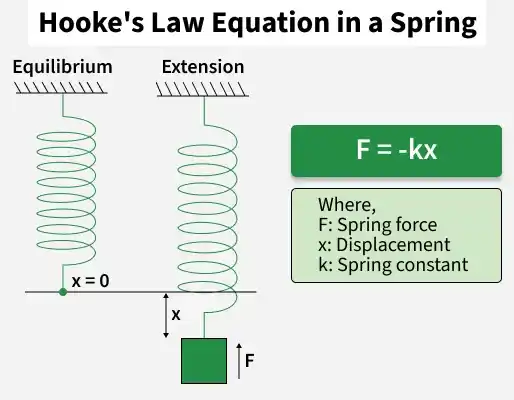
Hooke’s Law Equation is given as,
F = -kx
where:
- F = Restoring force applied by the spring
- k = Spring constant or force constant
- x = Displacement or extension produced in the spring
Hooke’s Law of Elasticity
Hooke’s Law of Elasticity explains the relationship between stress and strain in an elastic material. According to this law, within the elastic limit, stress is directly proportional to strain.
Stress ∝ Strain or Stress = E × Strain (E is the modulus of elasticity)
The law is valid only within the elastic limit of the material. Beyond this limit, permanent deformation occurs.
For a homogeneous rod:
k \propto Ak \propto \frac{1}{l}
where:
- A = Area of cross-section
- l = Length of the rod
- k = Stiffness of the rod
Types of Spring
Springs come in various shapes and sizes, each designed to serve specific purposes in mechanical systems. The three primary types of springs—linear springs, non-linear springs, and torsion springs—differ in how they respond to forces and their underlying mechanical properties. Let's explore these springs in detail:
1. Linear Springs
Linear springs are the most common type of spring, and they obey **Hooke’s Law over a wide range of forces. The force required to extend or compress a linear spring is directly proportional to the displacement from its equilibrium position.
The relationship for linear springs is expressed by Hooke's Law:
F = -kx
Where:
- F is the force applied,
- k is the spring constant,
- x is the displacement (stretch or compression).
2. Non-linear Springs
Non-linear springs do not obey Hooke's Law, meaning that the force-displacement relationship is not linear. The force required to stretch or compress a non-linear spring does not increase at a constant rate as the displacement increases.
3. Torsion Springs
Torsion springs are a type of spring that works by twisting rather than compressing or elongating. These springs store mechanical energy in the form of angular displacement. The force required to twist the spring is proportional to the angular displacement, similar to how linear springs behave with displacement in the linear direction.
τ = −kt θ
Where,
- τ is the torque,
- kt is the torsion spring constant (the stiffness of the torsion spring),
- θ is the angular displacement.
Hooke’s Law Experiment
Hooke’s Law can be demonstrated using a spring and different loads. When no force is applied, the spring remains at its natural length, but as weights are added, the spring stretches. According to Hooke’s Law, the extension or compression produced in the spring is directly proportional to the applied force, provided the elastic limit of the spring is not exceeded.
F ∝ x or F = kx
- F = Applied force
- x = Extension or compression produced
- k = Spring constant
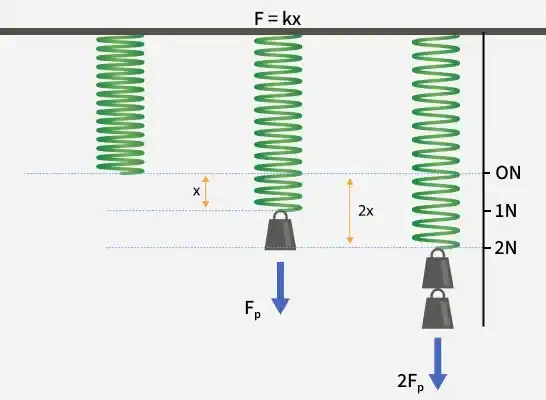
In the experiment, when a force of 1N is applied, the spring stretches by x units, and when the force is increased to 2N, the extension becomes 2x. This shows that the extension produced in a spring is directly proportional to the applied force within the elastic limit, thereby verifying Hooke’s Law.
Hooke’s Law Graph
The figure shows the stress-strain curve for low-carbon steel. Initially, the graph is a straight line from the origin, indicating that stress is directly proportional to strain and the material obeys Hooke’s Law. After a certain limit, the material loses its elastic behavior and starts showing plastic deformation.
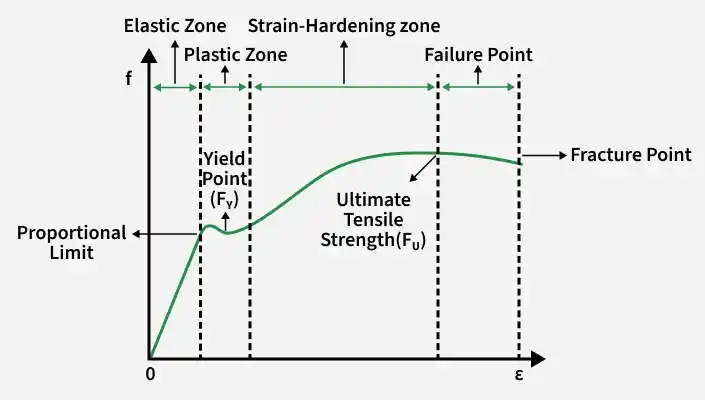
- **Elastic Region: In this region, the material obeys Hooke’s Law and regains its original shape after the removal of force.
- **Yield Point: This is the point beyond which the material starts losing its elasticity and permanent deformation begins.
- **Plastic Region: In this region, the material undergoes permanent deformation and does not return to its original shape.
- **Fracture Point: This is the final point where the material breaks due to excessive stress
Hooke’s Law Applications
- Retractable pens use springs based on Hooke’s Law to control the movement of the refill.
- Toy guns use springs that work on Hooke’s Law to produce recoil motion after firing.
- Spring balance works on Hooke’s Law to measure weight using extension of spring.
- Vehicle suspension systems use springs to absorb shocks and vibrations.
- Mechanical clocks use springs based on Hooke’s Law to maintain regular motion.
Limitations of Hooke's Law
- The law only holds true within the material’s elastic limit, beyond which permanent deformation occurs.
- The temperature changes can affect the spring constant and the material's elasticity.
- The law applies to elastic materials, but not to plastic or brittle materials.
**Read More, Relation between Stress and Strain