How to Calculate Moment Of Inertia? (original) (raw)
Last Updated : 23 Jul, 2025
The Moment of Inertia, referred to as the angular mass or rotational inertia, with respect to the rotation axis is a quantity that determines the amount of torque necessary to achieve a desired angular acceleration or a characteristic of a body that prevents angular acceleration. The moment of inertia is calculated as the sum of each particle's mass times the square of its distance from the rotational axis.
Table of Content
- Moment of Inertia
- How to Calculate Moment Of Inertia?
- Formulas For Calculating Moment Of Inertia
- Solved Examples of Moment of Inertia
Moment of Inertia
The term "Moment of Inertia" refers to the quantity that describes how a body resists angular acceleration and is calculated as the product of the mass of each particle times the square of the particle's distance from the rotational axis. Or, to put it another way, you could say that it's a quantity that determines how much torque is required for a certain angular acceleration in a rotating axis. Inertia moment is often referred to as **rotational inertia or angular mass. kg m 2 is the unit of moment of inertia in the SI system.
Moment of Inertia of a System of n Particles
The moment of inertia is the following for a system of point particles rotating around a fixed axis:
**I = ∑m i r i 2
where,
ri is the distance between the axis and the ith particle,
mi is the mass of ith particle.
How to Calculate Moment Of Inertia?
Several ways are used to calculate the moment of inertia of any rotating object.
- For [uniform objects](https://Uniform Motion - Definition, Graph, Formula - GeeksforGeeks), the moment of inertia is calculated by taking the product of its mass with the square of its distance from the axis of rotation (r2).
- For non-uniform objects, we calculate the moment of inertia by taking the sum of the product of individual point masses at each different radius for this the formula used is
**I = ∑m i r i 2
Formulas For Calculating Moment Of Inertia
Expressions for the moment of inertia for some symmetric objects along with their axis of rotation are discussed below in this table.
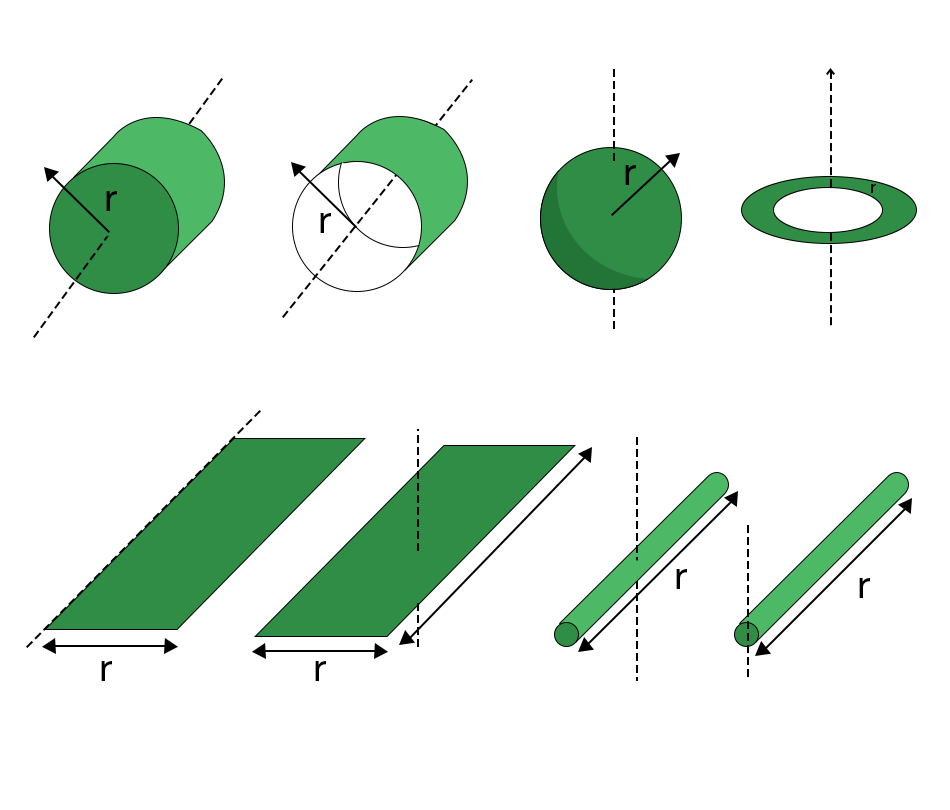
| Object | Axis | Expression of the Moment of Inertia |
|---|---|---|
| Hollow Cylinder Thin-walled | Central | I = Mr2 |
| Thin Ring | Diameter | I = 1/2 Mr2 |
| Annular Ring or Hollow Cylinder | Central | I = 1/2 M(r22 + r12) |
| Solid Cylinder | Central | I = 1/2 Mr2 |
| Uniform Disc | Diameter | I = 1/4 Mr2 |
| Hollow Sphere | Central | I = 2/3 Mr2 |
| Solid Sphere | Central | I = 2/5 Mr2 |
| Uniform Symmetric Spherical Shell | Central | I = \frac{2}{5}M\frac{(r_2^5-r_1^5)}{(r_2^3-r_1^3)} |
| Uniform Plate or Rectangular Parallelepiped | Central | I = 1/12 M(a2 + b2) |
| Thin rod | Central | I = 1/12 Mr2 |
| Thin rod | At the End of Rod | I = 1/3 Mr2 |
**Related Resources:
Solved Examples of Moment of Inertia
**Example 1: Determine the solid sphere's moment of inertia at a mass of 22 kg and a radius of 5 m.
**Answer:
Given:
M = 22 kg, R = 5 mWe have for solid sphere, MOI (I) = 2/5 MR2
I = 2/5 × 22 × 25
**I = 220 kg m 2
**Example 2: Calculate the mass of the uniform disc when its moment of inertia is 110 kg m 2 **and its radius is 10 m.
**Answer:
Given:
I = 110 kg m2, R = 10 mWe have for uniform disc (I) = 1/4 MR2
M = 4I / R2
M = 4 × 110 / 102
M = 440 / 100
**M = 4.4 kg
**Example 3: If a uniform plate has a mass of 23 kg, a length of 10 m, and a breadth of 7 m, determine its moment of inertia.
**Answer:
Given: M = 23 kg, L = 10 m, b = 7 m
We have for uniform plate MOI I=\frac{1}{12}M(L^2+b^2)
I=\frac{1}{12}×23×(10^2+7^2)
I=\frac{1}{12}×23×(100+49)
I=\frac{1}{12}×23×(149)
**I = 285 kg m 2
**Example 4: When the uniform hollow right circular cone has a moment of inertia of 98 kg m 2 **and a mass of 20 kg, determine the radius of the cone.
**Answer:
Given:
I = 98 kg m2, M = 20 kgWe have for right circular cone, MOI (I) = 1/2 MR2
R2 = 2I / M
R2 = 2 × 98 / 20
R2 = 9.8
R = √9.8
**R = 3.13 m
**Example 5: If the mass is 10 kg and the radius is 7 m, determine the hollow cylinder's moment of inertia.
**Answer:
Given:
M = 10 kg, R = 7 mWe have for hollow cylinder, MOI (I) = MR2
I = 10 × 49
**I = 490 kg m 2
**Example 6: When r 1 is 10 m, r 2 is 20 m, and the mass of the annular ring is 14 kg, calculate the moment of inertia of the ring.
**Answer:
Given: r1 = 10 m, r2 = 20 m, M = 14 kg
We have for Annular ring (I) = 1/2 M(r22 + r12)
I = 1/2 × 14 × (400 + 100)
I = 7000 / 2
**I = 3500 kg m 2
Conclusion of Moment of Inertia
Moment of Inertia is pivotal in rotational mechanics, defining an object's resistance to rotation. Its application spans engineering, physics, and various fields, guiding the design and optimization of rotating systems like gears and flywheels. Understanding moment of inertia facilitates the enhancement of system performance and reliability, driving innovation across diverse applications.