Human Ear (original) (raw)
Last Updated : 27 May, 2026
The ear is a sensory organ that enables us to hear sounds from our surroundings.
- Its main functions are hearing and maintaining body balance.
- The ear converts sound waves into electrical impulses, which are carried to the brain through the auditory nerve for interpretation.
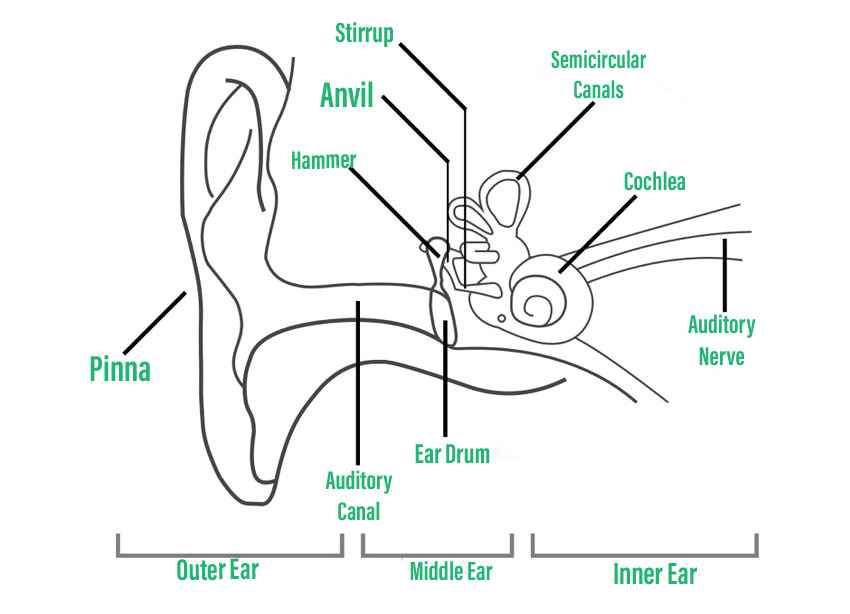
The human ear is mainly divided into three parts:
1. Outer Ear
When sound waves enter the ear, they first pass through the outer ear. The outer ear collects sound waves and directs them into the ear canal. The pinna and earlobe are the visible parts of the outer ear and have a shell-like structure. The sound waves travel through the auditory canal and strike the eardrum, a thin flexible membrane that separates the outer ear from the middle ear. The vibrations produced in the eardrum are then amplified several times by the three tiny bones present in the middle ear before being transmitted to the inner ear.
2. Middle Ear
The middle ear contains three tiny interconnected bones called the hammer (malleus), anvil (incus), and stirrup (stapes). These bones help in transmitting sound vibrations from the eardrum to the inner ear. The hammer is attached to the eardrum and vibrates when sound waves strike it. These vibrations are then passed to the anvil and finally to the stirrup. The bones of the middle ear amplify the sound vibrations before sending them to the inner ear for further processing.
3. Inner Ear
The Cochlea, or inner ear, is a snail-like structure. Because there is some fluid inside the cochlea, when the number of variations is conveyed in the middle ear, the cochlea sends the sound to the brain. The auditory nerve receives these electrical impulses.
**Functions
The human ear's various structures aid in various purposes.
- The eardrum is protected by the pinna of the outer ear, which transports sound to the eardrum through the auditory canal.
- When the eardrum vibrates, sound is transmitted to the inner ear.
- The middle ear's ossicles enhance sound and transmit vibrations to the oval window. The membrane that separates the inner and middle ear is known as the oval window.
- The Eustachian tube is a thin tube that links our nose to our ear. This tube aids in the passage of air into the lungs and discharges mucus to the nasopharynx.
- The cochlea is a structure found in the inner ear. It is filled with fluid and houses the Corti organ. The Corti's organ has cilia, which are hair-like sensory cells. Waves from the middle of the year generate vibrations in the inner ear fluid, which causes the cilia to vibrate. The cilia vibrate, sending nerve signals to the brain.
- The semicircular canals in the inner ear are vertically aligned with one another. It also has fluid in it, which aids in mobility.
Range of Hearing of Human
- The audible range of sound is defined as the range of frequencies that humans can hear between 20 Hz and 20000 Hz.
- Infrasonic sound is defined as sound with a frequency less than 20 Hz.
- Ultrasonic sound is defined as sound with a frequency greater than 2000 Hz.
Humans cannot hear both infrasonic sound and ultrasonic sound