Kepler's Laws of Planetary Motion (original) (raw)
Last Updated : 10 Apr, 2026
The motion of planets around the Sun has been a subject of curiosity for centuries. Earlier scientists believed planets moved in circular paths, but careful observations led to a more accurate understanding.
The German astronomer Johannes Kepler formulated three fundamental laws that describe planetary motion. i.e.,
- Kepler's First Law (Law of Orbits)
- Kepler’s Second Law (Law of Areas)
- Kepler’s Third Law (Law of Periods)
These laws are known as Kepler’s Laws of Planetary Motion and form the basis of modern astronomy.
**Kepler’s First Law (Law of Orbits)
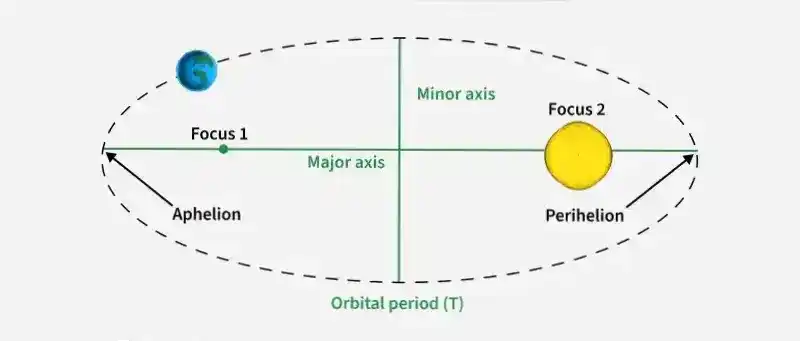
All planets move around the Sun in an elliptical orbit, with the Sun at one of the two foci.
**Explanation
- Planetary orbits are elliptical (oval-shaped)
- The Sun is located at one focus, not at the center
- The distance between the planet and the Sun keeps changing
**Important Terms:
- Perihelion: Closest point to the Sun
- Aphelion: Farthest point from the Sun
- Semi-major axis (a): Half of the longest diameter
- Semi-minor axis (b): Half of the shortest diameter
**Equation of Elliptical Orbit:
r = \frac{p}{1 + e\cos\theta}
where:
- r = distance from Sun
- p = semi-latus rectum
- e = eccentricity
**Eccentricity (e):
- Measures how much the orbit deviates from a circle
- (e = 0) → perfect circle
- (0 < e < 1) → ellipse
e = \frac{r_{max} - r_{min}}{r_{max} + r_{min}}
**At Special Points:
- At perihelion (θ = 0): r_{min} = \frac{p}{1 + e}
- At aphelion (θ = 180°): r_{max} = \frac{p}{1 - e}
**Relation Between Axes:
\boxed {b = a\sqrt{1 - e^2}}
**Kepler’s Second Law (Law of Areas)
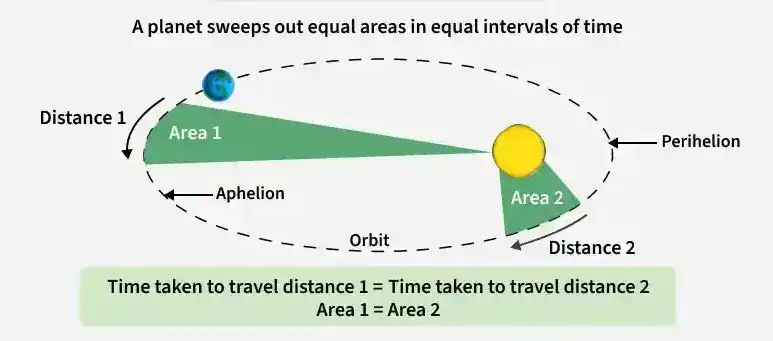
A line joining a planet and the Sun sweeps out equal areas in equal intervals of time.
**Explanation
- When the planet is closer to the Sun, it moves faster
- When it is farther, it moves slower
This means planetary speed is not constant
**Mathematical Form (Areal Velocity):
\frac{dA}{dt} = \text{constant}
**Derivation Insight:
\frac{dA}{dt} = \frac{1}{2} r^2 \frac{d\theta}{dt}
From angular momentum: L = m r^2 \frac{d\theta}{dt}
\Rightarrow \frac{dA}{dt} = \frac{L}{2m}
Since angular momentum is conserved, area rate is constant. Kepler’s Second Law is a result of conservation of angular momentum
**Kepler’s Third Law (Law of Periods)
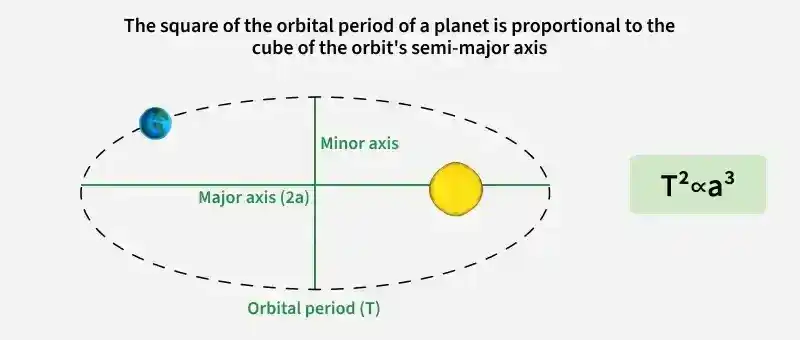
The square of the orbital period is proportional to the cube of the semi-major axis.
\boxed {T^2 = k a^3}
**Explanation
- Planets farther from the Sun take more time to complete one revolution
- There exists a fixed relationship between distance and time period
**Derivation Using Newton’s Law:
Using Isaac Newton’s law of gravitation:
F = \frac{GM_s M_p}{R^2}
Centripetal force:
F = \frac{M_p v^2}{R}
Equating:
\frac{GM_s}{R} = v^2
Using:
v = \frac{2\pi R}{T}
We get:
T^2 = \frac{4\pi^2}{GM_s} R^3
Replacing (R) with (a):
\boxed{T^2 \propto a^3}
**Constant of Proportionality: k = \frac{4\pi^2}{GM_s}
**Significance of Kepler’s Laws
- Explained planetary motion accurately
- Helped develop Newton’s law of gravitation
- Used in space missions and satellite design
- Basis of modern astronomy
**Applications of Kepler’s Laws
- Satellite orbit design
- Space exploration
- Predicting planetary positions
- Studying celestial bodies
Solved Examples
**Example 1: The radius of a planet is 3 times the radius of the Earth. Calculate the time period of the revolution of the planet.
**Solution: According to Kepler's third law:
T2 ∝ R3
Consider the radius of the Earth be Re, radius of the planet be Rp, time period of the Earth be Te and time period of the planet be Tp.
Given:
Rp = 3 Re
Time period of the Earth, Te = 1 yr
The relation between the planets is given as:
Tp2 ⁄ Te2 = Rp3 ⁄ Re3
Tp2 ⁄ (1 yr)2 = (3 Re)3 ⁄ Re3
Tp2 = 27 yr
Tp = 5.2 yr
Hence, the time period of the planet is 5.2 years.
**Example 2: The radius of a planet is 8 times the radius of the Earth. Calculate the time period of the revolution of the planet.
**Solution: According to Kepler's third law:
T2 ∝ R3
Consider the radius of the Earth be Re, radius of the planet be Rp, time period of the Earth be Te and time period of the planet be Tp.
Given:
Rp = 8 Re
Time period of the Earth, Te = 1 yr
The relation between the planets is given as:
Tp2 ⁄ Te2 = Rp3 ⁄ Re3
Tp2 ⁄ (1 yr)2 = (8 Re)3 ⁄ Re3
Tp2 = 512 yr
Tp = 22.62 yr
Hence, the time period of the planet is 22.62 years.
**Example 3: The ratio of orbital angular momentum (about the sun) to the mass of the Earth is 4.4 × 10 15 m 2 /s. Find the area enclosed by the Earth.
**Solution: Given:
L ⁄ m = 4.4 × 10¹⁵ m2 ⁄ s
Time taken to cover the complete orbit is equal to the time period of the Earth,i.e.,
dt = 365 days
= 365 × 86400 s
= 31536000 s
Area enclosed by a planet in an orbit is given by:
dA ⁄ dt = L ⁄ 2 m
dA = (L ⁄ m) × (dt ⁄ 2)
= (4.4 × 1015 × 31536000) m2
= 6.938 × 10²² m2
Hence, the area enclosed by the Earth is equal to 6.938 × 10²² m2.