Laws of Conservation of Momentum (original) (raw)
Last Updated : 27 May, 2026
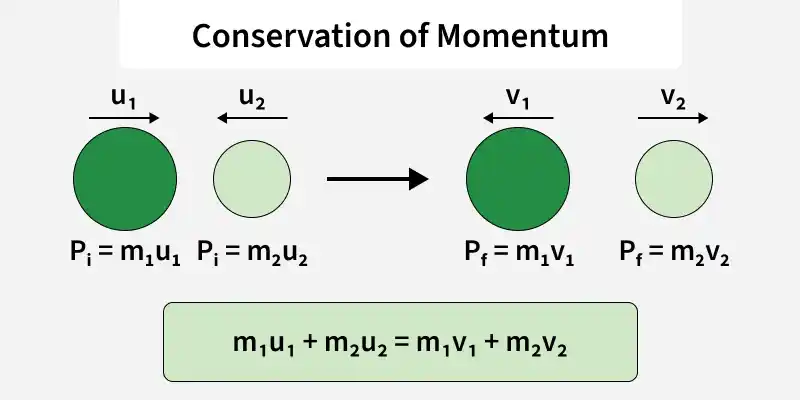
The Law of Conservation of Momentum states that when no external force acts on a system, the total momentum of the system remains constant. In other words, the total momentum before a collision or interaction is always equal to the total momentum after the collision or interaction. This law is valid only for an isolated system where external forces are absent.
Mathematically, it is expressed as:
m1u1 + m2u2 = m1v1 + m2v2
where:
- m1,m2 = masses of the objects
- u1, u2 = initial velocities
- v1, v2 = final velocities
Derivation of Conservation of Momentum
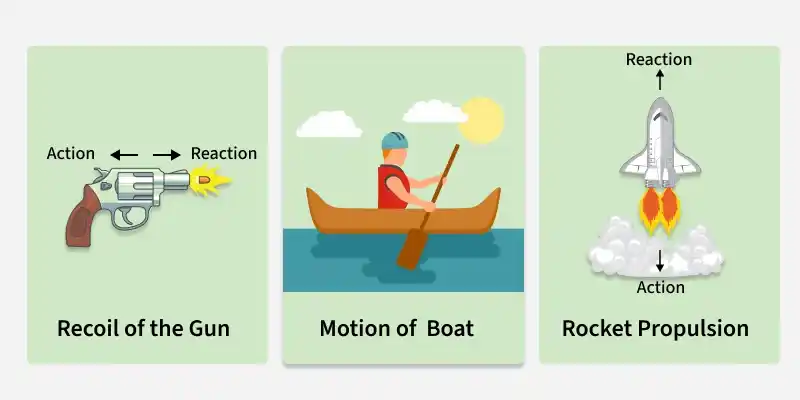
The law of Conservation of Momentum is derived with the help of Newton’s third law of motion which states that for every action there is an equal and opposite reaction.
Method-1
Consider two point masses **m 1and **m 2. Initially, these bodies were moving with the velocities **u 1 and **u 2. Now they collide with each other and their final velocities become **v 1 and **v 2 . Their time of collision is **t.
Change in momentum of the mass A:- **△P A = m 1 (v 1 - u 1 )
Change in momentum of the mass B****:- △P** B = m 1 (v 2 - u 2 )
From Newton's law of motion,:- FAB = -FBA....(1)
We also know :- **F = △P/t
△PA / t = -△PB / t
m1(v1 - u1)/t = - m1(v2 - u2)/t
m1(v1 - u1) = - m1(v2 - u2)
\boxed{m_1u_1 + m_2u_2 = m_1v_1 + m_2v_2}
Method-2
If net external force on the system is zero then linear momentum of the system remains constant.
According to Newtons 2nd Law :- Fext = dp/dt
If Fext = 0 then dp/dt = 0
Therefore p = constant
\boxed{P_{initial} = P_{final}}
Reason for Conservation of Momentum
Momentum is conserved due to Newton’s Third Law of Motion. During a collision, interacting bodies exert equal and opposite forces on each other for the same time interval. Since impulse equals change in momentum
F\Delta t = \Delta p
the momentum gained by one object is equal and opposite to the momentum lost by the other, keeping total momentum constant.
Key Features
- Momentum is a vector, so direction matters.
- It is especially useful in collisions, where interaction time is very short.
- Momentum remains conserved even when **kinetic energy is not (e.g., breaking objects).
- Apparent violations (like a ball bouncing off a wall) still obey the law when the **entire system (ball + Earth) is considered.
Example of Conservation of Momentum
Solved Examples
**Example 1. Calculate the momentum of a ball thrown at a speed of 100 m/s and weighing 500g.
**Solution: Given
M = 500g and V = 100 m/s
Momentum is given by, p = MV
p = MV
p = (500)(100)
p = 50000 gm/s
p = 5 × 10⁴ gm/s = 50 kgm/s
**Example 2. Suppose two balls with a mass of 5 Kg and 2 Kg are moving in the same direction at 6 m/s and 2 m/s respectively collide, and after the collision, the 5 kg ball is moving at a speed of 5 m/s. What is the speed of the 2 kg ball?
**Solution: Given
m1 = 5 kg and m2 = 2 kg
Initial Velocities: u1 = 6 m/s and u2 = 2 m/s
Final Velocities: v1 = 5 m/s and v2 = ?
According to the law of conservation of momentum
m1u1 + m2u2 = m1v1 + m2v2
(5)(6) + (2)(2) = (5)(5) + 2(v2)
30 + 4 = 25+ 2(v2)
2v2 = 34 - 25 = 9
v2 = 4.5 m/s
**Example 3 .Consider a cannon that weighs 500 kg. It fires a cannonball at the speed of 200 m/s. The weight of the cannonball is 2 kg. Find the speed of the recoil for the cannon.
**Solution: Given
m1 = 500 Kg and m2 = 2 Kg
Initial Velocities,
Velocity of cannon (u1) = 0 m/s
Velocity of cannon ball (u2) = 0 m/s
Final Velocities,
Velocity of cannon (v1) = 0 m/s
Velocity of cannon ball (v2) = 200 m/s
Using the law of conservation of momentum
m1u1 + m2u2 = m1v1 + m2v2
(500)(0) + (2)(0) = (500)(v1) + 2(200)
- 400 = 500(v1)
v1 = -400/500
v1 = -0.8 m/s (here, - sign indicates that the recoil motion of the cannon is opposite to the motion of the cannon ball) Thus, the cannon gun will recoil at a speed of 0.8m/s after firing the cannon.
**Example 4. Find the velocity of a bullet of mass 8 grams when fired from a pistol of mass 2.4 kg. (Recoil velocity of the pistol is 1 m/s)
**Solution: Mass of Bullet, m1 = 8 gram = 0.008 kg
Mass of Pistol, m2 = 2.4 kg
Initial velocity of the bullet, u1 = 0
Initial Recoil velocity of a pistol, u2 = 0
Velocity of a bullet, v1 =?
Recoil Velocity of pistol, v2 = 1 m/s
Using the law of conservation of momentum,
m1u1 + m2u2 = m1v1 + m2v2
(0.008)(0) + (2.4)(0) = (0.008)(v1) + (2.4)(1.5)
0 = (0.008)(v1) + 3.6
v1 = 3.6/(0.0008) = 450 m/s
Hence, the recoil velocity of the pistol is 450 m/s
**Unsolved Questions
**Question 1:- Two particles of masses m and 2m move towards each other with velocities 3u and u respectively. After collision, they stick together. Find the velocity of the combined system after collision and comment on the nature of the collision.
**Question 2:- A man of mass 60 kg jumps from a stationary boat of mass 120 kg with a speed of 3 m/s relative to the boat. Calculate the recoil speed of the boat. Explain why momentum is conserved in this situation.
**Question 3:-A shell of mass 3 kg, initially at rest, explodes into two fragments of masses 1 kg and 2 kg. The 1 kg fragment moves with a velocity of 6 m/s along the positive x-axis. Find the velocity of the other fragment.
**Question 4:- A bullet of mass 0.02 kg moving with a velocity of 200 m/s strikes a wooden block of mass 2 kg kept on a smooth horizontal surface. The bullet gets embedded in the block. Find the velocity of the block after collision and identify the type of collision.
**Question 5:- A boy of mass 40 kg is standing on a skateboard of mass 10 kg at rest. He jumps forward with a velocity of 5 m/s relative to the ground. Calculate the recoil velocity of the skateboard. State the principle used in solving the problem.