Lens Formula and Magnification (original) (raw)
Last Updated : 2 May, 2026
A lens is a transparent optical device made of glass or other refracting material that has either two curved surfaces or one curved and one plane surface. It works on the principle of refraction of light, i.e., the bending of light rays when they pass from one medium to another. A lens is used to converge or diverge light rays in order to form images and is widely used in optical instruments such as microscopes, telescopes, cameras, and spectacles.
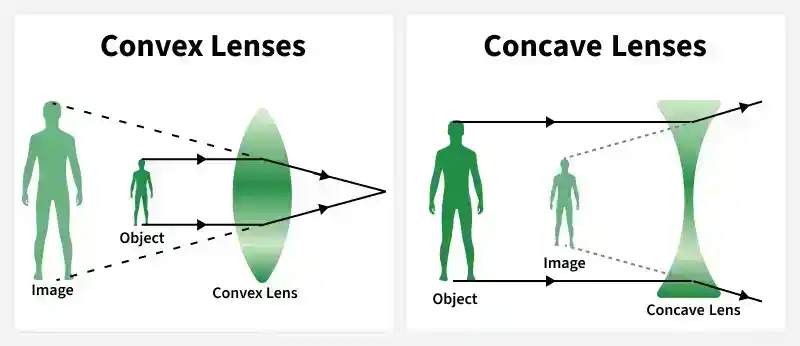
Types of Lenses
Lenses are classified based on their shape and the way they refract light. The two main types of lenses are convex and concave.
1. Convex Lens
A convex lens is thicker at the centre and thinner at the edges. It converges (brings together) parallel rays of light to a single point called the focus. Because of this property, it is also known as a converging lens. Convex lenses are used in magnifying glasses, microscopes, telescopes, and cameras. They can form both real and virtual images depending on the object's position.
2. Concave Lens
A concave lens is thinner at the centre and thicker at the edges. It diverges (spreads out) parallel rays of light as if they are coming from a single point called the focus. Therefore, it is also known as a diverging lens. Concave lenses are commonly used in spectacles to correct myopia (short-sightedness). They always form virtual, erect, and diminished images.
Thus, convex and concave lenses play important roles in optical systems based on their ability to converge or diverge light rays.
Lens Formula
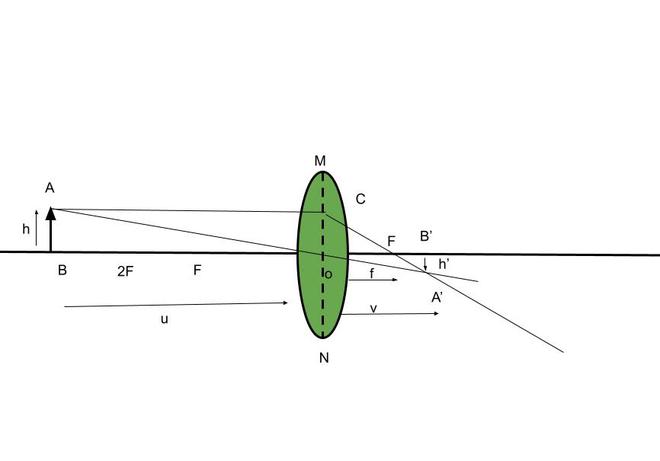
Consider a thin lens forming an image A′B′ of an object AB. Using similar triangles:
\frac{A'B'}{AB} = \frac{OB'}{OB}
Also, from another pair of similar triangles:
\frac{A'B'}{AB} = \frac{OB' - OF}{OF}
Equating both:
\frac{OB'}{OB} = \frac{OB' - OF}{OF}
Using sign convention:
OB = −u, OB′ = v, OF = f
\frac{v}{-u} = \frac{v - f}{f}
On simplifying:
\frac{1}{f} = \frac{1}{v} - \frac{1}{u}
Final formula:
\frac{1}{v} - \frac{1}{u} = \frac{1}{f}
Magnification of Lens
Magnification of a lens describes how much the size of an image is increased or decreased compared to the size of the object. It indicates the ratio of the height of the image formed to the height of the object.
m = \frac{h'}{h} = \frac{v}{u}
Where:
- m = magnification of the lens
- h′ = height of the image
- h = height of the object
- v = image distance from the lens
- u = object distance from the lens
Power of a Lens
The power of a lens is a measure of its ability to converge or diverge light rays. It depends on the focal length of the lens. A lens with a shorter focal length has greater power because it bends light more strongly.
P = \frac{1}{f}
Where:
- (P) = power of lens
- (f) = focal length (in meters)
The SI unit of power of a lens is Dioptre (D). The power of a convex lens is positive, while the power of a concave lens is negative.
Sample Problem
**Problem 1: What is the length of the image produced by placing the object of 10cm away from a convex lens of **focal length equal to 5 cm?
**Solution:
Given:
The focal length, f is 5 cm.
As the object is on the left side so, the object distance, u is -10 cm.
Using the lens formula, the focal length is given by:
1/f = 1/v - 1/u
where v is the image distance.
1/5 cm = 1/v - 1/(-10 cm)
Now, Solve for v as:
1/v = 1/5 cm - 1/10 cm
= 1/10 cm
v = 10 cm
Therefore, the distance of the image is **10 cm.
**Problem 2: In a convex lens, if the distance of the image is positive then what is the nature of the image?
**Solution:
Given that, the distance of the image is positive that means the image is created on the right side of the lens.
If the image is created on the right side of the lens then the nature of the image is real and inverted.
**Problem 3: If an object is placed at a distance of 3 cm from a concave lens of focal length 12 cm. Find the position and nature of the image?
**Solution:
Given:
The focal length, f is -12 cm.
The object distance of the concave lens, u is -3 cm.
By using the lens formula,
1/f = 1/v - 1/u
where v is the image distance.
1/(-12 cm) = 1/v - 1/(-3 cm)
1/v = -1/3 - 1/12
= -5/12
v = -2.4cm
Hence, the image is formed at 2.4 cm in front of the concave lens (on its left side), Virtual and erect.
**Problem 4: **The magnification of a mirror is −3 and the height of the object is 16 cm. Find the size and nature of the image formed.
**Solution:
Given:
The height of the object, h is 16 cm.
The magnification, m is -3cm.
The formula to calculate the magnification is:
m = h'/h
where h' is the height of the image.
Substitute the given values in the above expression as:
-3 cm = h'/16 cm
Solve for h' as:
h' = -3 × 16
= -48cm
Therefore, the height of image is 48 cm.
Since, m is negative, so the nature of the image is real and inverted.
**Problem 5: What is the power of the concave lens whose focal length is 4 cm?
**Solution:
As the given lens is concave therefore the focal length will be negative.
i.e f = -0.04 m
To find the power of lens the formula is,
P = 1 / f
Therefore, Substituting the given values as:
P = 1/-0.04
= -0.25 D
Hence, the power of the concave lens is -0.25 D.
Unsolved Problems
Question 1: An object is placed 15 cm in front of a convex lens of focal length 10 cm. Find the position and nature of the image formed.
Question 2: An object of height 8 cm is placed 20 cm from a convex lens of focal length 12 cm. Find the height of the image.
Question 3: An object is placed at a distance of 5 cm from a concave lens of focal length 10 cm. Determine the image position and nature of the image.
Question 4: A lens forms an image at a distance of 30 cm when the object is placed 20 cm from it. Find the focal length of the lens.
Question 5: The magnification of a lens is -2.5 and the height of the object is 12 cm. Find the height and nature of the image formed.