Modulus of Rigidity (original) (raw)
Last Updated : 18 May, 2026
Modulus of rigidity is also known as the shear modulus; it helps to measure how resistant a material is to being deformed sideways or twisted.
Calculated as the ratio of shear stress to shear strain. This property helps explain why materials resist transverse deformations.
- SI unit of modulus of rigidity is Pascal (Pa) or N/m².
- Commonly represented by G, S, or μ.
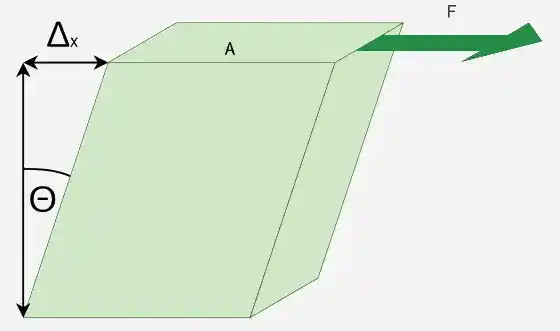
The modulus of rigidity is a measure of how much a material resists deformation when a force is applied perpendicular to its surface.
Formula
The formula of modulus of rigidity, or shear modulus (G), is given below:
G = \frac{\tau_{xy}}{\gamma_{xy}} = \frac{F/A}{\Delta X / L}
\boxed {G = \frac{F L}{A \Delta X}}
where,
- 𝛕xy is Shear Stress
- 𝛄xy is Shear Strain
- F is Force Acting on Object
- A is Area on which Force is Acting
- ΔX is Transverse Displacement
- L is Initial Length
Units and Dimension of Shear Modulus
- The SI unit for Modulus of rigidity is Pascal (Pa) or N/m²
- Modulus of rigidity can also be expressed in gigapascals (GPa) or pounds per square inch (PSI).
- The dimensional formula for the modulus of rigidity is ML⁻¹T⁻².
**Characteristics
- Modulus of rigidity is a measure of the elastic shear stiffness of a material.
- The modulus of rigidity can be experimentally determined by the slope of a stress-strain curve created during tensile tests conducted on a material sample.
- For isotropic materials, the modulus of rigidity value is determined by a torsion test.
**Examples
| Material | Modulus of Rigidity Value |
|---|---|
| Concrete | 3 x 10⁶ psi (21 GPa) |
| Wood | 13 GPa |
| Brass | 40 GPa |
| Ideal liquid | 0 GPa |
**Steel: The modulus of rigidity for steel is approximately 79 GPa (Gigapascals) or 79,000 MPa (Megapascals). This value represents the material's resistance to shearing or torsion forces.
**Aluminium: The modulus of rigidity of aluminum can vary depending on the alloy and other factors, but for most industrial applications it typically ranges from 24 to 28 GPa (or 3.5 × 10⁶ to 4.1 × 10⁶ psi).
**Example: For aluminum 6061-T6, the modulus of rigidity is about 24 GPa. This value shows how strongly the material resists twisting or shearing forces and is key to understanding how aluminum behaves under shear stress.
Relation With Young's Modulus
The modulus of rigidity (G) and the modulus of elasticity (E) are related through the material's Poisson's ratio (v). The relationship can be expressed as
E = 2 G (1 + \nu)
Where,
- **E is Young's Modulus
- **G is Shear Modulus
- **v is Poisson's Ratio
This equation shows that the modulus of elasticity is related to the modulus of rigidity and Poisson's ratio.
- It indicates that these elastic constants are interrelated and can be derived from each other.
- The Poisson's ratio is a measure of the transverse strain to longitudinal strain and is typically denoted by the symbol ν.
- This relationship holds for linear, homogeneous, and isotropic materials.
Modulus of Rigidity vs Modulus of Elasticity
| Property | Modulus of Elasticity | Modulus of Rigidity |
|---|---|---|
| Also known as | Young's Modulus | Shear Modulus |
| Definition | Measure of a material's ability to deform elastically under stress | A measure of a material's resistance to shearing or torsion force |
| Symbol | E | G, S, or μ |
| Formula | Stress/Strain | Shear Stress / Shear Strain |
| SI Unit | Pascal (Pa) | Pascal (Pa) |
| Example | Rubber has a low modulus of elasticity, signifying more deformation under less stress | Steel has a high modulus of rigidity, signifying notable resistance to shape alterations |
Relation With Bulk Modulus
The Modulus of Rigidity (G) and Bulk Modulus (K) are related through the material's Poisson's ratio (v). The relationship can be expressed as
\boxed {G = \frac{3 K (1 - 2 \nu)}{2 (1 + \nu)}}
where,
- **G is the Shear Modulus
- **K is the Bulk Modulus
- **v is the Poisson's Ratio
Also, Young's modulus can be written as
E = \frac{9KG}{3K + G}
These relations show that the elastic constants (E, G, K) are interrelated. This relationship is valid for linear, homogeneous, and isotropic materials.
Applications
- **Design of Structures: The shear modulus is used in designing structures such as bridges and buildings, where the material must resist forces that would cause it to deform.
- **Material Selection: The modulus of rigidity helps in selecting suitable materials for construction. Materials with a lower shear modulus deform more easily, while materials with a higher value resist deformation.
- **Calculation of Deformation and Vibrations: The shear modulus is used to calculate the deflection of beams and plates under transverse loads. It also helps in analyzing vibrations in plates and shells.
- **Understanding Material Behavior: The shear modulus indicates how elastic or flexible a material is when subjected to shear forces, helping predict its behavior under different conditions. conditions.
Solved problems
**Question 1: The area of the upper face of a rectangular block is 0.5 m x 0.5 m, and the lower face is fixed. The height of the block is 1 cm. A shearing force applied to the top face produces a displacement of 0.015 mm. Find the strain, stress, and shearing force. Modulus of rigidity = η = 4.5 × 10¹⁰ N/m².
**Solution: Given
Area under shear = A = 0.5 m x 0.5 m = 0.25 m²
Height of the block = h = 1 cm = 1 × 10⁻² m
Displacement of top face = x = 0.015 mm = 0.015 × 10⁻³ m = 1.5 × 10⁻⁵ m
Modulus of rigidity = η = 4.5 × 10¹⁰ N/m²
Shear strain = tan θ = x/h = (1.5 × 10⁻⁵) / (1 × 10⁻²) = 1.5 × 10⁻³
Modulus of rigidity = η = Shear stress / Shear strain
Shear stress = η × Shear strain = 4.5 × 1010 × 1.5 × 10-3
Shear stress = 6.75 × 10⁷ N/m².
Shear stress = F/A
F = Shear stress × Area
F = 6.75 × 107 × 0.25
F = 1.69 × 10⁷ N
**Ans:
Shear strain = 1.5 × 10⁻³
Shear stress = 6.75 × 10⁷ N/m²
Shearing force = 1.69 × 10⁷ N
**Question 2: A metallic cube of side 5 cm has its lower surface fixed rigidly. When a tangential force of 104 kg. wt. is applied to the upper surface, it is displaced through 0.03 mm. Calculate (1) the shearing stress, (2) the shearing strain, and (3) the modulus of rigidity of the metal.
**Solution: Given
- Area under shear = A = 5 cm x 5 cm = 25 cm² = 25 × 10-4 m²
- Height of the block = h = 5 cm = 5 × 10⁻² m
- Displacement of top face = x = 0.03 mm = 0.03 × 10⁻³ m = 3 × 10⁻⁵ m
- Shearing Force = 104 kg-wt = 104 × 9.8 N
Shear stress = F/A
Shear stress = (104 × 9.8)/( 25 × 10-4)
Shear stress = 3.92 × 10⁷ N
Shear strain = tanθ = x/h = (3 × 10⁻⁵ ) / (5 × 10⁻² ) = 6 × 10⁻⁴
Modulus of rigidity = η = Shear stress / Shear strain
η = (3.92 × 10⁷) / (6 × 10⁻⁴) = 6.53 × 10¹⁰ N/m²
**Ans:
Shear stress = 3.92 × 10⁷ N
Shear strain = 6 × 10⁻⁴
Modulus of rigidity = 6.53 × 10¹⁰ N/m²
**Question 3: A metal plate has an area of face of 1 m x 1 m and a thickness of 1 cm. One face of a larger area is fixed, and a tangential force is applied to the opposite face. The displacement of the edge produced thereby is 0.005 cm. Find the shearing stress, strain, and magnitude of the tangential force applied. The modulus of rigidity of metal is ϒ = 8.4 × 10 N/m².
**Solution: Given
- Area under shear = A = 1 m x 1 cm = 1 m²
- Thickness of plate = h = 1 cm = 1 × 10⁻² m
- Displacement of top face = x = 0.005 cm = 0.005 × 10⁻² m = 5 × 10⁻⁵ m
- Modulus of rigidity = η = 8.4 × 10¹⁰ N/m²
Shear strain = tanθ = x/h = (5 × 10⁻⁵) / (1 × 10⁻²) = 5 × 10⁻³
Modulus of rigidity = η = Shear stress / Shear strain
Shear / stress = η × Shear strain = 8.4 × 1010 × 5 × 10-3
Shear stress = 4.2 × 10⁸ N/m².
Shear stress = F/A
F = Shear stress × Area
F = 4.2 × 108 ×1
F = 4.2 × 10⁸ N
**Ans:
- Shear / Strain = 5 × 10⁻³
- Shear Stress = 4.2 × 10⁸ N/m²
- Shearing Force = 4.2 × 10⁸ N
**Question 4: The shear modulus of a material is 30 GPa, and Poisson’s ratio is 0.25. Find Young’s modulus.
**Solution: Given
- G = 30 GPa = 30 × 109 N/m2
- \nu = 0.25
E=2G(1+ν)
Substitute values
E=2×30×10^9(1+0.25)
E=60×10^9×1.25
E=75×10^9N/m^2
E=75GPa
**Question 5: A cube of side 0.1 m is subjected to a tangential force of 200 N. The top surface shifts by 0.001 m. Find shear strain, shear stress, and shear modulus.
**Solution: Given
- Side = 0.1 m
- Force F = 200 N
- Displacement, x = 0.001 m
- Area, A = 0.1 × 0.1 = 0.01 m2
- Height, L = 0.1 m
Shear / Strain, γ=\frac{x}{L}
= \frac{0.001}{0.1}
γ=0.01
Shear Stress
τ=\frac{F}{A}
=\frac{200}{0.01}
τ=20000N/m^2
Shear Modulus
G=\frac{τ}{γ}
G = \frac{20000}{0.01}
G=2×10^6N/m^2
**Ans
- Shear strain = 0.01
- Shear stress = 2 × 10⁴ N/m²
- Shear modulus = 2 × 10⁶ N/m²
Unsolved Problem
**Question 1: A material has a shear modulus of 40 GPa and a Poisson's ratio of 0.3. Calculate Young’s modulus of the material.
**Question 2: A cube of side 0.15 m is fixed at the bottom. A tangential force of 500 N causes a lateral displacement of 0.002 m at the top. Find shear strain and shear stress.
**Question 3: The Young’s modulus of a material is 2×10¹¹ N/m,2 and Poisson’s ratio is 0.25. Determine the shear modulus.
**Question 4: A rectangular block of height 4 cm and cross-sectional area 0.02 m is subjected to a tangential force of 800 N. If the shear modulus is 5×10¹⁰ N/m2 . Find the lateral displacement produced.
**Question 5: A material has a bulk modulus of 1.8×10¹¹ N/m and a shear modulus of 7×10¹⁰ N/m². Calculate Young’s modulus.