Momentum and its Conservation Formula (original) (raw)
Last Updated : 23 Jul, 2025
In physics, the great scientist **Isaac Newton had a major impact through his development of **Newtonian mechanics. In this framework, momentum is treated as a **vector quantity, meaning it has both **magnitude and direction. It is measured in the standard unit of **kilogram-meter per second (kg·m/s). Quantities in physics are classified as either **scalars, which have only magnitude, or **vectors, which have both magnitude and direction.
What is Momentum?
Momentum is a physical quantity that describes the motion of an object. It is the product of an object's **mass and **velocity.
The amount of momentum that an object has mostly depends upon two variables,
- How much stuff is moving?
- How fast is the stuff moving?
It depends directly upon the mass and velocity. In terms of an equation, the momentum of an object is equal to the mass of the object times the velocity of the object.
Momentum= mass × velocity
In physics, the symbol of the quantity momentum is the lower case **p. Thus, the above equation can be rewritten as:
**p = m × v
- A moving object has momentum; a stationary object has zero momentum.
- Since velocity includes direction, momentum also has a direction.
- Momentum is conserved in isolated systems (principle of conservation of momentum).
- Momentum describes how hard it is to stop a moving object.
- Heavier and faster-moving objects have greater momentum.
- Even small objects can have large momentum if they move very fast (like a bullet).
- The direction of momentum is the same as the direction of velocity. For example, a 1,000-kg truck moving north at 20 m/s has a momentum of 20,000 kg·m/s northward relative to a person standing on the roadside.
Types of momentum
Momentum is classified into two main types—**linear momentum and **angular momentum—each describing motion in a different way: straight-line motion and rotational motion, respectively.
**1. Linear Momentum
Linear momentum is a vector quantity that represents the motion of an object based on its mass and velocity. It is determined by multiplying the object's mass by its velocity.
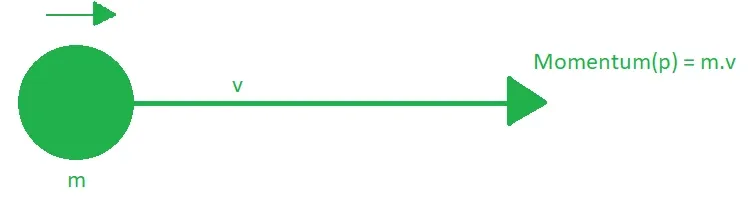
In the image above:
- m = Mass
- V= Velocity Vector
- → p = Linear Momentum Vector
**For example, if a dog runs into you while you're running, the impact is minor because its momentum is similar to yours. But if you are hit by a truck with much greater momentum due to its mass, the impact can be life-threatening.
**Read More, Linear Momentum
**2. Angular Momentum
Angular momentum is a vector quantity that measures an object's rotational motion, indicating how strongly it resists changes in its rotation around an axis.
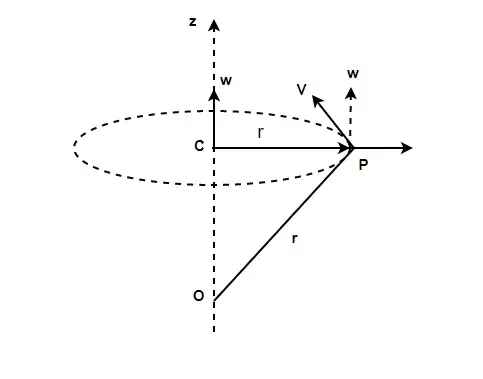
In this image above ,
- O = origin
- r= Position vector
- P= Position
- C= Center of rotation
- v= Linear velocity vector
- w= Angular velocity vector
**For example, A spinning figure skater speeds up when pulling in their arms due to conservation of angular momentum. As the moment of inertia decreases, the rotational speed increases to keep angular momentum constant.
**Read More, Angular Momentum
**3. Conceptual Momentum
Conceptual momentum refers to the amount of motion an object has, determined by multiplying its mass and velocity. As a vector quantity, it includes both magnitude and direction.
**For example, a moving car has momentum based on its mass and speed. If it speeds up or changes direction, its momentum changes accordingly.
Conservation of momentum
**Momentum is determined by the product of an object's **mass and its **velocity. When two bodies are in motion and no **external forces act on them, the total momentum before and after their interaction or collision remains constant. This principle is known as the **law of conservation of momentum.
Formula,
This fundamental law of physics applies to phenomena like **collisions and **explosions. The **law of conservation of momentum states that:
**P 1 ****(before) + P** 2 (before) = P 1 (after) + P 2 (after)
This equation is valid for the object that undergoes collision. "The image below illustrates a collision between two vehicles, demonstrating the law of conservation of linear momentum."
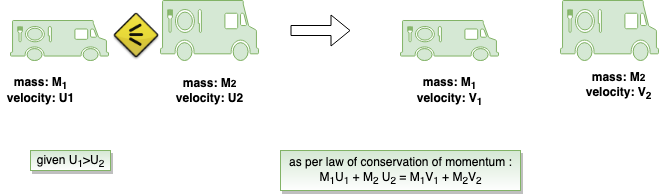
**Before the collision:
- Two vehicles are moving in the same direction.
- Vehicle 1 has **mass M₁ and **velocity U₁.
- Vehicle 2 has **mass M₂ and **velocity U₂.
- It is given that **U₁ > U₂, meaning Vehicle 1 is moving faster.
**After the collision:
- Vehicle 1 moves with **velocity V₁.
- Vehicle 2 moves with **velocity V₂.
- Their masses remain the same.
**Derivation of conservation of momentum
Let's consider a situation where a truck of mass _**m₁and velocity**u₁_is moving toward a car of mass _**m₂_and velocity **u₂, coming from the opposite direction. Since they move in **opposite directions, the total momentum is:
Total momentum=m1u1−m2u2
If both are moving in the **same direction, then:
Total momentum=m1u1+m2u2
Now suppose the truck and car collide for a short time **t****,** resulting in a change in their velocities to_**v₁_ and **v₂ respectively, while their masses remain the same. The total momentum after the collision is then:
Total momentum= m1v1+m2v2
Total momentum before collision = m1u1 + m2u2
Total momentum after collision = m1v1 + m2v2
Acceleration of car (a) = (v2 - u2)/t
Also, as F = ma
F1 = Force exerted by truck on the car.
F1 = m2(v2 - u2)/t
Acceleration of truck = (v1 - u1)/t
F2 = m1(v1 -u1)/t and F1 = -F2
m2(v2 - u2)/t = -m1(v1 - u1)/t
**m 2 v 2 **- m 2 u 2 = m 1 v 1 + m 1 u 1
**Or
**m 1 u 1 **+ m 2 u 2 **= m 2 v 2 **+ m 1 v 1
Sample problems
**Problem 1: A shell is fired from a gun with a velocity of 300m/s making an angle 60 o with the horizontal. It explodes into two fragments when it reaches the highest position. The ratio of the masses of the two pieces is 1:3. If the smaller stops immediately after the collision. find the velocity of the other.
**Solution:
Velocity at the highest point = 300 × cos 60° = 150m/s
Using momentum conservation, 150 × m = 3m/4 × v
v= 200m/s
**Problem 2: There are cars with masses 2 kg and 5 kg respectively that are at rest. A car having the mass 5 kg moves towards the east with a velocity of 5 m.s -1 . Find the velocity of the car with mass 2 kg with respect to ground.
**Solution:
m1 = 2 kg
m2 = 5 kg
v1 = ?
v2 = 5 m.s-1
We know from the law of conservation of momentum that,
Pinitial= 0, as the cars are at rest
Pfinal = p1 + p2
Pfinal = m1v1 + m2v2
= 2 kg × v1 + 5 kg × 5 m.s-1
Pi = Pf
0 = 2 kg . v1 + 25 kg.m.s-1
v1 = 12.5 m.s-1
**Problem 3: Suppose A 800-kg car moving with a velocity of 10 m/s hits a 2000-kg parked truck. The impact causes the 2000-kg car to be set in motion at 2 m/s. Assuming that momentum is conserved during the collision, determine the velocity of the car immediately after the collision.
**Solution:
Momentum of car before collision = 800 × 10 kg.m/s
Momentum of truck before collision = 0 kg . m/s
Total momentum before collision = 8000 kg.m/s
Momentum of car after collision = 800 × v1 kg.m/s
Momentum of truck before collision = 2000 × 2 kg . m/s
By applying the conservation of momentum :
8000 kg.m/s = 800kg . v1 + 4000 kg.m/s
v1 = 4000kg.m.s / 800kg
v1 = 5m/s
Hence, speed of car after collision will be 5m/s.
**Problem 4: List the formula of conservation of momentum along with some examples.
**Answer:
The formula of conservation of momentum:
The total momentum of bodies before collision = total momentum of bodies after collision.
Phenomenon which obey conservation of momentum:
- Gun and bullet system
- Collision of vehicles
- Air balloon system etc
**Problem 5: Explain the working of Gun-Bullet system with the concept of conservation of momentum.
**Answer:
According to the conservation of momentum, the momentum lost by one object equals the momentum gained by another. When a gun fires a bullet, the bullet moves forward, and the gun recoils backward with equal force. However, since the gun has much more mass than the bullet, its acceleration is much smaller.
**Problem 6: Law of conservation of momentum is related to Newton's laws of motion. Name that Newton's law of motion?
**Answer:
The Law of conservation of momentum is related to Newton's third law of motion i.e. every action has equal and opposite reaction. For example, when a person punches on the wall, the wounds are inevitable, this is due to the equal impact given to the person's hands.
**Problem 7: If a ball is projected upward by a player from the ground with ten units of momentum, what is the amount of momentum of recoil of the Earth? Why player don't feel that recoil?
**Solution:
The earth recoils with amount of 10 units of momentum. Since the mass of the Earth is extremely very large, the recoil velocity of the Earth is too small to feel. Therefore, players or people, in general, do not feel that recoil.
Conclusion
Momentum is a vector quantity calculated as the product of an object’s mass and velocity. According to the law of conservation of momentum, the total momentum in an isolated system remains constant. While momentum can shift between objects, the system’s overall momentum stays unchanged.
**You may also Read,