Perpendicular Axis Theorem (original) (raw)
Last Updated : 27 May, 2026
The Perpendicular Axis Theorem states that for any flat (two-dimensional) body, the moment of inertia about an axis perpendicular to its plane is equal to the combined effect of its moments of inertia about two mutually perpendicular axes lying in the same plane and passing through the same point. It applies only to planar objects and is widely used to simplify the analysis of rotational motion.
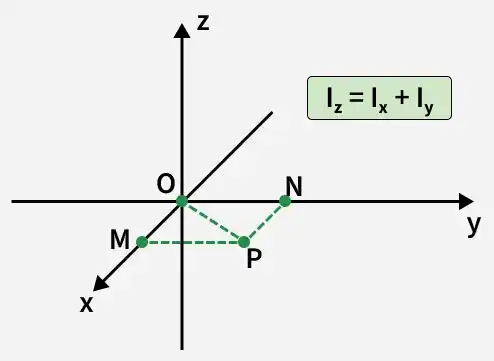
Iz = Ix + Iy
- Iz is the moment of inertia about the axis perpendicular to the plane (z-axis).
- Ix is the moment of inertia about the x-axis lying in the plane.
- Iy is the moment of inertia about the y-axis lying in the plane and perpendicular to the x-axis.
Moment of Inertia
Moment of inertia is the measure of an object’s resistance to rotation about a given axis. It depends on how the mass of the object is distributed relative to the axis of rotation. The farther the mass is from the axis, the greater the moment of inertia, making it harder to rotate the object. It plays a key role in understanding how objects respond to forces that cause rotational motion.
I = ∑mi ri2
where,
- I is moment of inertia
- mi is mass of particle
- ri is distance from axis of rotation
Proof of Perpendicular Axis Theorem
Consider a plane lamina lying in the x–y plane, made up of a large number of particles. Let a particle of mass m be located at a point P with coordinates (x, y).
The perpendicular distances of this particle from x-axis = y and y-axis = x
So,
Moment of inertia about x-axis:
Ix = ∑ m y² …(1)
Moment of inertia about y-axis:
Iy = ∑ m x² …(2)
Now, the distance of the particle from the z-axis (perpendicular to the plane) is:
r² = x² + y²
So, moment of inertia about z-axis:
Iz = ∑ m r²
Iz = ∑ m (x² + y²)
Iz = ∑ m x² + ∑ m y²
Using equations (1) and (2):
Iz = Ix + Iy
Perpendicular Axis Theorem vs Parallel Axis Theorem:
Here's a comparison between the Perpendicular Axis Theorem and the Parallel Axis Theorem:
| Aspect | Perpendicular Axis Theorem | Parallel Axis Theorem |
|---|---|---|
| Definition | Represents the distribution of the objects mass around the axis selected. | It is calculation of moment of inertia by the axis, which is coincide to the object's axis of rotation. |
| Orientation of Axis | Along the directions of the object or perpendicular to its plane. | the object image on the screen is parallel with the plane of that object. |
| Applicability | Able to be applied to for planar objects with uniform mass distribution. | Suitable for the trajectory calculation of any objects, of any shape and their mass distribution. |
| Use Cases | Typically, they are used in the designs of planar structures like the beams, the disks, and the plates. | Among the popular materials used in fabrication are two dimensional shapes and irregular forms. |
| Simplification of Calculations | One of the main objectives is to decrease algorithms to a perpendicular axis that calculates planar objects. | Generalize the moment of inertia computation around any axis by adding a coefficient that is distance from the center of mass over mass. |
Application of Perpendicular Axis Theorem
- Calculating Moment of Inertia: Helps find the moment of inertia of flat objects like discs, plates, and rings easily.
- Engineering Design: Used in designing rotating parts such as flywheels, gears, and machinery for better efficiency and stability.
- Mechanical Systems Analysis: Helps predict how rotating systems respond to forces and torque.
- Vehicle Dynamics: Applied in studying rotation of wheels, axles, and gears to improve vehicle stability and performance.
- Medical Engineering: Used in designing prosthetics and rehabilitation devices by understanding rotational motion and mass distribution.