Photocell and Probability Interpretation to Matter Waves (original) (raw)
Last Updated : 23 Jul, 2025
Dual nature of radiation and matter is a fundamental concept in physics that describes the wave-like and particle-like behaviour of bothradiation and matter. This concept was first introduced by Louis de Broglie in 1924, who proposed that all matter, not just electromagnetic radiation, has wave-like properties. This idea was later confirmed by the famous double-slit experiment and the development of quantum mechanics.
Let's learn about DeBroglie's Theorem and others in detail in this article,
DeBroglie's Wavelength
The de Broglie wavelength is a concept in quantum mechanics that describes the wave-like nature of matter. It is named after French physicist Louis de Broglie, who first proposed the idea in 1923.
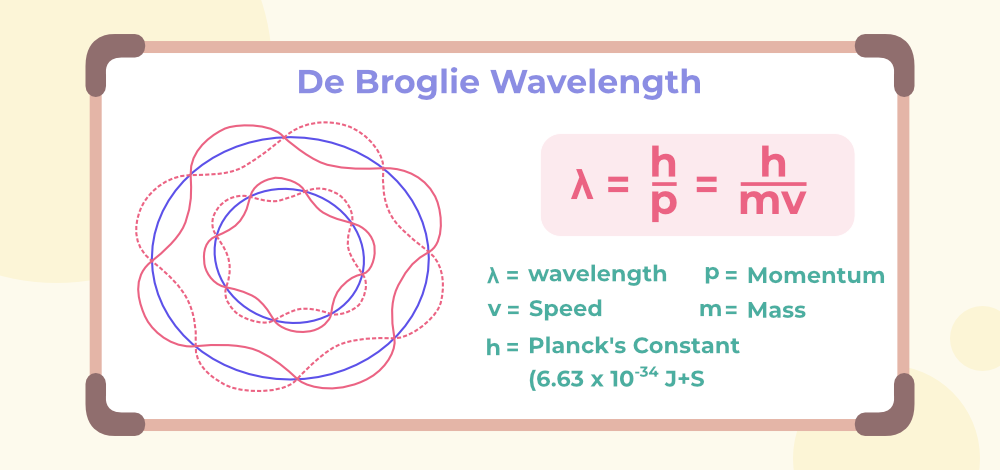
The de Broglie wavelength of a particle is given by the following equation:
λ = h/p
where
λ is the wavelength
h is Planck's constant and its value is 6.62607015 x 10⁻³⁴ Js
p is the momentum of the particle.
This equation is based on the idea that particles, like waves, can exhibit both wave-like and particle-like behaviour. The wavelength of a wave is inversely proportional to its frequency and directly proportional to its momentum. Since particles have momentum, they can also be described by wavelength.
De Broglie wavelength can be experimentally verified by observing the diffraction of electrons through a crystal lattice. The diffraction pattern observed is similar to that of light waves diffracting through a grating, providing experimental evidence for the wave-like nature of matter.
It is important in understanding the behaviour of subatomic particles and has applications in fields such as electron microscopy and quantum computing.
The image given below shows the De Broglie Wavelength of the particle.
Derivation of DeBroglie Wave-Length Equation
From Einstein’s relation of mass-energy equivalence, we know that,
E = mc2 ⋯(1)
where,
E is the energy of the particle,
m is the mass of the particle,
c is the speed of light
According to Planck’s theory, every quantum of a wave has a discrete amount of energy associated with it, and he gave the equation:
E = hf ⋯(2)
where,
E is the energy of the particle
h is Planck’s constant
f is frequency
De-Broglie’s hypothesis suggested that particles and waves behave as similar entities. Thus, he equated the energy relation for both particle and wave; equating equations (1)and (2), we get:
mc2 = hf
Since the particles generally do not travel at the speed of light, DeBroglie substituted the speed of light c, with the velocity of a real particle v, and obtained:
mv2 = hf ⋯(3)
If λ is the wavelength of the wave, then the frequency will be f = v/λ
Substituting this in equation (3), we get:
mv2 = hv / λ
λ = h / mv
λ = h/p ⋯(4)
where,
p is the momentum of the particle.
De Broglie Wavelength and Kinetic Energy
The kinetic energy of an object of mass m moving with velocity v is given as,
K = 1/2mv2 or, K = 1/2mv⋅v
m⋅K = 1/2 (mv)2
Since, p = mv, Thus,
m.K = 1 / 2(p)2
From equation (4),p = h/λ
m ⋅ K = 1/2 (h / λ)2
λ2 = h2 / 2mK
λ = h / √(2mK)
De-Broglie Wavelength and Potential
When a charged particle, having a charge q is accelerated through an external potential difference V, the energy of the particle can be given as:
E = qV ⋯(i)
According to Planck’s equation,
E = hf
Since, f = v / λ
Therefore, E = h v / λ …(ii)
Equating the equations (i)and (ii),
qV = h v / λ
λ = hv / qV
Thermal De Broglie Wavelength
There exists a relation between the De-Broglie equation and the temperature of the given gas molecules, and the thermal de Broglie wavelength gives it (λTh). The Thermal de Broglie equation represents the average value of the de Broglie wavelength of the gas particles at the specified temperature in an ideal gas.
The expression gives the thermal de Broglie wavelength at temperature T,
λTh = λ = h/√2mkBT
where,
h is Planck constant
m is the mass of a gas particle
kB is Boltzmann's constant
De-Broglie Wavelength of an Electron
As we have seen above, the matter waves associated with real objects are so small that it is of no good use to us. But for sub-atomic particles with negligible masses, the value of the de-Broglie wavelength is substantial. To calculate the de-Broglie wavelength associated with a microscopic particle,
Let us take an electron of mass m = 9.1×10⁻³¹kg,
moving with the speed of light, i.e.,
c = 3×10⁸ m/s
Then de-Broglie wavelength associated with electron can be given as,
λ = h / mc
λ = 6.62607×10⁻³⁴ Js / 9.1×1031 kg × 3×108 m/s
= 0.7318×10¹¹m
= 0.073 A°
This is a substantial value. Thus, the de-Broglie wavelength associated has a significant value, and it can be detected.
Relation Between De-Broglie Wavelength and Potential (for an electron)
The expression for the de-Broglie wavelength of an electron,
λ = h/√2mK
If the electron having a charge e is moving under an external potential V, then,
The kinetic energy of the electron, K = eV
Substituting this expression in the above equation,
λ = h/√2meV
for an electron,
h = 6.62607×10⁻³⁴Js
e = 1.6×10⁻¹⁹ C
m = 9.1×10⁻³¹ kg
Now, the De-Broglie Wavelength of an electron is given as,
λ = 12.27 /√V Å
where,
V is the voltage applied.
What is the Photoelectric Effect?
The dual nature of matter and waves refers to the idea that matter and energy can exhibit both wave-like and particle-like properties depending on the circumstances in which they are observed. In the context of a photocell, a photocell can be thought of as a device that converts the wave-like properties of light into the particle-like properties of electrical energy. This is achieved through the process of the photoelectric effect, where photons of light knock electrons off a semiconductor material, creating a current.
The photoelectric effect is one of the earliest experimental evidence for the wave-particle duality of light and electrons. The photoelectric effect showed that light behaves as particles (photons) with energy, not as waves, and this is one of the founding experiments that led to the development of quantum mechanics.
What is a Photocell?
A photocell is a device that converts light energy into electrical energy. In the context of the dual nature of matter and radiation, a photocell helps to demonstrate the wave-particle duality of light, which means that light can exhibit both wave-like and particle-like behaviour. When light falls on the photocell, it releases electrons, which results in the generation of an electrical current, demonstrating the particle-like behaviour of light. On the other hand, the photocell's response to light is proportional to the intensity of the light, which is a wave-like property. Hence, the photocell serves as a practical example of the dual nature of matter and radiation.
Working of a Photocell
A photoelectric cell, also known as a photoconductive cell, is a device that converts light energy into electrical energy. Here is a step-by-step explanation of how it works,
- The photoelectric cell is made up of semiconductor material, such as silicon, that is exposed to light.
- When light strikes the semiconductor material, it causes the release of electrons from the material's surface.
- These electrons are then attracted to a metal electrode, called the anode, which is located on the surface of the semiconductor material.
- As the electrons flow from the semiconductor to the anode, they create an electrical current.
- The electrical current can then be used to power devices or be stored in a battery.
- The intensity of the light striking the semiconductor material directly affects the amount of electrical current produced. More intense light results in a greater amount of electrical current.
- The energy of the light also affects the behaviour of the photoelectric cell. When light energy is below a certain threshold level, called the threshold frequency, no electrons will be emitted. Above the threshold frequency, the number of electrons emitted increases with the frequency of light.
- The photoelectric effect is the phenomenon in which electrons are emitted from the surface of a metal when light shines on it, and this phenomenon is the basis of a photoelectric cell.
The image given below shows a photocell and its working.

Read More,
Solved Examples on De-Broglie Wavelength
Example 1: What is the wavelength of an electron moving at 5.31 x 10⁶ m/sec?
Solution:
Given:
mass of electron = 9.11 x 10⁻³⁴ kg
h = 6.626 x 10⁻³⁴ J·sde Broglie's equation is
λ = h/mv
λ = 6.626 x 10⁻³⁴ J·s/ 9.11 x 10-31 kg x 5.31 x 106 m/sec
λ = 6.626 x 10⁻³⁴ J·s / 4.84 x 10⁻²⁴ kg·m/sec
λ = 1.37 x 10⁻¹⁰ m
λ = 1.37 Å
The wavelength of an electron moving 5.31 x 10⁶ m/sec is 1.37 x 10⁻¹⁰ m or 1.37 Å.
Example 2: What is the de Broglie wavelength of a 0.05 eV neutron?
Solution:
λ = h / p
= h / √2mok
= hc / √(2moc2 )K
= 12.4 x 10³ / √2(940 x 106) (0.05)λ = 1.28 Å
The de Broglie wavelength of a 0.05 eV(thermal) neutron is 1.28Å.
Example 3: A certain photon has momentum 1.50×10⁻²⁷kgms-1. What will be the photon’s de Broglie wavelength?
Solution:
p = 1.50×10⁻²⁷kgms-1
h = 6.63×10⁻³⁴Js
De Broglie wavelength of the photon can be computed using the formula:
λ = h / p
= 6.63×10 -34 / 1.50×10-27
= 4.42 ×10-7
= 442 ×10-9
= 442 Nanometer.
Therefore, the de Broglie wavelength of the photon will be 442 nm