Power of a Lens (original) (raw)
Last Updated : 3 Apr, 2026
The power of a lens is a measure of how strongly it can bend (refract) light. It indicates the ability of a lens to converge or diverge light rays. A lens with greater power bends light more sharply, while a lens with less power bends light less.
- Power is inversely proportional to its focal length: p = \frac{1}{f}
- Unit of power is diopter (D)
- Power of a Convex Lens (Converging Lens) is positive as its focal length is positive.
- Power of a Concave Lens (Diverging Lens) is negative as its focal length is negative.
- Power of a plane glass is 0.
Power of Lens Formula (Using Refractive Index)
There is a relation between the focal length of the lens and its refractive index; it’s known as the Lens maker's formula. It includes the radius of curvatures of both surfaces. The lens is a part of the hollow sphere of glass, Radius of curvature of the lens is the radius of that sphere. Each lens has two radii of curvature.
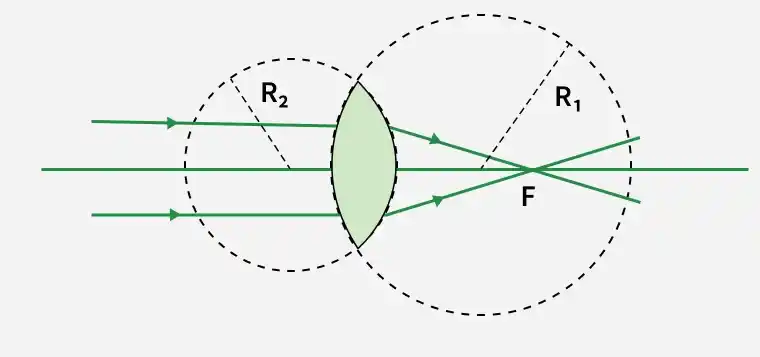
According to the Lens maker's formula:
\frac{1}{f} = (n - 1) \left( \frac{1}{R_1} - \frac{1}{R_2} \right)
where,
n is the Refractive index of the material
f is the focal length of the lens
R1 is the radius of curvatures of first surface
R2 is the Radius of curvature of second surfaceAlso the power of a lens is given by,
P = \frac{1}{f}
Now, from both the above equations:
P = (n - 1) \left( \frac{1}{R_1} - \frac{1}{R_2} \right)
This is the required relation between the power and the refractive index of the lens. This formula can be used to find the power of the lens using the refractive index of the material and radius of curvatures of the lens.
Power of Combination of Lenses
Two or more lenses can be combined in order to increase or decrease the power of lenses.
Let take two lenses A and B with focal lengths f1 and f2 respectively.
- These two lenses are placed in contact with each other such that their principal axes coincide with each other.
- An object is placed at O on the principal axis of the combination.
- Lens A produces an image of the object at E1.
This image acts as an object for lens B and the final image is formed at E.
PO = u, i.e. object distance for lens A
PE = v, i.e. final image distance
PE1 = V1, i.e. image distance for lens A and object distance for lens B.
Using Lens formula on the image formed by lens A:
1/v1 - 1/u = 1/f1 ......(1)
Using Lens formula on the image formed by lens B:
1/v - 1/v1 = 1/f2 ......(2)
Adding equation (1) and (2) as:
1/v - 1/u = 1/f1 + 1/f2 ......(3)
Replace the combination with a single lens of focal length F, such that the final image is formed at E.
1/v - 1/u = 1/F ......(4)
Now from equation (1) and (2) as:
1/F = 1/f1 + 1/f2 ......(5)
where,
F is the focal length of the combination of lenses A and B.Since,
P = 1 / f
Therefore, equation (5) changes to
P = P1 + P2
where,
P is the power of the combination of lenses,
P1 is the Power of lens A,
P2 is the Power of lens B.This is the formula for the combined power of lenses. Proper sign convention needs to be followed when substituting the values of P1 and P2.
Solved Problems
**Example 1: How does the power of a lens change if its focal length is doubled?
**Solution: Power gets halved as Power is inversely proportional to focal length.
**Example 2: What is the power of a convex lens (with sign) of focal length 40cm?
**Solution: Since, Power = 1 / f
Substituting the given values as,
P = 100/40
= 2.5D
Since it's a convex lens, so power will be positive.
Thus, the power of convex lens is ****+2.5D.**
**Example 3: Identify the type of lens and its focal length if its power is 0.2D.
**Solution: Since the focal length, f = 1 / Power (P)
Therefore, substituting the given values in the above expression as:
f = 1 / (0.2D)
= 5 m
Since the power is positive, therefore given lens is a **convex lens.
**Example 4: A convex lens of a focal length of 50 cm is in contact with a concave lens of a 20 cm focal length. Find the power of the combination of lenses.
**Solution: For a combination of lenses,
P = P1 + P2
P = 1/f1 + 1/f2
P = 100/50 + 100/(-20) (concave lenses have negative focal length)
= -3 D
**Example 5: Find the power of a plano-convex lens when the radius of a concave surface is 10 cm and the refractive index is (n) 1.5.
**Solution: Given
R1 = ∞, R2 = - 10 cm = -0.1 m, n= 1.5P = (n-1) × (1/R1 - 1/R2)
P = (1.5-1) × (1/∞ - 1/{-0.1})
P = 0.5 × (0 + 10)
P = 5 D
Unsolved Problems
**Question 1: A concave lens has a focal length of 25 cm. Find its power and state whether it is converging or diverging.
**Question 2: A convex lens has a power of +4 D. Determine its focal length in meters.
**Question 3: Two lenses, one convex of focal length 30 cm and one concave of focal length 15 cm, are placed in contact. Find the power of the combination.
**Question 4: A plano-convex lens has a refractive index of 1.6, with a convex surface radius of 12 cm and a flat surface. Find the power of the lens.
**Question 5: If the focal length of a convex lens is reduced from 50 cm to 25 cm, how does the power change?