Projectile Motion for Horizontal Displacement (original) (raw)
Last Updated : 15 Mar, 2025
Suppose an object is thrown at a certain angle θ with a certain velocity. In that case, the path followed by the object is called a trajectory, the thrown object is called a projectile, and the motion followed by it is called projectile motion. Once launched, the projectile moves by its inertia under the influence of gravitational force (the only force acting on the projectile is gravitational force).
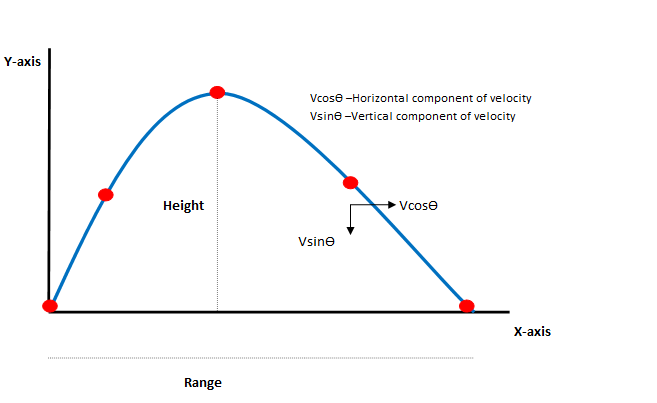
Projectile Motion for Horizontal Displacement
Horizontal Displacement of Projectile Motion
The horizontal displacement of the projectile is called the **range of the projectile and depends on the object's initial horizontal velocity. When a projectile is launched with the same initial speed at two complementary angles of projection, the range will remain the same.
**Horizontal displacement caused due to the projectile motion of particle, is given by:
∆x = V0 x t
Where ∆x is the horizontal projectile displacement
V0 = velocity of the particle
t = time of flight
If the particle moves under constant acceleration, the projectile motion is called vertical projectile motion. Here, the particle moves along the y-axis.
How to find horizontal displacement in projectile motion?
To calculate the horizontal displacement of a particle in projectile motion using a calculator, follow these steps:
**Step 1: Enter the values for velocity and time in their respective input fields.
**Step 2: In the "Horizontal Displacement at Time" input field, enter 'x'.
**Step 3: Click the "Calculate the Unknown" button to obtain the result.
**Step 4: The horizontal displacement value will be displayed in the output field.
**Let's imagine if an object is projected with an initial velocity v at an angle θ, and the initial height is h. Then, its components of velocity are given as,
The horizontal velocity component: **v x = v.cos(θ) and
The vertical velocity component: **v y = v.sin(θ).
In the case of the horizontal motion of the projectile, the vertical component of velocity is 0, therefore vsinθ is also 0.
Solved Examples of Projectile Motion
**Example 1: Mohan travels 6 km to the North but then back-tracks to the South for 4 km to reach his home. Then total displacement of Mohan?
The displacement of Mohan is given by the formula:
Δx = (xf – xi)
Here the initial position of Mohan is xi
The final position is xf which is the distance traveled towards the north minus the distance traveled towards the south.
Δx = (6 km North – 4 km South) – 0
= **2 km North
**Example 2: Find the value of horizontal displacement of a fired projectile at a constant velocity of 12 m/s and time of flight is 20 s.
Given,
The velocity of particle = 12 m/s
Time of flight = 20 sec
Then Horizontal displacement of projectile is,
∆x = vc x t
= 12 x 20
= **240 m
**Example 3: Find the value of horizontal displacement of a fired projectile at a constant velocity of 40 m/s and time of flight is 12 s.
Given,
Velocity of particle = 40 m/s
Time of flight = 12 sec
Then Horizontal displacement of projectile is,
∆x = vc x t
= 40 x 12
= 480 m
**Example 4: A stone is thrown at a constant velocity of 10 m/s horizontally to the surface of the earth and the stone follows the parabolic path If the horizontal displacement attained by the stone is 100 m then find its time of flight.
Given,
Velocity of stone = 10 m/s
Horizontal displacement of projectile = 100m
Since,
∆x = vc x t
Therefore,
Time of flight, t = ∆x / vc
= 100 /10
= **10 s
**Example 5: A boy kicked a football with a certain constant velocity v. If the ball follows a trajectory path with a horizontal displacement of 330 m and its time of flight during the projection is 20 s. Then what is the velocity of the ball?
Given,
The velocity of football = v m/s
Time of flight = 20 sec
Horizontal displacement of football = 330 m
∆x = vc x t
vc = ∆x / t
= 330 / 20
= **16.5m/s