Refraction of Light (original) (raw)
Last Updated : 30 Apr, 2026
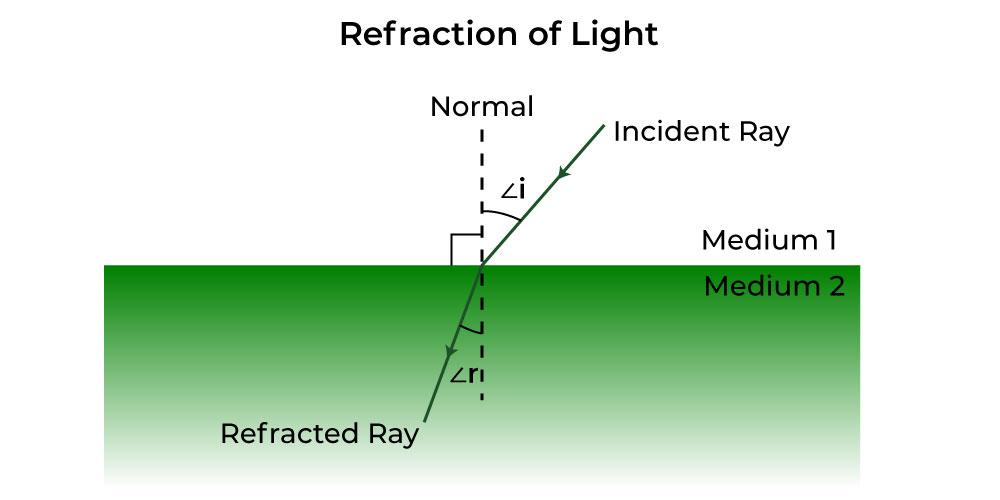
Refraction of light occurs when a light ray changes its direction as it passes from one medium to another, due to a change in its speed. This change occurs because different media have different optical densities, which affect the speed of light traveling through them. When light moves from a rarer medium to a denser medium or vice versa, it bends at the boundary between the two media. Common examples of refraction include the bending of a pencil placed in water, the formation of rainbows, and the apparent twinkling of stars.
This phenomenon also occurs with sound, water waves, and other types of waves when they move from one medium to another. The bending of waves due to refraction makes many optical devices possible, such as lenses, magnifying glasses, and prisms, and also explains natural phenomena like rainbows.
Here are the definitions of important terms used to study Refraction:
- **Normal - The normal is an imaginary straight line drawn perpendicular to the surface of a refracting or reflecting medium at the point of incidence. It is shown in a ray diagram as a dotted line and is used as a reference to measure the angles of incidence and refraction.
- **Incident Ray - The light rays that strike the refracting surface at the separation of two media are called the Incident Ray.
- **Refracted Ray - The light rays that bend after passing into another medium are called the Refracted Ray.
- **Angle of Incidence - This is the angle between the incident ray and the normal. It is represented by ∠i and it is also called an **Incident angle.
- **Angle of Refraction - This is the angle between the refracted ray and the normal. It is represented by ∠r, and it is also called a Refracted angle.
Laws of Refraction
The refraction of light traveling through different mediums follows some laws. There are two laws of refraction as stated below, which, at the sight of refraction, the light follows, and we see the refracted image of the object.
- The reflected ray, the incident ray, and the normal at the point of incidence all will tend to lie in the same plane.
- Secondly, the ratio of the sine of the angle of the incidence and refraction is constant, which is termed **Snell’s law.
\frac{\sin i}{\sin r} = \text{Constant} \; (n)
where i is the angle of incidence, r is the angle of refraction, the constant value depends on the refractive indices of the two mediums.
Refractive Index
The Refractive index also called the index of refraction, enables us to know how fast light travels through the material medium.
Refractive Index is a dimensionless quantity. For a given material or medium, the refractive index is considered the ratio between the speed of light in a vacuum (c) and the speed of light in the medium (v) on which it goes. The Refractive index for a medium is represented by small n, and it is given by the following formula:
n = \frac{c}{v}
- c is the speed of the light in a vacuum, and
- v is the speed of light in the medium.
The given velocities of light in different media can give the refractive index by the following also, where the first medium is not vacuum:
n_{21} = \frac{v_1}{v_2}
where n21 is the refractive index of 2 with respect to 1.
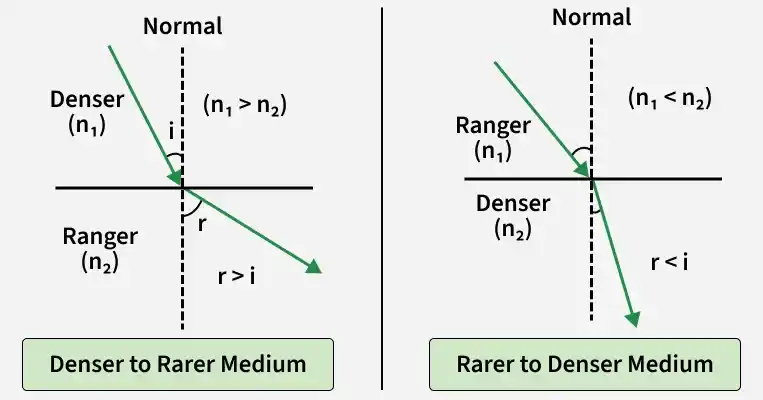
Based on the given refractive index of the material or medium, the light ray either changes its direction or bends at the junction that separates the two given media. If the light ray travels from a certain medium to another of a slightly higher refractive index, it bends towards the normal in that case when traveling from a rarer to a denser medium, or else it bends away from the normal when traveling from a denser to a rarer medium.
Snell's Law
Snell’s law provides the degree or extent of refraction that occurs through a relationship between the incident angle, refracted angles, and the refractive indices of a given pair of media.
According to Snell’s law, the ratio of the sine of the incident angle to the sine of the refracted angle is a constant for any light of a given color or for any given pair of media. The constant value is called the refractive index of the second medium with respect to the first.
Snell's Law is given by the relation,
\dfrac{\sin i}{\sin r}=\text{Constant}=n
or
\dfrac{\sin i}{\sin r}=\dfrac{v_1}{v_2}=\dfrac{n_2}{n_1}
where,
- i and r are the angle of incidence and refraction,
- n is the refractive index and n1 and n2 are the refractive indices of medium 1 and 2, and
- v1 and v2 are the speed of light in medium 1 and 2 respectively.
Causes of Refraction of Light
As it is known, when light travels in different mediums, its speed varies. e.g., light passes through the air more than in glass. Hence, it can be said that, due to the change in the speed of light in different mediums, the light rays are refracted.
To understand the causes of refraction of light in much depth, let's understand What are rarer and denser mediums are. and Types of Refractions as:
Types of Refraction
- **Refraction from a denser to a rarer medium - When light rays pass from a rarer to a denser medium, the light rays bend towards the normal. Due to this the angle of refraction is smaller than the angle of incidence. e.g. In the case when light rays pass from air to water or from air to glass, they bend towards normal. It is because of the reason that the speed of light rays reduces while passing from air to glass or water.
- **Refraction from a rarer to denser medium - When light rays pass from a denser to rarer medium, the light rays bend away from the normal. Due to this, the angle of refraction becomes more than the angle of incidence. e.g. In case light rays pass from water to air or glass to air, light rays bend away from the normal. The speed of light rays becomes greater while passing from glass or water to air.
Characteristics of Refraction
Some of the important characteristics of Refraction are:
- The frequency of light does not change when it travels from one medium to another, but the velocity and wavelength of light do change.
- A ray of light bends when it travels from one optical medium to another with a variable refractive index. For a specific pair of media, the ratio of the sine of the angle of incidence to the sine of the angle of refraction is constant.
- The relationship between a medium's refractive index and the speed of light in that medium is as follows:
\dfrac{\sin i}{\sin r}=\dfrac{v_1}{v_2}=\dfrac{n_2}{n_1}
where,
- i and r are the angle of incidence and refraction.
- n is the refractive index and n1 and n2 are the refractive indices of medium 1 and 2, and
- v1 and v2 are the speeds of light in medium 1 and 2, respectively.
Effects of Refraction of Light
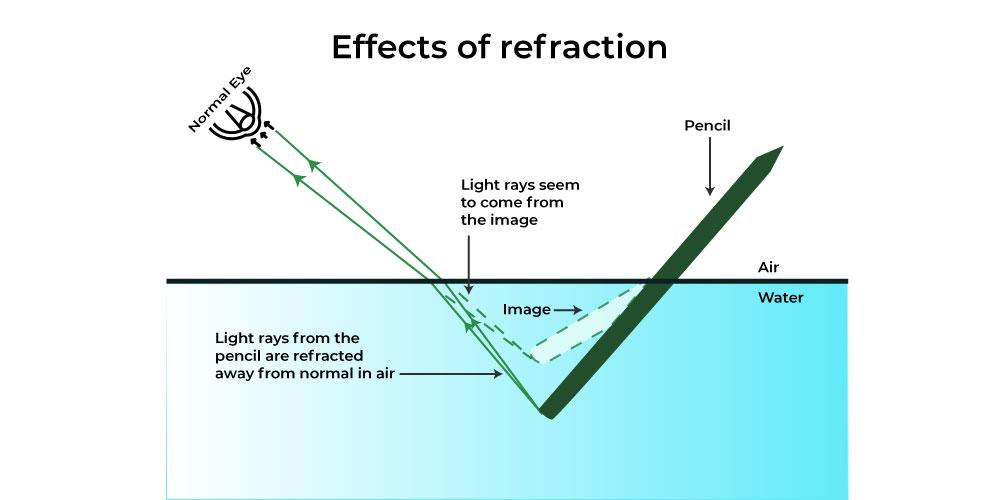
Refraction of light occurs when light passes from one medium to another and its speed changes, causing the light ray to bend. Light travels in the form of waves, and when these waves move between different media, their direction changes. A common example is a pencil placed in water, which appears bent or crooked because light travels slower in water than in air.
**Examples
- The stars twinkle in the night sky due to the refraction of their light.
- Looming and Mirage formation, both occur due to the optical illusions caused by the refraction of light.
- The formation of rainbows in the sky and VIBGYOR, when white light passes through the prism are also major examples of refraction.
- A swimming pool always seems or looks much shallower than it really is because the light that comes from the bottom of the pool bends at the surface due to the refraction of light.
Applications
Refraction has many wide and common applications in optics and also in technology. A few of them are given below:
- A lens uses the refraction phenomenon to form an image of an object or body for various purposes, such as magnification.
- Spectacles that are worn by people with defective vision use the principle of refraction.
- Refraction is used in the peepholes of the house doors for safety, in cameras, inside movie projectors, and also in telescopes.
Related Articles:
Solved Problems
**Question 1: What is the constant value if the angle of incidence is 22° and the angle of refraction is given to be 15°?
****Solution:**\frac{\sin i}{\sin r} = \text{constant}
Given
sin i = sin 22° and sin r = sin 15°
Putting the values of angles from log table we get
\frac{\sin 22^\circ}{\sin 15^\circ} = 1.44
the value of constant or refractive index is 1.44.
**Question 2: What is the constant value if the angle of incidence is 30° and the angle of refraction is given to be 46°?
**Solution:
\frac{\sin i}{\sin r} = \text{constant}
Given sin i= sin 30° and sin r= sin 46°
Putting the values of angles from log table we get
\sin 30^\circ = 0.50, \quad \sin 46^\circ \approx 0.72
\frac{\sin 30^\circ}{\sin 46^\circ} = \frac{0.50}{0.72}
Hence, the constant is 0.69.
**Question 3: What is the value of the sine of the angle of incidence if the angle of refraction is given to be sin 35°? Given the value of the refractive index is 1.33.
**Solution: \frac{\sin i}{\sin r} = \text{constant}
Given constant= 1.33 and sin r = sin 35**° = 0.57
Putting the values of angles from log table we get
sin i / sin 35° = 1.33
sin i = 1.33 × 0.57
= 0.75
**Question 4: Calculate the speed of light in diamond with respect to air. Take the absolute refractive index of glass from the table.
**Solution:
n = c/v
where refractive index of diamond n= 2.42, c = 3 × 10⁸ m/s
\therefore n= \frac{3\times 10^{8}}{v_{g}}
\therefore v_{d}= \frac{3\times 10^{8}}{n }
\therefore v_{d}= \frac{3\times 10^{8}}{2.42}
\therefore v_{d}= 1.24 \times 10^{8}
the velocity or speed of light in Diamond is vd = 1.24 × 10 8 m/s
Unsolved Problems
**Question 1: The angle of incidence is 40° and the angle of refraction is 25°. Find the value of the constant using Snell’s law.
**Question 2: A light ray passes from air into water. The angle of incidence is 35° and the angle of refraction is 26°. Calculate the refractive index of water with respect to air.
**Question 3: The refractive index of a medium is 1.5. If the angle of refraction is 30°, find the value of the sine of the angle of incidence.
**Question 4: The speed of light in vacuum is 3 × 10⁸ m/s and the refractive index of a medium is 1.33. Calculate the speed of light in the medium.
**Question 5: A light ray travels from glass to air. If the angle of incidence is 45° and the angle of refraction is 60°, verify Snell’s law by calculating the ratio sin i / sin r.