Relation between Angular Velocity and Linear Velocity (original) (raw)
Last Updated : 2 Jun, 2026
Motion is defined as the change in position of an object with respect to time, and in physics, the rate of this change is called velocity. Rotational motion refers to the motion of bodies about a fixed axis, and such bodies often exhibit behavior similar to translational motion.
**Example: angular velocity corresponds to linear velocity, torque corresponds to force, and moment of inertia corresponds to mass.
**Angular Rotation
It refers to the circular motion of a body about a fixed axis. In solving problems related to rotational motion, similarities with translational motion are often used by applying analogous variables. The angle of rotation is defined as the angle covered by the body and is denoted by θ. As the object moves in a circular path, the distance it travels is called the arc length, which is directly related to the angle of rotation through the radius of the circular path.
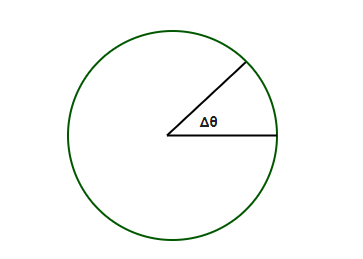
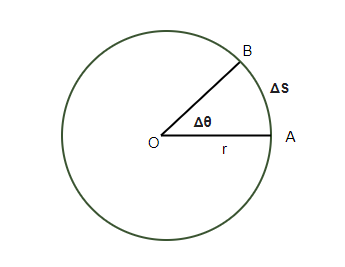
Let the arc length be denoted by s and the radius of curvature by r. The angle of rotation θ is given by:
θ = \frac{s}{r}
Angular Velocity
Suppose a body is rotating around some fixed axis. Then the body changes its angle with time. Denoting the angle by θ, the angular velocity is defined as the rate of change of the angle of the body. Angular velocity is denoted by ω. If the body is rotating at a constant rate, the average angular velocity is used.
\omega = \frac{\Delta \theta}{\Delta t}
In the cases where the rotational motion is not constant, instantaneous angular velocity is calculated.
ω = dθ/dt
Angular Velocity and Linear Velocity
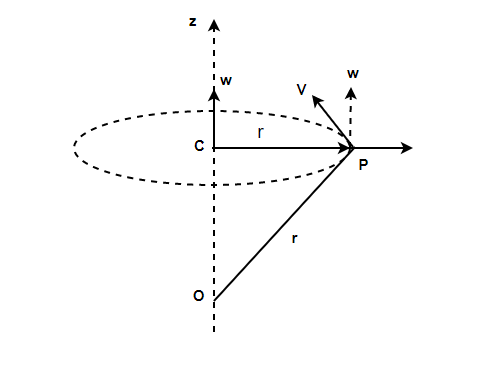
Linear Velocity is the measure of how much distance an object covers per unit of time. For an object moving in a circular motion, the linear velocity is related to the angular velocity. The object covering an angle is also covering some distance in terms of a circular arc. Let us say that the linear velocity of a particle P rotating around a fixed axis is given by,
|v| = \frac{\Delta s}{\Delta t}
It is known that,
s = rθ
Substituting the value of "s" in the equation given above,
|v| = \frac{r \Delta \theta}{\Delta t}
⇒ |v| = r\frac{ \Delta \theta}{\Delta t}
Substituting the values of angular velocity discussed in the previous section.
|v| = rω
Sample Problems
**Question 1: Find the angular velocity of the ball traveling at a speed of 10 m/s in a 20m radius circle.
**Solution: The relation between angular and linear velocity of the ball is given by,
|v| = rω
Given:
v = 10 m/s
r = 20m
Find:
ω = ?
v = rω
⇒ 10 = (20)ω
⇒ 0.5 m/s = ω
**Question 2: Find the angular velocity of the ball traveling at a speed of 100 m/s in a 5 m radius circle.
**Solution: The relation between angular and linear velocity of the ball is given by,
|v| = rω
Given:
v = 100 m/s
r = 5m
Find:
ω = ?
v = rω
⇒ 100 = (5)ω
⇒ 20 m/s = ω
**Question 3: Find covers a full circle in 20 seconds. Find the angular velocity of the particle.
**Solution: Angular Velocity is given by,
ω = (Angle Covered)/(Time)
Given:
Angular Covered = 360°
= 2π
Time "t" = 20 seconds.
Find:
ω = (Angle Covered)/(Time)
⇒ ω = 2π / 20
⇒ ω = π /10 rad /s.
**Question 4: Find covers 270 degrees in 5 seconds. Find the angular velocity of the particle.
**Solution: Angular Velocity is given by,
ω = (Angle Covered)/(Time)
Given:
Angular Covered = 270° = 3π /2 radians , Time ,t = 5 secs
ω = (Angle Covered)/(Time)
Substituting the given values:
**ω = (3π /2) / 5 = 3π /10
**or
**ω = 0.3πrad/s
**So, the angular velocity of the particle is 0.3? rad/s.
**Question 5: A planet is moving around its sun in a circular manner. The angular velocity of the planet is 0.5 rad/s. The distance of the planet from its sun is estimated at 1,00,000 Km. Find out the linear velocity of the planet.
**Solution: The relation between angular and linear velocity of the ball is given by,
|v| = rω
Given:
ω = 0.5 rad/s
r = 105 Km
⇒ r = 108 m
Find:
v = ?
v = rω
⇒ v = (108)(0.5)
⇒ 5 × 10⁷ m/s = v
Unsolved Problems
**Question 1: A particle moves in a circular path of radius 10 m with a linear speed of 20 m/s. Find its angular velocity.
**Question 2: A wheel rotates with an angular velocity of 4 rad/s. Find the linear velocity of a point on its rim if the radius is 2.5 m.
**Question 3: A body covers an angle of 3π3\pi3π radians in 6 seconds. Find its average angular velocity.
**Question 4: A particle moves in a circle of radius 7 m and completes one full revolution in 14 seconds. Find its angular velocity.
**Question 5: The angular velocity of a rotating object is 10 rad/s, and the radius is 0.5 m. Find the distance covered by the object in 4 seconds.