Relative Motion in Two Dimension: Definition | Examples | Practice Questions (original) (raw)
Last Updated : 23 Jul, 2025
Relative motion refers to the speed at which two objects move about each other. It depends on the direction and speed of both objects involved. For example, the speed of a moving vehicle is measured with respect to the ground. The position is also measured with respect to a reference, which is called the origin.
A train moving has a velocity of 100 Km/h with respect to the ground, but if another train is moving at 150 km/h. The velocity of the first train will not be 100 km/h with respect to the person sitting on the second train. It is essential to study the relative motion of the objects.
Reference Frames
In physics, a frame of reference is an abstract coordinate system and a set of physical reference points that uniquely fix the coordinate system help in standardizing the measurements with respect to that frame.
**Example: Consider the figure below. The velocity of the cart with respect to the boy is non-zero, but the velocity of the cart with respect to the person sitting inside the car is zero.

Frame of Reference and Relative Motion
**Scenario 1:
- The image below shows a car moving with a man. In this case, the man is running in the opposite direction of the car.
- **Observation: In this case, the speed of the car observed by the man is less than the speed of the car observed by the man in the second case.
**Scenario 2:
- The second part of the image shows the car moving with the man running in the opposite direction of the car.
Relative Motion in Two Dimensions
These concepts can be extended to two-dimensional spaces also. Given in the figure below, consider a particle P and reference frames **S and **S'.
The position of the frame **S' as measured in **S is **r S'S, the position of the particle **P as measured with respect to the frame **S' is given by **r PS' and the position of the particle **P with respect to the frame of reference **S is given by r PS,
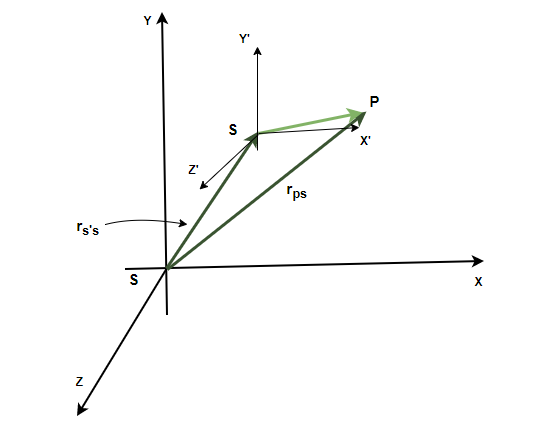
**Notice from the figure that,
**r PS = r PS' **+ r S'S
**These vectors give us the formula for relative velocities too, differentiating the above equation,
\frac{d}{dt}(r_{PS}) = \frac{d}{dt}(r_{PS'} + r_{S'S})
⇒\vec{v}_{PS} = \vec{v}_{PS'} + \vec{v}_{S'S}
Intuitively speaking, the velocity of a particle with respect to S is equal to the velocity of S' with respect to S plus the velocity of the particle with respect to S.
**Differentiating this equation again, the equation for the acceleration is given by,
\frac{d}{dt}(\vec{v}_{PS}) = \frac{d}{dt}(\vec{v}_{PS'} + \vec{v}_{S'S})
⇒\vec{a}_{PS} = \vec{a}_{PS'} + \vec{a}_{S'S}
The acceleration of a particle with respect to S is equal to the acceleration of S' with respect to S plus the acceleration of the particle with respect to S.
**Also Read,
Solved Examples of Relative Motion in Two Dimension
**Question 1: A train is moving at a speed of 100 Km/h. The person sitting inside the train starts moving in the direction of the train at a speed of 10 km/h. Find the velocity of the person with respect to the ground. What is the direction of the person's velocity with respect to the ground if they are moving in the same direction as the train?
**Solution:
**Given:
- velocity of the train with respect to the ground, **v TG = 100 Km/h
- velocity of the person with respect to the train, v**PT = 10 Km/h
- velocity of the person with respect to the ground **v PG,
The equation mentioned above states, **v PG = v PT + v TG
plugging the values into the above equation,
⇒ **v PG = 100 + 10
⇒ **v PG = 110Since, the person is moving in the same direction as the train, the direction of the velocity is the same as the direction in which the train is moving.
**Question 2: A train is moving at a speed of 100 Km/h. The person sitting inside the train starts moving in the opposite direction of the train at a speed of 10 km/h. Find the velocity of the person with respect to the ground.
**Solution:
**Given:
- velocity of the train with respect to the ground, v TG = 100 Km/h
- velocity of the person with respect to the train, **v PT = -10 Km/h
- velocity of the person with respect to the ground **v PG,
**The equation mentioned above states, **v PG = v PT + v TG
**Plugging the values into the above equation,
⇒ **v PG = 100 - 10
⇒ v PG = 90
**Question 3: A vehicle is moving at a speed of 3i + 4j m/s. The person inside the car thinks the bird is flying at a velocity of 2i + 2j m/s. Find the speed of the bird with respect to the direct.
**Solution:
**Given,
- velocity of the vehicle with respect to the ground****,** **v VG = 3i + 4j
- velocity of the bird with respect to the vehicle, **v BV = 2i + 2j
- velocity of the person with respect to the ground **v BG,
**The equation mentioned above states, v BG = v BV + v VG
**plugging the values into the above equation,
⇒ vPG = 2i + 2j + 3i + 4j
⇒ vPG = 5i + 6j
⇒ |vPG| = √61 m/s
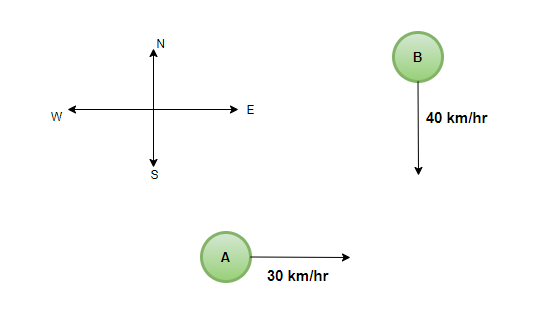
**Question 4: Two particles A and B are moving with velocities 30Km/h and 40Km/h respectively towards an intersection as shown in the figure. Find the velocity of particle A with respect to the velocity of particle B.
**Solution:
**Given, v A = 30 Km/h and **v B= 40 Km/h.
Figure shows they are moving in perpendicular directions.
- Velocity of A with respect to earth: **v AE= 30i
- Velocity of B with respect to earth: **v BE = -40j
**Using the equation studied above, velocity of A with respect to B: **v AB
Assuming that the earth is the connecting frame of reference here,
\vec{v}_{AB} = \vec{v}_{AE} + \vec{v}_{EB}
⇒ \vec{v}_{AB} = \vec{v}_{AE} - \vec{v}_{BE}
⇒ \vec{v}_{AB} = 30\hat{i} -(-40\hat{j})
⇒\vec{v}_{AB} = 30\hat{i} + 40\hat{j}Magnitude of this velocity is
\vec{v}_{AB} = 30\hat{i} + 40\hat{j}
⇒ |\vec{v}_{AB}| = \sqrt{30^2 + 40^2}
⇒ |\vec{v}_{AB}| = 50
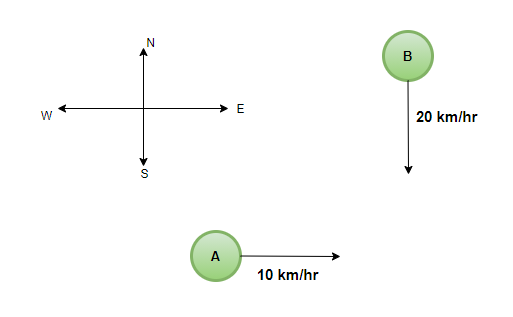
**Question 5: Two particles A and B are moving with velocities 10Km/h and 20Km/h respectively towards an intersection as shown in the figure. Find the velocity of particle A with respect to the velocity of particle B.
**Solution:
**Given: v A = 10 Km/h and **v B = 20 Km/h.
Figure shows they are moving in perpendicular directions.
- Velocity of A with respect to earth: **v AE = 10i
- Velocity of B with respect to earth: **v BE = -20j
Using the equation studied above, velocity of A with respect to B: **v AB
Assuming that the earth is the connecting frame of reference here,
\vec{v}_{AB} = \vec{v}_{AE} + \vec{v}_{EB}
⇒ \vec{v}_{AB} = \vec{v}_{AE} - \vec{v}_{BE}
⇒ \vec{v}_{AB} = 10\hat{i} -(-20\hat{j})
⇒\vec{v}_{AB} = 10\hat{i} + 20\hat{j}Magnitude of this velocity is
\vec{v}_{AB} = 10\hat{i} + 20\hat{j}
⇒ |\vec{v}_{AB}| = \sqrt{10^2 + 20^2}
⇒ |\vec{v}_{AB}| = \sqrt{500}]
Summary
- When analyzing an object's motion, it's important to define the reference frame in terms of its position, velocity, and acceleration.
- Relative velocity refers to the velocity of an object as seen from a specific reference frame, and it changes depending on the chosen reference frame.
- If two reference frames, S and **S', are moving at a constant velocity relative to each other, the velocity of an object in frame **S is the sum of its velocity in frame **S' and the velocity of **S' relative to **S.
- When two reference frames are moving at a constant velocity relative to each other, the acceleration of an object is the same in both frames.