Scattering of Light and Tyndall Effect (original) (raw)
Last Updated : 30 Mar, 2026
Scattering of light is the phenomenon in which light striking small particles in a medium is absorbed and then re-emitted in different directions. The intensity and direction of scattering depend on the particle size and the wavelength of light.
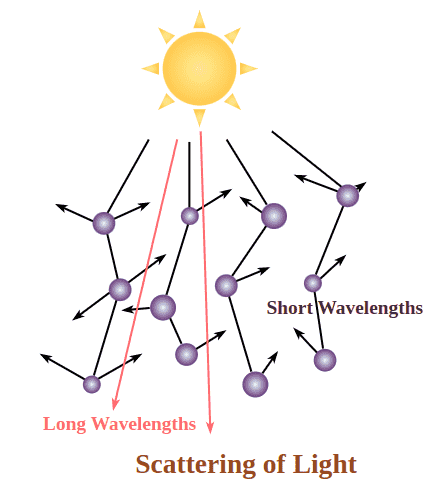
Shorter wavelengths (higher frequency light, like blue) scatter more because they interact more with the particles, while longer wavelengths (lower frequency light, like red) scatter less. Scattering explains natural phenomena such as the blue color of the sky, red hues during sunrise and sunset, and the visibility of objects in various media.
Rayleigh's Law of Scattering
Rayleigh’s Law of Scattering states that the intensity of light scattered by small particles is inversely proportional to the fourth power of the wavelength of the light. Mathematically, if p is the scattered light and λ is the wavelength, then:
p \propto \frac{1}{\lambda^4}
This means shorter wavelengths (like blue and violet) scatter much more than longer wavelengths (like red). It explains why air molecules, such as oxygen and nitrogen, scatter blue light more efficiently, giving the sky its blue color.
**Tyndall Effect
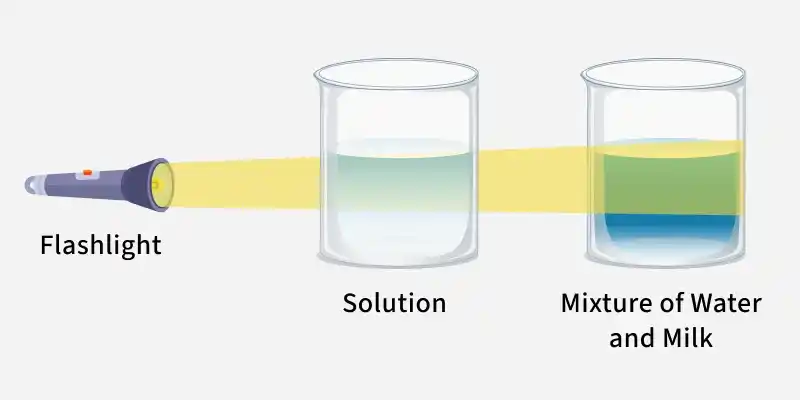
The Tyndall effect is the scattering of light by fine particles such as smoke, dust, or tiny water droplets suspended in a medium, which makes the path of light visible.
The color of scattered light depends on particle size:
- Fine particles scatter shorter wavelengths (blue).
- Larger particles scatter longer wavelengths (red).
- Very large particles scatter all wavelengths, producing white light.
Common observations of the Tyndall effect include:
- Sunlight in a smoke-filled room
- Light passing through fog or mist
- Sun rays visible in a forest
- Colloidal solutions
Causes of Tyndall Effect
- Colloidal particles are much larger than solute particles in a true solution.
- These particles absorb energy from the incoming light.
- The absorbed energy is scattered in different directions by the particles.
- The scattered light makes the path of the beam visible, and the particles appear as points of light against a dark background.
**Examples
- A torch beam becomes visible in a foggy atmosphere due to scattering by tiny water droplets.
- Opalescent glass appears bluish from the side, while orange light passes through it when illuminated.
- Dust particles become visible when a single ray of sunlight enters a dark room.
- Light is scattered by the fat and protein globules in milk when a beam is directed at it.
- Sunlight passing through a forest canopy or mist also shows the Tyndall effect.
Daily phenomena based on Tyndall Effect
- **Blue Color of the Sky: Shorter wavelengths (blue light) are scattered more by air molecules, making the sky appear blue. In space, without an atmosphere, the sky appears black.
- **Red Color of the Sun at Sunrise and Sunset: Sunlight travels a longer path through the atmosphere, scattering shorter wavelengths and allowing red and orange light to reach our eyes.
- **Blue Color of Eyes: Blue eyes appear due to the scattering of shorter wavelengths in the iris, where low melanin allows blue light to dominate.
Solved Problems
**Question 1: Why does sunlight appear white when the Sun is overhead but red during sunrise and sunset?
**Solution:
- When the Sun is overhead, sunlight travels a shorter distance through the atmosphere, so only a small amount of shorter-wavelength blue and violet light is scattered. Most wavelengths reach our eyes, making the Sun appear white.
- At sunrise and sunset, sunlight travels a longer path through the atmosphere. Most of the blue and violet light is scattered out, leaving longer wavelengths (red and orange), which makes the Sun appear reddish.
**Question 2: How does the size of particles in a medium affect the color of scattered light? Give examples.
**Solution: Smaller particles scatter shorter wavelengths (blue) more efficiently, while larger particles scatter longer wavelengths (red) or even appear white.
- Example : Air molecules scatter blue light, giving the sky its color.
- Example : Mist or smoke with larger water droplets may scatter white light, making the path of sunlight visible as a bright beam.
**Question 3: A colloidal solution scatters light of wavelength 500 nm. Another wavelength of 600 nm is also present. Using p ∝ 1/λ4, find the ratio of scattered intensity of 500 nm light to 600 nm light.
**Solution: Rayleigh's law states:
p \propto \frac{1}{\lambda^4}
\frac{I_{500}}{I_{600}} = \left(\frac{\lambda_{600}}{\lambda_{500}}\right)^4
= \left(\frac{600}{500}\right)^4
= (1.2)^4\approx 2.07
**Question 4: Sunlight contains blue (450 nm) and green (550 nm) light. Using Rayleigh’s law, calculate how many times more blue light is scattered than green light.
**Solution: According to Rayleigh's law:
p \propto \frac{1}{\lambda^4}
\frac{I_\text{blue}}{I_\text{green}} = \left(\frac{\lambda_\text{green}}{\lambda_\text{blue}}\right)^4
= \left(\frac{550}{450}\right)^4
= (1.222)^4 \approx 2.23
Unsolved Problems
**Question 1. Explain why the sky appears blue during the day and why it turns red during sunrise and sunset.
**Question 2. Describe how the size of particles affects the color of scattered light. Give two examples from daily life.
**Question 3. Explain why some people have blue eyes using the Tyndall Effect.
**Question 4. Blue light has a wavelength of 450 nm, and red light has a wavelength of 650 nm. Using Rayleigh’s law p ∝ 1/λ 4 , calculate how many times more blue light is scattered than red light.
**Question 5. A colloidal solution scatters light of wavelengths 500 nm and 600 nm. Calculate the ratio of the scattering intensity of 500 nm light to 600 nm light.