Sign Convention for Spherical Mirrors (original) (raw)
Last Updated : 2 Feb, 2026
Sign Convention for Spherical Mirrors: While studying the reflection of light by spherical mirrors and the formation of images by spherical mirrors, a set of sign conventions are needed to learn that is required to measure the focal length, the distance of the object or image from the mirror, and the magnification of the mirror.
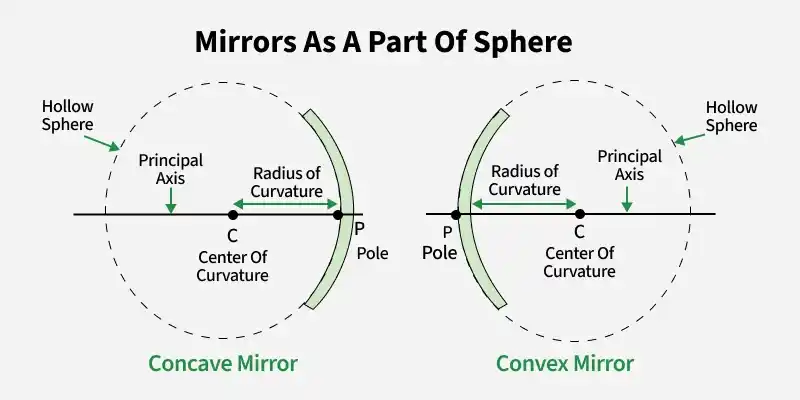
Commonly Used Terms in Spherical Mirrors
**1. Aperture
The aperture of a spherical mirror refers to the effective diameter of its reflecting surface that is exposed to incoming light rays. It determines how much light the mirror can collect. A larger aperture allows more light to fall on the mirror, thereby increasing the brightness of the image formed.
**2. Centre of Curvature
The centre of curvature is the centre of the hollow sphere of which the spherical mirror forms a part. It is denoted by (C). For a concave mirror, the centre of curvature lies in front of the mirror, whereas for a convex mirror, it lies behind the mirror.
**3. Radius of Curvature
The radius of curvature is the distance between the pole of the mirror and its centre of curvature. It is denoted by (R). For spherical mirrors, the radius of curvature is twice the focal length, i.e.,
R = 2f
**4. Pole
The pole is the midpoint of the reflecting surface of a spherical mirror. It is denoted by (P). All distances related to image formation, such as object distance and image distance, are measured from the pole along the principal axis.
**5. Principal Axis
The principal axis is the straight line passing through the pole (P) and the centre of curvature (C) of the mirror and extending on both sides. It serves as a reference line for studying reflection and image formation in spherical mirrors.
**6. Principal Focus
The principal focus is the point on the principal axis where rays of light parallel to the principal axis either converge or appear to diverge after reflection from the mirror. It is denoted by (F).
- In a **concave mirror, parallel rays actually converge at the focus, making it a real focus.
- In a **convex mirror, the reflected rays appear to diverge from a point behind the mirror, so the focus is virtual.
**7. Focal Plane
The focal plane is a plane perpendicular to the principal axis and passing through the principal focus. All rays parallel to the principal axis but inclined to it meet or appear to meet at different points on this plane after reflection.
**8. Focal Length
The focal length of a spherical mirror is the distance between its pole and principal focus. It is denoted by (f). The focal length determines the converging or diverging ability of the mirror and plays a crucial role in image formation.
**Check: Concave and Convex Mirrors
Sign Convention for Spherical Mirrors
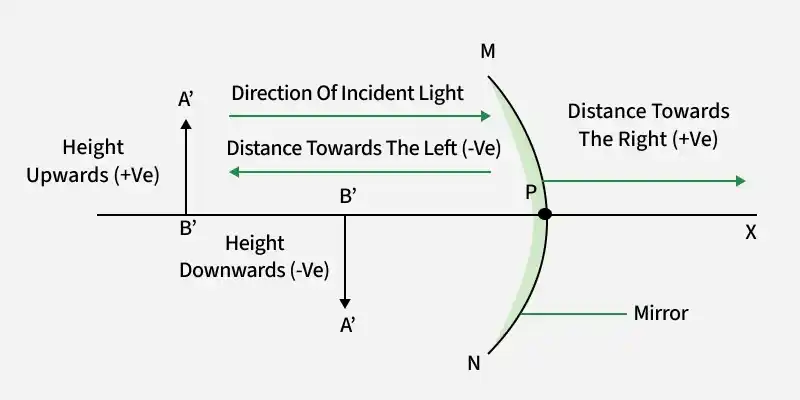
The set of guidelines to set signs for image distance, object distance, focal length, etc for mathematical calculation during an image formation is called the Sign Convention. The sign conventions in the case of the spherical mirrors are made in taking into consideration that the objects are always placed on the left side of the mirror, such that the direction of incident light is from left to right.
**The sign conventions followed for any spherical mirror are given as:
All distances are measured from the pole of a spherical error.
Distances measured in the direction of incident light are taken as positive, while distances measured in a direction opposite to the direction of the incident light are taken as negative.
The upward distances perpendicular to the principal axis are taken as positive, while the downward distances perpendicular to the principal axis is taken as negative.
For convenience, the object is assumed to be placed on the left side of a mirror. Hence, the distance of an object from the pole of a spherical mirror is taken as negative.
Since the incident light always goes from left to right, all the distances measured from the pole (P) of the mirror to the right side will be considered positive (because they will be in the same directions as the incident light). On the other hand, all the distances measured from pole (P) of the mirror to the left will be negative (because they are measured against the direction of incident light)
**Important Points to Remember
- According to the sign convention, the distances towards the left of the mirror are negative. Since an object is always placed to the left side of a mirror, therefore, the object distance (u) is always negative.
- The images formed by a concave mirror can be either behind the mirror (virtual) or in front of the mirror (real). So, the image distance (v) for a concave mirror can be either positive or negative depending on the position of the image.
- If the image is formed behind a concave mirror, the image distance (v) is positive but if the image is formed in front of the mirror, then the image distance will be negative.
- In a convex mirror, the image is always formed on the right-hand side (behind the mirror), so the image distance (o) for a convex mirror will be always positive.
- The focus of a concave mirror is in front of the mirror on the left side, so the focal length of a concave mirror will be negative (and written with a minus sign, say, -10 cm).
- On the other hand, the focus of the convex mirror is behind the mirror on the right side, so the focal length (and written with a plus sign, say +20 cm or just 20 cm), of a convex mirror is positive.
- The Focal Length and radius of curvature of a concave mirror are taken negatively.
- The Focal Length and radius of curvature of a convex mirror are taken positively.
**Check: Image Formation by Spherical Mirror
**Mirror Formula
The distance of the position of an object on the principal axis from the pole of a spherical mirror is known as object distance. It is denoted by u. The distance of the position of the image of an object on the principal axis from the pole of a spherical mirror is known as the image distance. It is denoted by v.
The relation between v and f of a spherical mirror is known as the mirror formula.
It is given by,
\boxed{\frac{1}{u} +\frac{1}{v} =\frac{1}{f}}
where
- u is the object's distance from pole
- v is the image's distance from pole
- f is the focal length of the mirror.
**Magnification (or Linear magnification)
Linear Magnification produced by a mirror is defined as the ratio of the size (or height) of the image to the size (or height) of the object. It is denoted by m. If h' is the size (or height) of the image produced by the mirror and h is the size (or height) of the object Linear magnification has no unit(i.e., it is unitless).
Then, Linear magnification is:
\text{Magnification} = \frac{\text{Height of Image}}{\text{Height of Object}}
m=\frac{h_i}{h_o }
where
- m is the magnification of the spherical mirror,
- hi is the Height of Image, and
- ho is the Height of Object.
**Related Articles:
Solved Examples
**Example 1: A concave mirror produces two times magnified real image of an object placed 10 cm in front of it. Find the position of the image.
**Solution: Here, -10 cm (Sign convention)
m = - 2 ( Image is real).
But m =-v/u
-2=-v/u
v=-20 cm
Thus, image of the object is at 20 cm from the pole of the mirror and in front of the mirror.
**Example 2: An object of 5 cm in size is placed at a distance of 20 cm from its concave minor of the focal length of 15 cm At what distance from the mirror, should a screen be placed to get the sharp image? Also, calculate the size of the image.
**Solution: Given that,
h=+5 cm
f = - 15.0 cm (Sign convention)
u = - 20 cm (Sign convention)
Determination of the position of image.
Using,
1/u + 1/v =1/f
We get ,
1/v = 1/f-1/u
v = -60cm
So the screen must be placed at a distance of 60 cm in front of the concave mirror.
Determination of size of the image and its nature.
Using,
m= h'/h =-v/u
h'=-(v/u)h
= -15 cm
Thus, the size of image **-15cm, negative sign with h' shows that the image is **real and **inverted.
**Example 3: A convex mirror used in a bus has a radius of curvature of 3.5 m. If the driver of the bus locates a car 10 m behind the bus, find the position, nature, and size of the image of the car.
**Solution: Here, R = 3-5 m f = R 2 3-5 2 = 1.75m, u = - 100 m.
Determination of the position of the car.
Using, Using, 1/u + 1/v =1/f
1/v =1/f -1/u
1/v= 1/1.75 -1/(-10)
v = 1.5 m
Thus, the car appears to be at 1.5 m from the convex mirror and behind the mirror.
Determination of the size and nature of the image
Using, m= h'/h =-v/u
= -1.5/-10
= 0.15
Thus, the size of the image of the car is 0.15 times the actual size of the car.
Since m is positive, so image of the car is virtual and erect (i.e., upright).
**Example 4: Determine the focal length of the concave mirror given the radius of curvature is 20 cm.
**Solution: Given that,
The radius of curvature, R =20 cm.
As we know, Radius of Curvature =2 × Focal Length
R = 2 × f
20 = 2 × f
f = 20/2 = **10 cm
Therefore, the focal length of the mirror is 10 cm.