Structure of Nucleus (original) (raw)
Last Updated : 23 Jul, 2025
The nucleus of an atom consists of two types of particles, positively charged particles called protons and neutrally charged particles called neutrons. **Protons + Neutrons in an atom represent the nucleus of an atom. The nucleus of an atom is represented by ZXA, where X is the nucleus of an atom, Z is the atomic number and A is the mass number.
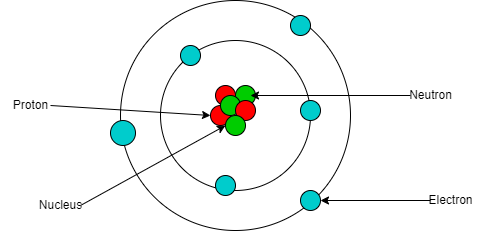
Terms Related to the Nucleus of an Atom
- **Nucleons: Protons and neutrons which are present in the nuclei of atoms are collectively known as nucleons.
- **Atomic Number: The number of protons in the nucleus is called the atomic number of the element. It is denoted by Z.
- **Mass Number: The total number of protons and neutrons (collectively known as nucleons) present in a nucleus is called the mass number of the element. It is denoted by A.
- **Nuclear Mass: The total mass of the protons and neutrons present in a nucleus is called nuclear mass.
**Note: Few important points to remember regarding the nucleus are:
- Number of protons in an atom = Number of electrons in an atom = Z
- Number of nucleons in an atom = A
- Number of neutrons in an atom N = A - Z
- A proton has a positive charge Qp= 1.6×10⁻¹⁹ C and mass mp = 1.6726×10⁻²⁷kg
- A neutron has no charge and its mass mn = 1.6749×10⁻²⁷kg
- No electrons are present inside the nucleus.
Types of Nuclei
Various types of Nuclei are discussed below:
- **Isotopes: These are nuclei of the same element having the same Z but different A. **Ex- 8O16, 8O17, 8O18
- **Isotones: These are nuclei of different elements having the same N but different A. **Ex- 6C137 and 7N147
- **Isobars: These are nuclei of different elements having the same A but different N and Z. Ex- 6C14 and 7N14
- **Mirror Nuclei: These are nuclei with the same A but in which neutron and proton numbers are interchanged. **Ex- 4Be73(Z= 4, N=3) and 3Li74(Z=3, N=4)
- **Isomer Nuclei: These are nuclei with the same A and same Z but differ in their nuclear energy states. They have different lifetimes and internal structures. These nuclei have different radioactive properties. **Ex- Co60 and Co60*
Size of the Nucleus
Rutherford assumed the distance of the closest approach as a measure of the size of an atomic nucleus. Assuming, the nuclei are spherical, the relation between the radius of the nucleus and the mass number is given by:
**R = R 0 A 1/3
where,
**R 0 is constant
For electrons R0 = 1.25×10⁻¹⁵m = 1.25 fermi(fm)
The Radius R of a nucleus is proportional to the cube root of its mass number.
Density of Nucleus
The nuclear density is independent of mass number A. The nuclear density is nearly constant and is equal to
**ρ = (3m)/(4πR 0 3 ) = 2.04×10 17 kg/m 3
where **m is the mass of a nucleus
Atomic Mass Unit (u or amu)
One atomic mass unit is defined as (1/12)th of the actual mass of a carbon-12 atom. It is denoted by amu or u.
1 amu = (1/12)× Mass of carbon-12 atom
= (1/12) × 1.992678×10-26 kg
**1 amu = 1.660565×10 -27 kg
Electron Volt
It is defined as the energy acquired by an electron when it is accelerated through a potential difference of 1 volt and is denoted by eV.
**1 eV = 1.602×10 -19 J
**Relation between amu and MeV:
**1 amu = 931 MeV
**Nuclear Forces
The strong forces of attraction which firmly hold the nucleons in the small nucleus and account for the stability of the nucleus are called nuclear forces.
**Characteristics of Nuclear Force
Some important characteristics of Nuclear Forces are:
- Nuclear force is a short-range force.
- Nuclear forces are the strongest force in nature.
- Nuclear forces are charge-independent.
- Nuclear forces are spin-dependent.
- Nuclear forces show saturation property.
- Nuclear forces are non-central forces.
- Nuclear forces are exchange forces.
Mass Defect
The mass of the nucleus is always less than the sum of the masses of nucleons composing the nucleus. The difference between the rest mass of the nucleus and the sum of the rest masses of nucleons constituting the nucleus is known as mass defect.
**△m = [Zm p +(A-Z)m n ] - M( Z X A )
where,
**m p= mass of protons
**Z = Atomic number
**A = Mass number
Binding Energy
The energy required to break a nucleus into its constituent nucleons and place them at an infinite distance is called binding energy.
**BE = (△m) c 2 = c 2 [Zm p +(A-Z)m n - M( Z X A )]
where,
**m p = mass of protons
**Z = Atomic number
**A = Mass number
**c = speed of light
**Rest Mass of Protons + Rest Mass of Neutrons = Rest Mass of Nucleus + BE
Binding Energy per Nucleon
The binding energy per nucleon of a nucleus is the average energy required to extract a nucleon from the nucleus.
Binding energy per nucleon \bar{B}= \frac{\text{Total binding energy}}{\text{Total number of nucleons} }=\frac{BE}{A}=\frac{\triangle mc^2}{A}
Solved Examples of Structure of Nucleus
**Example 1: Compare the radii of two nuclei with mass numbers 1 and 27 respectively.
**Solution:
Radius of nucleus R = R0A1/3
\frac{R_1}{R_2}= \big(\frac{A_1}{A_2}\big)^{1/3}
R1/R2 = (1/27)1/3
= 1/3
**Example 2: What is the nuclear radius of **125 Fe if that of 27 Al is 3.6 fermi?
**Solution:
Nuclear radius, R = R0A1/3 ⇒ R∝A1/3
For Al, A = 27, RAl = 3.6 fermi,
For Fe A = 125
\frac{R_{Fe}}{R_{Al}}= \big(\frac{A_{Fe}}{A_{Al}}\big)^{1/3}
RFe/RAl = (125/27)1/3
RFe = (5/3)RAl
= (5/3) ×3.6 fermi
RFe = 6 fermi
**Example 3: A neutron breaks into a proton and electron. Calculate the energy produced in this reaction in MeV. Mass of an electron = 9.1 ×10 -31 kg, Mass of proton = 1.6725×10 -27 kg, Mass of neutron 1.6747×10 -27 kg. Speed of light = 3×10 8 ms -1 .
**Solution:
Mass defect (**△)m = Mass of neutron - (mass of proton + mass of electron)
**△m = [(1.6747×10⁻²⁷) - (1.6725×10⁻²⁷ + 9.1 ×10⁻³¹)]
**△m = 0.0013×10⁻²⁷ kg
Energy released Q = **△mc2
Q = (0.0013×10-27) × (3×108)2
= 1.17×10⁻¹³ J
Q = (1.173×10⁻¹³) / (1.6×10⁻¹⁹)
= 0.73×10⁶ eV
Q = 0.73 MeV
**Example 4: Find the binding energy of 12 6 C. Also, find the binding energy per nucleon. Given mass of **1 1 H = 1.0078 u, 10n =1.0087 u, **12 6 C = 12.00004u.
**Solution:
One atom of 126C consists of 6 protons, 6 electrons, and 6 neutrons. The mass of the uncombined protons and electrons is the same as that of six 11H atoms.
Mass of six 11H atoms = 6×1.0078 = 6.0468 u
Mass of six neutrons = 6 × 1.0087 = 6.0522 u
Total mass of particles = 6.0468 +6.0522
= 12.0990 uMass of 126C atom = 12.00004
Mass defect = 12.0990 - 12.00004
= 0.0990Binding energy = 931 × (0.099)
= 92 MeVBinding energy per nucleon = 92/12
= 7.66 MeV