Surface Energy (original) (raw)
Last Updated : 1 Jun, 2026
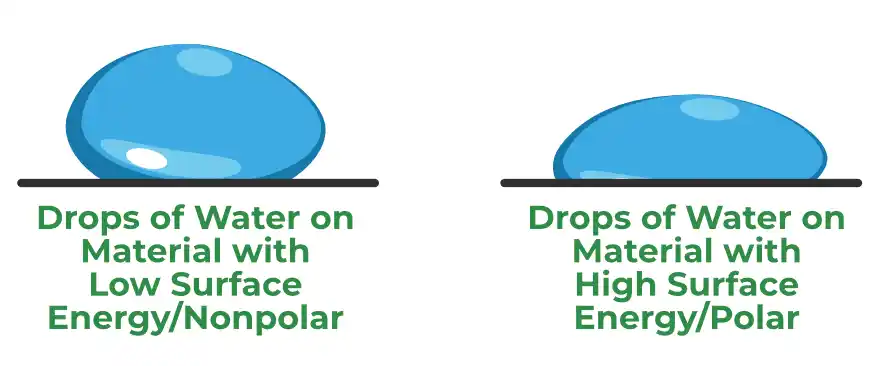
Surface energy is the extra energy stored at the surface of a material due to the imbalance of intermolecular forces experienced by surface molecules compared to those inside the bulk.
It is defined as the work required per unit area to create a new surface of a material. In simple terms, surface energy represents the potential energy present at the surface because surface molecules are not fully surrounded and are therefore in a higher energy state.
Unit and Dimension
- Joules/m2 or Newton/meter (N/m) is the SI unit for surface energy.
- Dimensional Formula for Surface energy is: [M1L0T-2]
Surface Energies of a few materials
| **Material | **Surface Energy (Joules/m 2 ) |
|---|---|
| Glass | 83.4 |
| Lead | 442 |
| Polystyrene | 40.6 |
Formula
Surface Energy is calculated using the following formula:
\text{Surface Energy} = \frac{Work Done}{Area}
E = S \times \Delta A
Where:
- E = Surface Energy
- S = Surface Tension
- ΔA = Increase in Surface Area
Relationship Between Surface Tension and Surface Energy
The relation between surface tension and surface energy is:
T = \frac{\Delta U}{\Delta A}
- T = Surface Tension
- ΔU = Change in Surface Energy
- ΔA = Change in Surface Area
Derivation
\text{Surface Energy} = \frac{\text{Energy}}{\text{Area}}
Surface Energy = \frac{\text{Joule}}{\text{metre}^2}
Surface Energy = \frac{\text{Newton} \cdot \text{metre}}{\text{metre}^2}
Surface Energy = \frac{\text{Newton}}{\text{metre}}
Surface Energy = \frac{\text{Force}}{\text{Length}}
Therefore, \text{Surface Energy} = \text{Surface Tension}
Surface Tension
Surface tension is defined as the force acting per unit length along the surface of a liquid.
\sigma = \frac{F}{L}
Where:
- σ = Surface tension of the liquid
- F = Force acting on the surface
- L = Length over which the force acts
Pressure Inside a Liquid Drop and a Bubble
A liquid drop remains stable and does not collapse due to the presence of surface tension acting on its surface. Surface tension tries to minimise the surface area and acts inward, compressing the drop. Because of this inward force, the pressure inside the drop is greater than the pressure outside.
Excess Pressure
The excess pressure inside the drop is given by:
p = pi − po
Where:
- pi = Pressure inside the drop
- po = Pressure outside the drop
- p = Excess pressure
Force Acting on the Drop
The outward force due to internal pressure acting on the surface of the drop is:
Force = (pi−po) × 4πr2
By balancing the inward force due to surface tension and outward force due to pressure:
p = \frac{2T}{r}
Where:
- T = Surface tension
- r = Radius of the drop
Solved Problem
**Example 1: If the Surface Tension of water is 24 × 10-3 N/m and the Increase in Surface Area is 20 m. Find its Surface energy.
**Solution: Given:
S = 24 × 10-3 N/m, ΔA = 20 m2
Since,
E = S × ΔA
E = 24 × 10-3 × 20
E = 0.480 Joules
**Example 2: Find the Surface Tension if the Surface Energy is 32 × 10-3 Joules/m2 and the Surface Area Increase is 12 m.
**Solution: Given:
E = 32 × 10-3 Joules, ΔA = 12 m2
Since,
E = S × ΔA
S = E / ΔA
S = 32 × 10-3 / 12
S = 2.666 × 10⁻³ N/m
**Example 3: If the liquid's surface tension is 40 × 10-3 N/m and the increase in surface area is 12 mm, Find out what its surface energy is.
**Solution: Given:
S = 40 × 10-3 N/m, ΔA = 12 mm2 = 12 × 10-6 m2
Since,
E = S × ΔA
E = 40 × 10-3 × 12 × 10-3
E = 0.480 × 10⁻³ Joules
**Example 4: Assume that the Surface Tension is 9 × 10⁻³ N/m and the Increase in the Surface Area is 23 m then Find its Surface energy.
**Solution: Given:
S = 9 × 10⁻³ N/m, ΔA = 23 m2
Since,
E = S × ΔA
E = 9 × 10-3 × 23
E = 0.207 Joules
**Example 5: Find Surface Energy when surface tension is 12 × 10-3 N/m and the Increase in Surface Area is 31 m.
**Solution: Given:
S = 12 × 10-3 N/m, ΔA = 31 m2
Since,
E = S × ΔA
E = 12 × 10-3 × 31
E = 0.372 Joules
**Example 6: Surface tension of water is 20 × 10-3 N/m and surface energy is 0.121 Joules/m2 then find the increase in surface area.
**Solution: Given:
S = 20 × 10-3 N/m, E = 0.121 Joules = 121 × 10-3 Joules
Since,
E = S × ΔA
ΔA = E / S
ΔA = 121 × 10-3 / 20 × 10-3
ΔA = 6.05 m
Unsolved Problems
**Question 1: The surface tension of a liquid is 18 × 10-3 N/m. If the surface area of the liquid increases by 25 m2, calculate the surface energy produced.
**Question 2: A liquid has a surface energy of 45 × 10-3 Joule. If the increase in surface area is 15 m2, determine the surface tension of the liquid.
**Question 3: The surface tension of a liquid is 30 × 10-3 N/m. If the total surface energy is 0.09 Joule, find the increase in surface area.
**Question 4: A spherical liquid drop has a radius of 2 mm. If the surface tension of the liquid is 50 × 10-3 N/m, calculate the excess pressure inside the drop.
**Question 5: The surface tension of a liquid is 25 × 10-3 N/m. If the surface area increases by 40 m2, calculate the work done in forming the new surface.