Torque on an Electric Dipole in Uniform Electric Field (original) (raw)
Last Updated : 5 Jan, 2026
Science is a strange subject that never ceases to amaze you as new subjects are presented. We're all aware that charge occurs everywhere around us and that its existence causes a variety of natural events. Furthermore, positive and negative charges exist in many forms, displaying various characteristics in the presence of a stimulating field.
Consider a dipole consisting of two charges, +q and -q, separated by a distance d. When placed in a uniform electric field with strength E, the axis of the dipole is perpendicular to the field. Torque is a measure that quantifies the rotational force applied to an object around an axis. An electric dipole consists of a pair of equal but opposite charges separated by a distance d.
Electric Dipole Moment
The product of the magnitude of these charges and the distance between them is the electric dipole moment. The electric dipole moment is a vector that has a clear direction from the negative to the positive charge.
The electric dipole moment,
**p = q d
where
- q is the magnitude of charge
- d is the separating distance.
The electric dipole moment quantifies the separation of positive and negative charges within a system, reflecting the system's overall polarity. In the SI system, the electric dipole moment is measured in Coulomb-meters (Cm). In atomic physics and chemistry, the debye (D) is commonly used to measure dipole moments.
Electric Dipole in an External Electric Field
Consider a dipole that is placed in a uniform external field 'E' to calculate the torque experienced by the dipole when placed in an external field.
- The positive charge will be subjected to an electric force of 'qE' magnitude in the upward direction.
- The negative charge will be subjected to an electric force of 'qE' magnitude in the downward direction.
Because the net force is zero, in this scenario, the dipole may remain fixed but rotate with a certain angular velocity. This fact has been demonstrated experimentally, and it indicates that both electrostatic forces (qE) behave as a clockwise torque. As a result, when the dipole is put in a uniform external electric field, it rotates. Always keep in mind that torque always works in pairs. Furthermore, its magnitude is the resulting product of force and its arm. The arm may be thought of as the distance between the point where force is applied and the point where rotation occurs for the dipole.
**Derivation of Torque on an Electric Dipole
Consider a dipole with charges +q and –q that form a dipole because they are separated by a distance of d. Place it in a homogeneous electric field of strength E, with the dipole's axis forming an angle θ with the electric field.
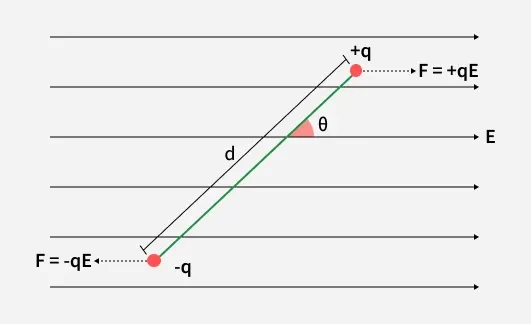
The force on the charges, **F = ± q E
The components of the force perpendicular to the dipole, **F = ± q E sinθ
Since these components are equal and are separated by a distance d, the torque on the dipole is:
**Torque = Force × distance between forces
**τ = (q E sinθ) d = q d E sinθ
Since 'qd' is the magnitude of dipole moment (p), and the direction of dipole moment is from positive to negative charge, the torque is the cross product of dipole moment and electric field. If the direction of an electric field is positive, the torque is in the clockwise direction (therefore negative) in the above figure.
Thus,
**τ = - p E sinθ
The negative sign shows that the torque is in the clockwise direction.
Related Articles:
Sample Problems
**Problem 1: An electric dipole is placed at an angle of 30° with an electric field of intensity 3 × 10⁴ N ⁄ C. It experiences a torque of 5 Nm. Calculate the charge on the dipole if the dipole length is 5 cm.
**Solution:
Given:
Electric field, E = 3 × 10⁴ N ⁄ C
Angle between dipole and electric field, θ = 30°
Dipole length, d = 5 cm = 0.05 m
Torque, τ = 5 N m
The torque on a dipole in an electric field is given by:
τ = q d E sin θ
q = τ ⁄ d E sin θ
= 5 ⁄ (0.05 × 3 × 104 × sin30°) C
= 6.7 mC
Hence, the torque on a dipole in an electric field is **6.7 mC.
**Problem 2: Two tiny electrical dipoles AB and CD, each with a dipole moment of p, are maintained at an angle of 120°. What is the dipole moment as a result? What would the amount and direction of torque operating on this system be if E is directed in the +x direction?
**Solution:
Effective dipole moment of AB and CD, pe = √(p2 + p2 + 2 p p cos120°)
= √(2 p2 + 2 p2(−1 ⁄ 2))
= p
The resultant vector makes a 30° angle with the x-axis, so the torque experienced by the effective dipole,
τ = p E sin 30°
= (1 ⁄ 2) p E
It acts along the z-direction.
Hence, the effective dipole moment is **p; the torque operating on the system is ****(1 ⁄ 2) pE** along the ****+z-direction**.
**Problem 3: An electric dipole of magnitude 0.5 C m is placed parallel to an electric field of intensity 30 N⁄C. Calculate the torque acting on the dipole.
**Solution:
Given:
Electric field, E = 30 N⁄C
Angle between dipole and electric field, θ = 0°
Electric dipole moment, p = 0.5 C m
The torque acting on a dipole is given as:
τ = p E sinθ
= p E sin0°
= 0
Hence, the torque acting on the dipole is **0.
**Problem 4: Why do a dipole experience force and torque both when placed in a non-uniform electric field?
**Solution:
Each charge of a dipole receives a force when it is put in a uniform electric field, and the dipole vector direction is not parallel to the field direction. The magnitude of both forces is identical, yet they are moving in opposing directions. A pair is formed by these equal and opposing parallel forces. This pair applies a torque on the dipole, causing it to spin and align in the field direction. The force, however, is always zero in a uniform field.
There will be a torque when a dipole is put in a non-uniform field, as stated above. The forces acting on the charges are not the same after the dipole is aligned with the field direction. As a result, the dipole will be subjected to a net force in the direction of increasing field. As a result, the electric dipole experiences both torque and force in a non-uniform field.
**Problem 5: At what angle does the dipole in an external electric field experience the maximum torque on it?
**Solution:
The torque acting on a dipole is given as:
**τ = p E sinθ
The value of the sine function is maximum at an angle of 90°, i.e., sin90° = 1, so the dipole experiences the maximum torque at an angle of 90° with the field, or we can say that the dipole experiences the maximum torque when it is held perpendicular to the electric field.