Types of Lever (original) (raw)
Last Updated : 26 Feb, 2026
Levers are simple machines designed to make work easier by reducing human effort. A simple machine is a device that changes the magnitude or direction of a force, allowing tasks to be performed more efficiently. Levers help us lift or move heavy objects by improving the applied force, a property known as leverage.
A lever consists of a rigid bar or beam that rotates about a fixed point called the fulcrum. By adjusting the positions of the applied force and the load, a lever can amplify or redirect force, making difficult tasks easier. In some cases, levers are also used to increase speed or distance of movement rather than force.
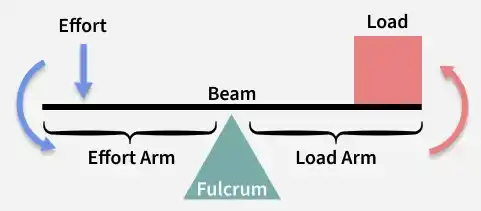
**1. Load (L): Load is a resistive force that has to be overpowered by simple machines. The S.I. unit of load is Newton (N).
**2. Effort (E): Effort is the external force used to pull off a load on a simple machine. The S.I. unit of effort is the Newton (N).
**3. Pivot: It refers to the support provided at a specific point.
**4. Mechanical Advantage (MA): It is the ratio of the effort arm to the load arm. It is given as MA = Effort Arm (E)/Load Arm (L).
**5. Effort Arm: The distance between the effort (force) and the Fulcrum (pivot)
**6. Load Arm: The distance between the Load and the Fulcrum (pivot)
Types of Levers
Levers are classified based on the relative positions of the fulcrum, effort, and load. According to this classification, there are three types of levers: first-class levers, second-class levers, and third-class levers.
1. First-Class Lever
In a first-class lever, the fulcrum is located between the effort and the load.
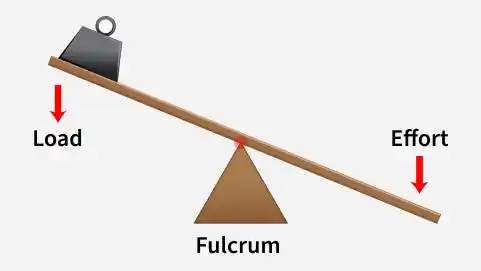
**Arrangement:
Effort – Fulcrum – Load
**Characteristics:
- Mechanical advantage can be greater than 1, equal to 1, or less than 1
- Can change the direction of force
- Commonly used where balance or direction reversal is needed
**Examples:
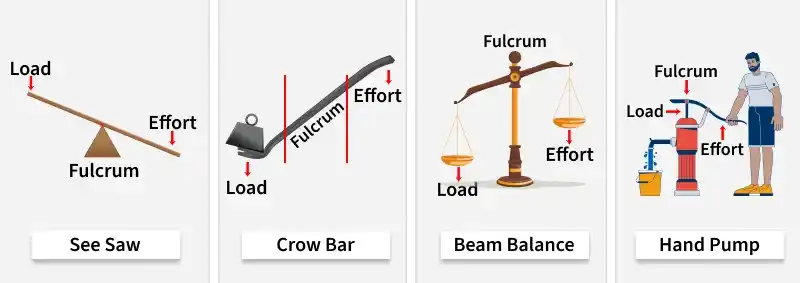
- Seesaw—balances two weights about a central pivot
- Scissors – pivot lies between handles (effort) and blades (load)
2. Second-Class Lever
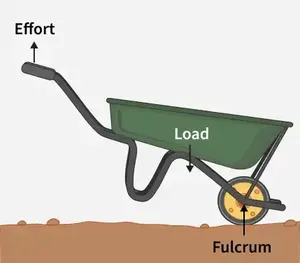
In a second-class lever, the load lies between the fulcrum and the effort.
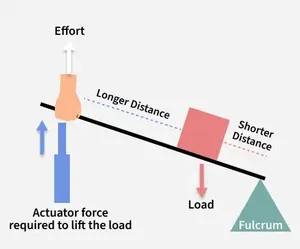
**Arrangement:
Fulcrum – Load – Effort
**Characteristics:
- Mechanical advantage is always greater than 1
- Allows lifting of heavy loads with less effort
- Does not change the direction of force
**Examples:
- Wheelbarrow – wheel acts as a fulcrum, with the load in the middle
- Nutcracker—the nut is the load between the effort and the pivot.
- Door – hinges act as fulcrum
3. Third-Class Lever
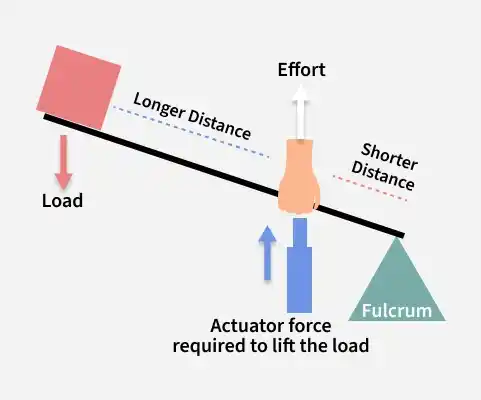
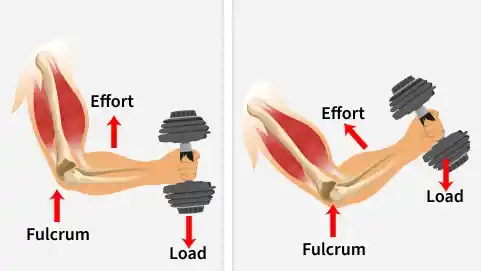
In a third-class lever, the effort is applied between the fulcrum and the load.
**Arrangement:
Fulcrum – Effort – Load
**Characteristics:
- Mechanical advantage is less than 1
- Requires more effort but provides greater speed and displacement
- Common in human body mechanisms
**Examples:
- **Human forearm – elbow is fulcrum, muscle force is effort
- **Fishing rod
- **Baseball bat and hockey stick
Types of Levers Based on Mechanical Advantage
| Lever Type | Position of Fulcrum | Mechanical Advantage | Attribute | Main Use |
|---|---|---|---|---|
| First | Between effort and load | Variable | Force Multiplier | Direction change |
| Second | At one end | > 1 | Speed Multiplier | Force multiplication |
| Third | At one end | < 1 | Change in direction of effort | Speed & range |