Physics Importance, Scope and History (original) (raw)
Last Updated : 6 Aug, 2025
Physics is the study of the fundamental forces and interactions that govern how matter and energy behave in the universe. It explores how these elements interact with each other, shaping the world around us, both in time and space.
**Importance of Physics
Here is a brief list of bullet points highlighting the importance of physics:
- **Explains natural phenomena – Helps us understand how the universe works (e.g., gravity, motion, energy).
- **Foundation of technology – Enables development of electronics, machines, and modern gadgets. It forms the basis of all branches of engineering (mechanical, electrical, etc.).
- **Predicts natural events – Helps forecast weather, understand earthquakes, and more.
- **Drives innovation – Leads to discoveries like lasers, X-rays, and quantum computing.
- **Applies in daily life – Explains things like car brakes, mobile signals, and even walking.
Scope of Physics
- **Healthcare: Advances in medical imaging, such as MRI and CT scans, are based on physics principles, enabling doctors to diagnose and treat patients with precision.
- **Telecommunications: The development of fiber optics and 5G technology relies on principles of light and electromagnetism, revolutionizing communication and internet connectivity.
- **Energy: Physics plays a big role in renewable energy sources like solar panels and wind turbines, helping create sustainable solutions to the global energy crisis.
- **Space Exploration: The study of physics enables missions to Mars, the Moon, and beyond, using rocket science and satellite technology to explore outer space.
- **Environmental Science: Physics helps model climate change, understand weather patterns, and develop technologies for clean energy and environmental protection.
- **Transportation: Physics is behind the innovations in electric vehicles and self-driving cars, focusing on efficiency, motion, and energy systems.
- **Material Science: Physics drives the development of new materials, such as graphene, with applications in electronics, medicine, and construction.
- **Nanotechnology: The manipulation of materials at the atomic level is made possible by understanding quantum mechanics and opens up possibilities for medical treatments, electronics, and new materials.
- **Smart Devices: Physics principles are fundamental in the design of smartphones, smartwatches, and other electronics, allowing for smaller, faster, and more efficient devices.
**History of Physics
The history of physics is a captivating journey of exploration that has fundamentally shaped our understanding of the universe. From the earliest philosophical musings to the revolutionary discoveries of modern scientists, physics has evolved through groundbreaking theories and experiments that have explained the mysteries of matter, energy, space, and time.
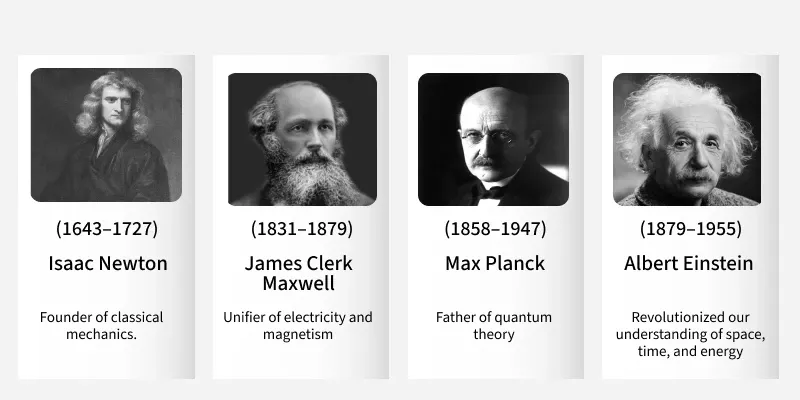
History of Physics
This ongoing evolution not only fuels technological innovation but also deepens our understanding of the very laws that govern everything around us.
- Early civilizations like the Greeks, Egyptians, and Indians laid the groundwork for physics with ideas about motion, matter, and the cosmos.
- Pioneers like **Galileo, Kepler, and Newton revolutionized the understanding of the natural world with laws of motion and gravity.
- **James Clerk Maxwell and others united electricity, magnetism, and light into a single theory of electromagnetism.
- **Albert Einstein’s theory of relativity and the development of quantum mechanics by scientists like **Niels Bohr and **Werner Heisenberg redefined the concept of space, time, and the behavior of particles.
- Quantum field theory and the standard model guide the search for a unified theory, exploring the smallest particles and the vastness of the universe.
- Physics is not just a collection of theories; it’s the lens through which we understand everything around us, from the microscopic to the cosmic.
Conceptual Question in Physics
What is the meaning of Physics?
The word "Physics" comes from the Greek word "physis," meaning "nature," and the suffix "-ics," meaning "the study of." So, physics is the study of nature and the laws that govern the physical world.
What is physics?
Physics is the scientific field that examines the nature of matter and the interactions of the fundamental components of the universe. It explores everything from the tiniest particles through quantum mechanics to the vastness of the universe through the framework of general relativity.
Why is physics based on SI units?
Physics is based on SI units for consistency, accuracy, and global standardization, ensuring clear communication and reliable data comparison across scientific disciplines.
Who is the father of physics?
Galileo Galilei is most commonly recognized as the "Father of Modern Physics." Some also credit Isaac Newton or Albert Einstein with this title, owing to their monumental contributions to the field.
What is the basic of physics?
Physics is a branch of natural science focused on studying matter and its movement through space and time, as well as related concepts like energy and force. Matter is typically defined as anything that possesses mass and volume.