PostgreSQL CASE (original) (raw)
Last Updated : 15 Jul, 2025
In **PostgreSQL, the **CASE expression allows you to perform conditional operations within your SQL queries. It evaluates a list of conditions and returns a result when the first condition is met. If no conditions are met, it returns the result specified in the ELSE clause.
Let us better understand the **CASE Statement in **PostgreSQL to better understand the concept.
**Syntax
1. General Form
The general form of the CASE expression evaluates conditions and returns the corresponding result:
**CASE **WHEN condition_1 **THEN result_1 **WHEN condition_2 **THEN result_2 [**WHEN ...] [**ELSE result_n] **END
2. Simple Form
The simple form of the CASE expression compares an expression to a set of values and returns the corresponding result:
**CASE expression **WHEN value_1 **THEN result_1 **WHEN value_2 **THEN result_2 [**WHEN ...] **ELSE result_n **END;
PostgreSQL CASE Statement Examples
For examples we will be using the sample database (ie, dvdrental).
**Example 1: General CASE Expression
Here we will work on the film table of the sample database. Suppose you want to assign a price segment to a film with the following logic:
- Mass if the rental rate is 0.99
- Economic if the rental rate is 1.99
- Luxury if the rental rate is 4.99
We will query for number of films in each segment using the below statement.
**Query:
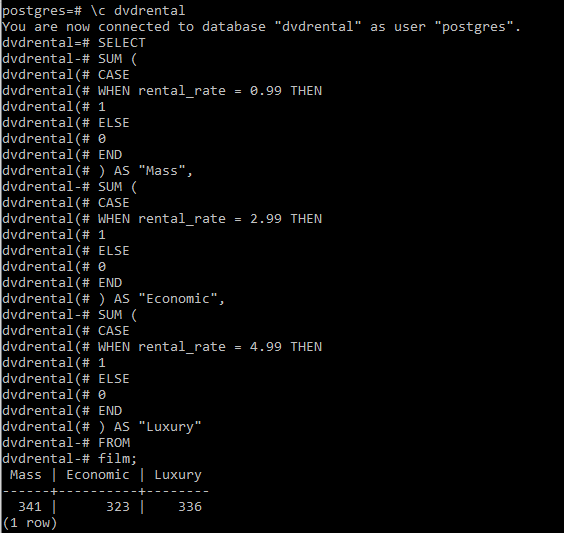
**SELECT **SUM ( **CASE **WHEN rental_rate = 0.99 THEN 1 **ELSE 0 **END ) **AS "Mass", **SUM ( **CASE **WHEN rental_rate = 2.99 **THEN 1 **ELSE 0 **END ) **AS "Economic", **SUM ( **CASE **WHEN rental_rate = 4.99 **THEN 1 **ELSE 0 **END ) **AS "Luxury" **FROM film;
**Output: This query will return the number of films in each price segment.
**Example 2: Simple CASE Expression
PostgreSQL provides another form of the CASE expression called simple form as follows.
**Query:
**CASE expression **WHEN value_1 **THEN result_1 **WHEN value_2 **THEN result_2 [**WHEN ...] **ELSE result_n **END;
We can rewrite the general CASE expression using the simple CASE as follows:
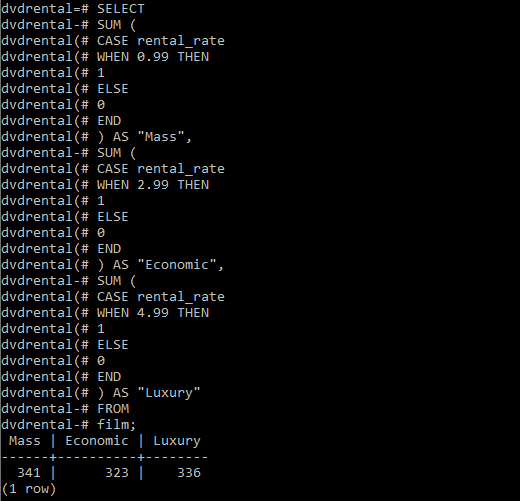
**SELECT **SUM ( **CASE rental_rate **WHEN 0.99 **THEN 1 **ELSE 0 **END ) **AS "Mass", **SUM ( **CASE rental_rate **WHEN 2.99 **THEN 1 **ELSE 0 **END ) **AS "Economic", **SUM ( **CASE rental_rate **WHEN 4.99 **THEN 1 **ELSE 0 **END ) **AS "Luxury" **FROM film;
**Output: The query returns the same result as the first CASE example.
Important Points About PostgreSQL CASE
- You can combine multiple conditions in the **CASE expression using logical operators (**AND, OR) for more complex logic.
- **CASE expressions can be nested within each other to handle more intricate conditions and outcomes.
- **PostgreSQL handles **NULLs uniquely, and you might need to use functions like **COALESCE or **IS NULL in your CASE expressions.
- **Complex CASE expressions can lead to performance issues, especially on large datasets. It's essential to test and optimize queries using **EXPLAIN and other performance tuning tools in PostgreSQL.