PostgreSQL CREATE TABLE (original) (raw)
Last Updated : 15 Jul, 2025
In PostgreSQL, the **CREATE TABLE statement is used to define a new table within a database. It allows us to specify the table's structure, including column names, data types, and constraints, ensuring data integrity and consistency. Understanding the **PostgreSQL table creation process is essential for managing structured data.
In this article, we will guide you through the **CREATE TABLE syntax in PostgreSQL, providing clear examples and explanations to help us efficiently create tables in our PostgreSQL database.
PostgreSQL CREATE TABLE
The CREATE TABLE statement in **PostgreSQL is fundamental for structuring data within a database. It allows us to define the table's name, **columns, their **data types, and any constraints that ensure the **integrity and **accuracy of our data. This process is key to building a well-organized and reliable database schema.
**Syntax
CREATE TABLE table_name (
column_name TYPE column_constraint,
table_constraint table_constraint
) INHERITS existing_table_name;
**Key Terms
- **Table Name: Define the name of the new table after the **
CREATE TABLE**clause. Use theTEMPORARYkeyword if you’re creating a temporary table. - **Column Definition: List the column name, data type, and constraint. Columns are separated by a comma (,). Column constraints include rules like
NOT NULL. - **Table-Level Constraints: Define rules for the data in the table at a broader level, such as **primary and **foreign keys.
- **Inheritance: Specify an existing table from which the new table inherits columns. This is a PostgreSQL extension to SQL, making table creation more flexible.
Optional Clauses:
- **IF NOT EXISTS: Ensures the table is created only if it doesn't already exist in the schema.
- **INHERITS: Allows a table to inherit columns from an existing table.
Examples of PostgreSQL CREATE TABLE
Now let us take a look at an example of the **CREATE TABLE in PostgreSQL to better understand the concept. These examples will demonstrate how to set up tables with various constraints and data types for optimal **data organization.
1. Creating the 'account' Table
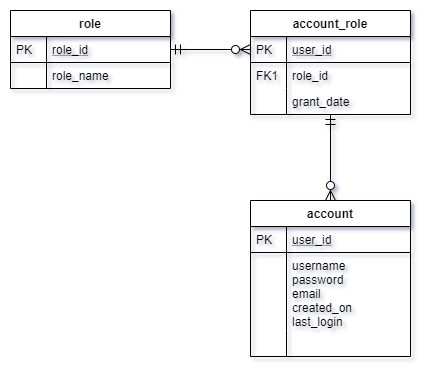
In this example, we create a new table named **account**to store user-related information. The table will have the following **columns and **constraints:
- ****'user_id'** – primary key
- ****'username'** – unique and not null
- ****'password'** – not null
- ****'email'** – unique and not null
- ****'created_on'** – not null
- ****'last_login'** – null
**Query:
CREATE TABLE account(
user_id serial PRIMARY KEY,
username VARCHAR (50) UNIQUE NOT NULL,
password VARCHAR (50) NOT NULL,
email VARCHAR (355) UNIQUE NOT NULL,
created_on TIMESTAMP NOT NULL,
last_login TIMESTAMP
);
2. Creating the 'role' Table
Now, let’s create the role table to manage different roles in the application. The role_id will be the **primary key, and role_name will be **unique.
**Query:
CREATE TABLE role(
role_id serial PRIMARY KEY,
role_name VARCHAR (255) UNIQUE NOT NULL
);
3. Creating the account_role Table
Finally, we create the 'account_role'table to manage the relationship between users and roles. This table has three columns: 'user_id', 'role_id', and 'grant_date'.
**Query:
CREATE TABLE account_role
(
user_id integer NOT NULL,
role_id integer NOT NULL,
grant_date timestamp without time zone,
PRIMARY KEY (user_id, role_id),
CONSTRAINT account_role_role_id_fkey FOREIGN KEY (role_id)
REFERENCES role (role_id) MATCH SIMPLE
ON UPDATE NO ACTION ON DELETE NO ACTION,
CONSTRAINT account_role_user_id_fkey FOREIGN KEY (user_id)
REFERENCES account (user_id) MATCH SIMPLE
ON UPDATE NO ACTION ON DELETE NO ACTION
);
PostgreSQL Table Constraints
PostgreSQL offers a variety of **constraints that apply rules on data integrity and help maintain the **accuracy and **consistency of the data. Below are some of the key table and column constraints in PostgreSQL:
1. Primary Key Constraint
The primary key for the account_roletable consists of two columns: 'user_id'and 'role_id'. The primary key constraint ensures that each combination of '**user_id'and 'role_id'**is unique.
PRIMARY KEY (user_id, role_id)
2. Foreign Key Constraints
Foreign key constraints ensure referential integrity between tables. The **foreign key constraint ensures that the values in a column match values in another table, creating a relationship between tables. This helps maintain **referential integrity across the database.
**Syntax
FOREIGN KEY (column) REFERENCES other_table (column)
ON DELETE CASCADE
ON UPDATE CASCADE
**Output
**3. Unique Constraint
The **unique constraint ensures that all values in a column are distinct across the table.
**Syntax
UNIQUE (column)
**4. Not Null Constraint
The **NOT NULL constraint ensures that a column cannot contain a NULL value, enforcing data integrity.
column_name datatype NOT NULL
Important Points About CREATE TABLE Clause in PostgreSQL
- The **
CREATE TABLE**clause is used to define a new table in the database. - Use the '**
INHERITS'**clause to create a table that inherits columns from an existing table. - Use the '
TEMPORARY' or '**TEMP'**keyword to create tables that exist only for the duration of the session. - Specify a tablespace for storing the table using the '
TABLESPACE'clause. - Use the
PARTITION BYclause to define table partitioning, which helps manage large tables. - Tables can be created within specific schemas for better organization.
Conclusion
In conclusion, **PostgreSQL table constraints play a crucial role in ensuring data integrity and consistency across our database. By understanding how to **create a table in PostgreSQL with appropriate constraints like **primary keys, **foreign keys, and **unique constraints, we can enforce rules that safeguard our data.
Additionally, applying **PostgreSQL column constraints such as **NOT NULL and **CHECK helps maintain the **quality and **accuracy of the stored information. Mastering these concepts ensures a strong and secure database design