PostgreSQL CURRENT_DATE Function (original) (raw)
Last Updated : 15 Jul, 2025
The **PostgreSQL CURRENT_DATE function is used to retrieve the current date. It’s a simple and effective way to ensure your database operations are using the correct date, particularly for applications that need timestamp records.
Let us better understand the **CURRENT_DATE Function in **PostgreSQL from this article.
**Syntax
CURRENT_DATE
**Return value:
The '**CURRENT_DATE' function returns a 'DATE' value that represents the current date.
PostgreSQL CURRENT_DATE Function Examples
Let us take a look at some of the examples of the CURRENT_DATE Function in PostgreSQL to better understand the concept.
**Example 1: Retrieve the Current Date
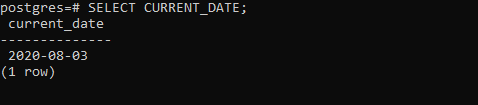
The following statement shows how to use the '**CURRENT_DATE' function to get the current date:
**SELECT CURRENT_DATE;
**Output:
**Example 2: Using CURRENT_DATE as a Default Value
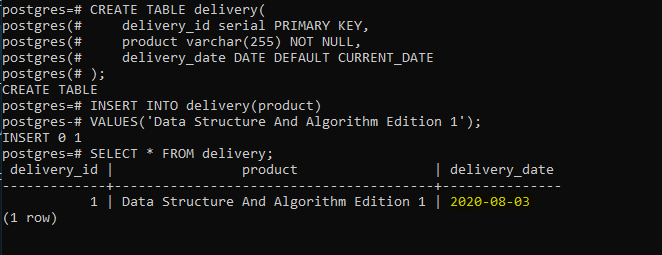
The **CURRENT_DATE function can be used as a default value of a column. So create a table named '****delivery'**for demonstration:
PostgreSQL `
CREATE TABLE delivery( delivery_id serial PRIMARY KEY, product varchar(255) NOT NULL, delivery_date DATE DEFAULT CURRENT_DATE ); INSERT INTO delivery(product) VALUES('Data Structure And Algorithm Edition 1'); SELECT * FROM delivery;
`
**Output:
Important Points About PostgreSQL CURRENT_DATE Function
- The**
CURRENT_DATE** function returns the date according to the server’s current time zone setting but does not include the time part.- **
CURRENT_DATE**is evaluated only once per transaction. This means that if you use **CURRENT_DATE**multiple times in a single transaction, it will return the same value every time, which can be beneficial for consistency.- Unlike**
NOW()** or **CURRENT_TIMESTAMP, which return the exact moment including time, **CURRENT_DATE**is immutable within the context of a single query,CURRENT_DATEcan be used as a default value in table definitions, ensuring new rows have the correct date without needing to be explicitly set during insertion.