Benefits Realization Management (original) (raw)
Last Updated : 10 Apr, 2026
Benefits Realization Management (BRM) is a structured and strategic approach that ensures the intended business benefits of a project or program are actually achieved, measured, and sustained over time. While traditional project management focuses on delivering outputs, BRM focuses on delivering real business value.
At its core, BRM helps organizations answer three critical questions:
- What benefits are we trying to achieve?
- How will success be measured?
- Who is accountable for realizing these benefits?
Output vs Outcome vs Benefit
Understanding the distinction between outputs, outcomes, and benefits is essential for effective BRM:
| Term | Definition | Example (Mobile Banking App Project) |
|---|---|---|
| **Output | Tangible deliverables produced | AI-enabled mobile banking app |
| **Outcome | Immediate effects of outputs | Increased user engagement |
| **Benefit | Measurable business value | 18% higher retention, $2.4M revenue increase |
Benefits Realization Lifecycle
A robust BRM framework follows a structured lifecycle to ensure benefits are planned, tracked, and sustained:
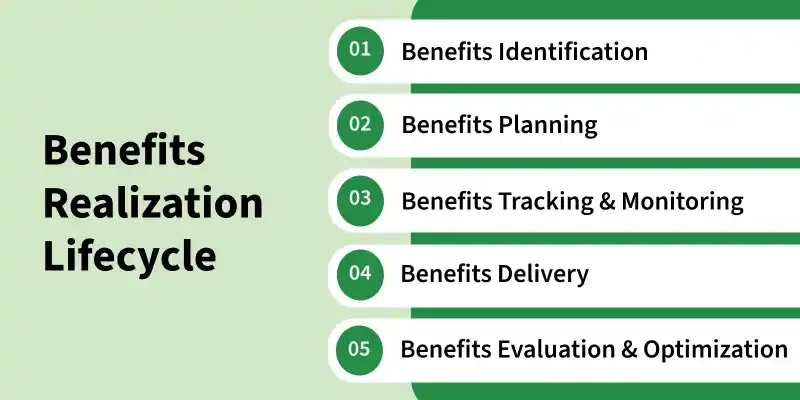
1. Benefits Identification
Conduct stakeholder workshops and strategic analysis. Identify and categorize benefits:
- **Financial: Revenue growth, cost savings
- **Customer: Satisfaction, loyalty, experience
- **Operational: Efficiency, productivity
- **Strategic: Market share, innovation
- **Social/Environmental: ESG and sustainability goals
2. Benefits Planning
- Define SMART benefit statements
- Establish baseline metrics and target KPIs
- Create a Benefits Realization Plan (timeline, dependencies, ownership)
- Assign Benefits Owners (typically business leaders)
3. Benefits Tracking & Monitoring
Integrate benefits tracking into project governance. Use dashboards and periodic reviews
**Track:
- Leading indicators (early signals)
- Lagging indicators (final outcomes)
4. Benefits Delivery
- Ensure smooth transition from project to operations
- Activate benefit measurement mechanisms post-implementation
- Align operational teams with benefit goals
5. Benefits Evaluation & Optimization
- Conduct Post-Implementation Reviews (PIRs) (3, 6, 12 months)
- Compare actual vs planned benefits
- Identify improvement opportunities
- Capture lessons learned for future initiatives
Effective BRM relies on a combination of strategic and analytical tools:
- **Benefits Map: Visual linkage between outputs, outcomes, and strategic goals
- **Benefits Register: Central repository of benefits, KPIs, owners, and status
- **Benefits Dependency Network: Shows interdependencies between deliverables and benefits
- **Balanced Scorecard: Multi-dimensional performance tracking
- **Benefits Heat Map: Visual progress tracking
- **Post-Implementation Review (PIR): Structured evaluation after delivery
Role of the Project Manager in BRM
Although Benefits Owners are typically business stakeholders, the Project Manager plays a critical enabling role:
- Facilitate benefits identification during project initiation
- Ensure benefits are clearly defined in the Business Case and Charter
- Integrate benefit tracking into reporting frameworks
- Identify and mitigate risks impacting benefits
- Support transition from project delivery to operations
- Promote a value-driven mindset within the team
Common Challenges and Solutions
| Challenge | Solution |
|---|---|
| Vague or unclear benefits | Use SMART criteria and stakeholder workshops |
| No defined ownership | Assign Benefits Owners early |
| Focus ends at project closure | Extend tracking post-project (6–12 months) |
| Lack of baseline data | Establish baselines during planning |
| Benefits decline after delivery | Ensure sustained ownership and accountability |
| Overestimated benefits | Use conservative estimates and sensitivity analysis |
Best Practices for Excellence
To maximize value from BRM, organizations should adopt these best practices:
- Embed BRM into project governance frameworks from Day 1
- Align benefits with organizational strategy and OKRs
- Use AI-powered analytics for predictive benefit tracking
- Conduct regular benefits health checks at phase gates
- Integrate BRM with Enterprise Portfolio Management (EPM)
- Establish a Benefits Realization Community of Practice
- Celebrate benefit milestones, not just project completion