Project Management Knowledge Areas (original) (raw)
Last Updated : 28 Mar, 2026
Project Management Knowledge Areas are distinct categories that group related processes and activities required to manage a project successfully. Each knowledge area focuses on a specific aspect such as scope, time, cost, quality, or communication.
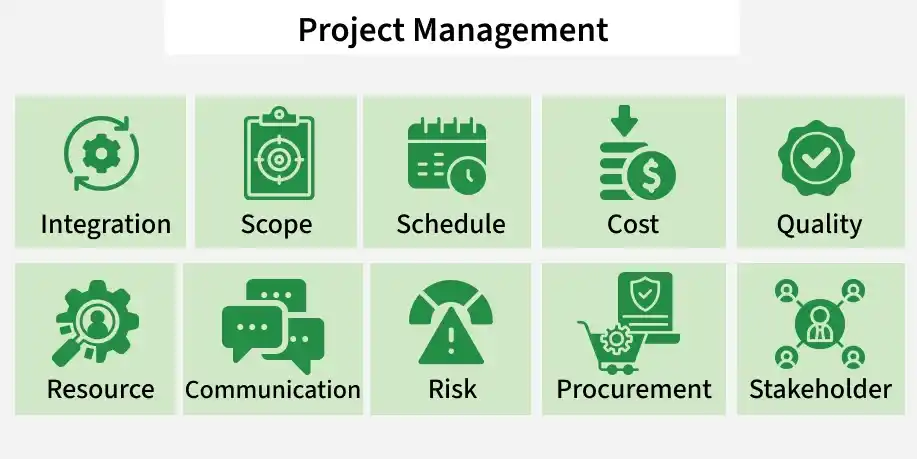
Project Management Knowledge Areas
Together, they ensure that all dimensions of a project are properly addressed and aligned with organizational goals.
The 10 Project Management Knowledge Areas
Modern project management frameworks define 10 key knowledge areas that guide project execution from start to finish.
1. Project Integration Management
- Project Integration Management ensures that all parts of the project work together seamlessly. It involves coordinating tasks, managing dependencies, and aligning project objectives with business goals.
**Focus: Overall coordination and decision-making
2. Project Scope Management
- Scope Management defines what is included in the project and what is not. It ensures that all required work is identified and prevents uncontrolled changes (scope creep).
**Focus: Defining and controlling project boundaries
3. Project Schedule (Time) Management
- Schedule Management involves planning, sequencing, and controlling project timelines. It ensures that tasks are completed within the defined schedule.
**Focus: Timely completion of project activities
4. Project Cost Management
- Cost Management deals with estimating, budgeting, and controlling project expenses. It ensures that the project is completed within the approved budget.
**Focus: Financial planning and control
5. Project Quality Management
- Quality Management ensures that the project deliverables meet required standards and stakeholder expectations. It includes quality planning, assurance, and control.
**Focus: Delivering consistent and high-quality outcomes
6. Project Resource Management
- Resource Management focuses on managing team members, materials, and equipment. It ensures optimal utilization of resources for efficient execution.
**Focus: People and resource allocation
7. Project Communication Management
- Communication Management ensures that the right information reaches the right people at the right time. It includes planning, managing, and monitoring communication.
**Focus: Information flow and stakeholder alignment
8. Project Risk Management
- Risk Management involves identifying, analyzing, and responding to potential risks. It helps minimize uncertainties and improves project stability.
**Focus: Managing uncertainty and threats
9. Project Procurement Management
- Procurement Management deals with acquiring goods and services from external vendors. It includes contract management and supplier coordination.
**Focus: External sourcing and vendor management
10. Project Stakeholder Management
- Stakeholder Management focuses on identifying stakeholders and managing their expectations. It ensures engagement, satisfaction, and support throughout the project.
**Focus: Relationship and expectation management
Why Knowledge Areas Matter
Understanding these knowledge areas is essential because they ensure that no critical aspect of a project is overlooked.
- **Structured Project Execution: They provide a clear framework to manage different components systematically, reducing confusion and improving efficiency.
- **Better Decision-Making: By organizing project activities into defined areas, managers can make informed decisions based on specific data and insights.
- **Improved Control and Monitoring: Each knowledge area includes processes that help track progress, identify issues, and take corrective actions.
- **Alignment with Organizational Goals: They ensure that project activities are aligned with broader business objectives, leading to meaningful outcomes.
How Knowledge Areas Work Together
Project Management Knowledge Areas are not independent, they are highly interconnected.
For example:
- A change in scope may impact schedule and cost
- Poor communication can increase risks
- Inefficient resource management can affect quality
This interdependence makes integration and coordination critical for project success.