What is Project Plan (original) (raw)
Last Updated : 23 Mar, 2026
A project plan is a structured roadmap that defines how a project will be executed, monitored, and completed successfully. It translates objectives into actionable steps, timelines, resources, and controls.
Core Project Estimations
Project planning begins with estimating the key parameters that determine feasibility and success.
**1. Project Size: Defines the scale and complexity of the project. It helps estimate the technical difficulty and development workload.
**2. Project Cost: Determines the total financial investment required. Includes resources, tools, infrastructure, and operational expenses.
**3. Project Duration: Estimates the total time required to complete the project. Helps set realistic schedules and delivery timelines.
**4. Project Effort: Measures the total work required (often in person-hours or person-months). Helps determine staffing and workload distribution.
The accuracy of all planning activities depends heavily on the reliability of these estimations.
Key Project Planning Activities
Once estimates are defined, detailed planning begins.
1. Resource Planning
Identifying and allocating required resources:
- Human resources
- Tools and technology
- Infrastructure and materials
2. Workforce Organization & Staffing
- Team structure design
- Role definitions
- Staffing plans and responsibility mapping
3. Risk Management Planning
- Risk identification
- Risk analysis
- Mitigation and contingency planning
4. Supporting Management Plans
Additional structured plans ensure operational control:
- Quality Assurance Plan
- Configuration Management Plan
- Communication Plan
- Change Management Plan
Precedence in Project Planning Activities
Project planning follows a logical sequence because each step depends on earlier estimates.
**Typical Planning Order:
- **Size Estimation: Determines project scale
- **Effort Estimation: Calculates workload
- **Cost Estimation: Derives budget requirements
- **Resource Planning: Allocates people and assets
- **Schedule Planning: Establishes timelines
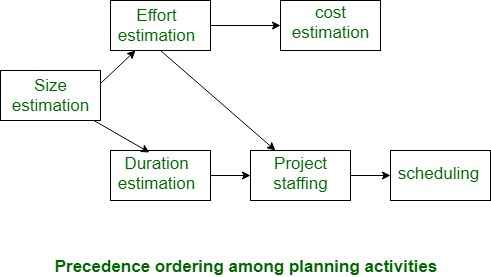
Size estimation is the foundation, all other planning elements depend on it.
Sliding Window Planning (Rolling Wave Planning)
Project planning requires precision. Unrealistic timelines or resource commitments often lead to:
- Schedule delays
- Budget overruns
- Client dissatisfaction
- Low team morale
- Project failure
However, creating perfectly accurate plans at the start is difficult, especially for large and complex projects.
The Challenge
At project initiation:
- Requirements may be unclear
- Scope may evolve
- Team composition may change
- External factors may shift
The Solution: Sliding Window Planning
Sliding Window Planning (also called Rolling Wave Planning) is a phased planning approach. Instead of planning everything in full detail upfront:
- The project is planned in stages
- Near-term work is planned in detail
- Future work is planned at a high level
- Plans are refined as more information becomes available
How It Works
- Start with an initial high-level plan
- Execute the first phase
- Gather new insights and updated information
- Plan the next phase in greater detail
- Repeat until project completion
Benefits
- Reduces early-stage uncertainty
- Prevents unrealistic commitments
- Improves estimation accuracy
- Enables adaptive decision-making
- Increases stakeholder confidence
As the project progresses, planning becomes more accurate and reliable.