Project vs Operations (original) (raw)
Last Updated : 28 Mar, 2026
Operations are the ongoing, repetitive activities that keep an organization running day after day. They produce the same product or service repeatedly to sustain the business.
Think of operations as the “engine” of the company:
- Manufacturing cars on an assembly line
- Processing customer orders in an e-commerce warehouse
- Handling daily patient care in a hospital
- Running payroll, IT support tickets, or monthly financial reporting
Operations focus on efficiency, consistency, and continuous optimization rather than creating something new.
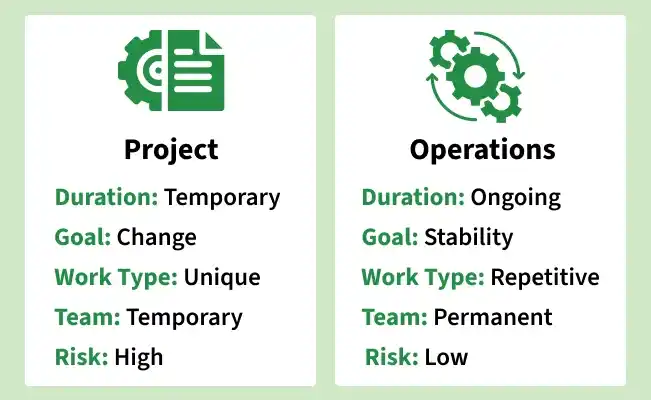
Projects vs Operations
| Aspect | Project | Operations |
|---|---|---|
| Duration | Temporary (defined start & end) | Ongoing (no fixed end) |
| Output | Unique product, service, or result | Repetitive, standardized output |
| Objective | Achieve a specific goal or change | Maintain and improve processes |
| Scope | Defined and controlled | Stable and continuous |
| Resources | Temporary team | Permanent teams |
| Risk | Higher (uncertainty) | Lower (predictable) |
| Success Criteria | Time, cost, scope, quality, value | Efficiency, consistency, cost control |
| Management Style | Project Management | Operations Management |
- If it creates something new and ends: **Project
- If it repeats and continues: **Operations
Real-World Examples
To make the difference clearer, let’s look at practical scenarios:
**Project Example:
- A retail company decides to open 50 new stores across India.
This is a project because it has a defined timeline, budget, and a unique outcome. Once completed, the project ends.
**Operations Example:
- The same company now runs those 50 stores every day.
This is operations: daily sales, inventory replenishment, staff scheduling, customer service. Repetitive, ongoing, no end date.
**Hybrid Situation:
- The company later decides to upgrade the point-of-sale system in all 50 stores.
Even though it’s inside operations, this upgrade is treated as a project because it’s temporary, has a defined scope, and creates a new capability.
Why the Distinction Matters
- **Right Tools & Techniques: Projects need Gantt charts, risk registers, change control, and phase gates. Operations need process mapping, Lean/Six Sigma, KPIs, and capacity planning. Using the wrong toolkit creates unnecessary complexity or chaos.
- **Resource Allocation: Project teams are assembled temporarily and disbanded after closure. Operational teams are permanent. Mixing them leads to burnout or skill gaps.
- **Risk & Change Management: Projects expect and manage change (scope creep, risks). Operations resist uncontrolled change to maintain stability.
- **Performance Measurement: Projects are judged by delivering unique value on time/budget. Operations are judged by consistent output and incremental improvements.
- **Organizational Impact: Successful projects drive transformation and growth. Efficient operations drive stability and profitability.
Common Mistakes to Avoid
**1. Treating One-Time Initiatives as Routine Work
- Organizations sometimes handle unique initiatives as regular operational tasks. This leads to poor planning, lack of clear timelines, and missed objectives because the work is not structured as a project.
**2. Managing Daily Operations Like a Project
- Applying heavy project management processes to routine activities creates unnecessary complexity. It slows down execution and reduces efficiency in tasks that should be simple and repeatable.
**3. Keeping Project Teams Active After Completion
- Failing to disband a project team after completion results in wasted resources and increased costs. Teams should be released or reassigned once the project objectives are achieved.
**4. Ignoring the Need for Change Management in Projects
- Projects inherently involve change, but treating them like stable operations can lead to resistance and confusion. Without proper change management, projects often face delays and stakeholder dissatisfaction.
**5. Mixing Project and Operational Responsibilities
- When roles and responsibilities are not clearly defined, teams may struggle to balance project work with daily operations. This leads to burnout, reduced productivity, and unclear accountability.
Quick Decision Checklist
Ask these questions to classify your work:
- Does it have a fixed end date?
- Is the outcome unique?
- Does it create change rather than maintain it?
- Is it tied to a specific goal, scope, and budget?
- Will the team disband after completion?
If most answers are Yes: It’s a Project
If most answers are No: It’s Operations