Strategic Project Management (original) (raw)
Last Updated : 10 Apr, 2026
Strategic Project Management is the disciplined process of selecting, prioritizing, executing, and governing projects in direct alignment with an organization’s long-term vision, mission, and strategic objectives.
Strategic Project Management focuses on:
- Aligning projects with organizational strategy
- Maximizing business value and ROI
- Enabling informed, long-term decision-making
- Ensuring continuous benefits realization
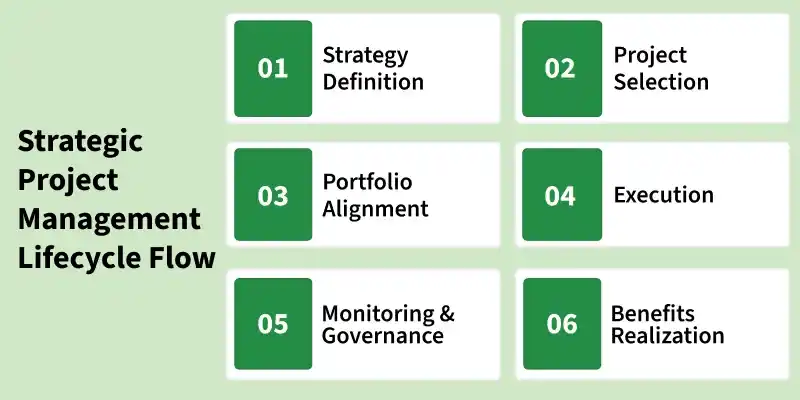
It shifts the focus from “doing projects right” (tactical efficiency) to “doing the right projects” (strategic effectiveness) while ensuring they deliver measurable business value.
Strategic vs Tactical Project Management
| **Aspect | **Tactical Project Management | **Strategic Project Management |
|---|---|---|
| **Focus | Execution and delivery | Alignment with organizational strategy |
| **Success Metrics | Time, cost, scope | Business value, ROI, competitive advantage |
| **Decision-Making | Short-term, operational | Long-term, strategic |
| **Project Selection | Based on urgency or requests | Based on strategic fit and value |
| **Stakeholder Focus | Project team and sponsor | Executive leadership and enterprise |
| **Risk Management | Project-level risks | Enterprise-level risks and opportunities |
| **Benefits Realization | Ends at project closure | Continues post-project for value tracking |
Core Principles of Strategic Project Management
Strategic project management is guided by a set of foundational principles:
- **Strategic Alignment: Every project must clearly contribute to organizational goals such as growth, innovation, digital transformation, or sustainability.
- **Value-Driven Decision Making: Projects are evaluated based on expected business value, not just cost, timeline, or effort.
- **Benefits Realization Management: Benefits are identified early, tracked throughout execution, and measured after project completion.
- **Portfolio Integration: Projects are managed as part of a portfolio, ensuring optimal resource allocation and prioritization.
- **Agility and Adaptability: Organizations must be able to pivot projects when strategic priorities change.
- **Stakeholder Value Focus: Balance the needs of customers, employees, investors, and society.
- **Governance and Oversight: Strong leadership involvement, structured reviews, and decision checkpoints ensure alignment and accountability.
How to Align Projects with Organizational Strategy
Achieving alignment requires a structured and systematic approach:
- **Understand Corporate Strategy: Review vision, mission, strategic pillars, and OKRs
- **Conduct Strategic Mapping: Use tools like strategy maps or balanced scorecards
- **Apply Project Selection Models: Use weighted scoring, cost-benefit analysis, and strategic fit evaluation
- **Define Clear Benefits: Identify financial, operational, customer, and innovation value
- **Assign Benefits Ownership: Ensure accountability for tracking and realizing benefits
- **Monitor Strategic Contribution: Use dashboards linked to enterprise KPIs
- **Review Alignment Regularly: Validate at each project phase or milestone
Benefits of Strategic Project Management
Organizations that adopt this approach gain significant advantages:
- Higher return on investment and optimized resource utilization
- Improved competitive positioning in the market
- Stronger executive support and sponsorship
- Reduced risk of irrelevant or “zombie” projects
- Increased organizational agility and resilience
- Better employee engagement through meaningful work
- Enhanced long-term value and benefits realization
Role of the Project Manager in Strategic Project Management
Modern project managers are no longer just executors, they are strategic partners.
**Key responsibilities include:
- Understanding and communicating the strategic context of projects
- Ensuring alignment between scope and business objectives
- Driving benefits realization planning and tracking
- Providing insights and recommendations to stakeholders
- Acting as a bridge between execution teams and executive leadership
Common Challenges and How to Overcome Them
| Challenge | Solution |
|---|---|
| Poor strategic alignment | Mandate strategic fit scoring in project intake process |
| Shifting organizational priorities | Build flexibility into governance and conduct regular alignment reviews |
| Resistance from tactical stakeholders | Educate teams on “why” the project matters strategically |
| Difficulty measuring intangible benefits | Use balanced scorecards and proxy metrics |
| Lack of executive sponsorship | Engage C-suite early and demonstrate value contribution |
**Best Practices for Strategic Project Management
To ensure long-term success, organizations should adopt the following practices:
- Integrate AI-driven tools for portfolio and strategy alignment
- Embed sustainability and ESG criteria into project evaluation
- Implement OKRs and structured benefits realization plans
- Conduct regular strategy–project alignment workshops
- Foster a culture where project managers think beyond execution