Team Building for Project Success (original) (raw)
Last Updated : 4 Apr, 2026
Team building is the process of creating a cohesive, collaborative, and high-performing group of individuals working toward a common project goal. It focuses on strengthening relationships, improving communication, and fostering trust to enhance overall team effectiveness.
At its core, team building helps to:
- Improve collaboration and communication across team members
- Build trust and psychological safety within the team
- Enhance motivation, engagement, and accountability
- Enable faster problem-solving and decision-making
- Drive consistent and successful project outcomes
**Importance of Team Building in Project Management
Projects often involve cross-functional teams with diverse skills, backgrounds, and working styles. Without deliberate team-building efforts, teams can struggle with coordination and performance.
**Common challenges without team building:
- Miscommunication and frequent conflicts
- Low trust and reduced collaboration
- Decreased productivity and engagement
- Increased burnout and attrition
- Compromised quality and delayed deliverables
**Benefits of effective team building:
- Higher motivation and engagement
- Stronger collaboration and knowledge sharing
- Faster problem-solving and decision-making
- Improved adaptability during challenges
- Enhanced stakeholder satisfaction
**Stages of Team Development (Tuckman Model)
Understanding team dynamics is essential for effective leadership. The **Tuckman Model outlines five stages that most teams go through:
**1. Forming
- Team members are cautious, roles are unclear, and dependence on leadership is high.
- **Manager’s Focus: Set clear goals, define roles, and establish structure.
**2. Storming
- Conflicts arise due to differences in opinions, personalities, and working styles.
- **Manager’s Focus: Facilitate communication, resolve conflicts, and align the team.
**3. Norming
- Trust builds, collaboration improves, and roles become clearer.
- **Manager’s Focus: Encourage teamwork and reinforce positive behaviors.
**4. Performing
- The team operates efficiently with high autonomy and st rong alignment.
- **Manager’s Focus: Delegate responsibilities and remove obstacles.
**5. Adjourning
- The project concludes, and the team disbands.
- **Manager’s Focus: Celebrate achievements and capture lessons learned.
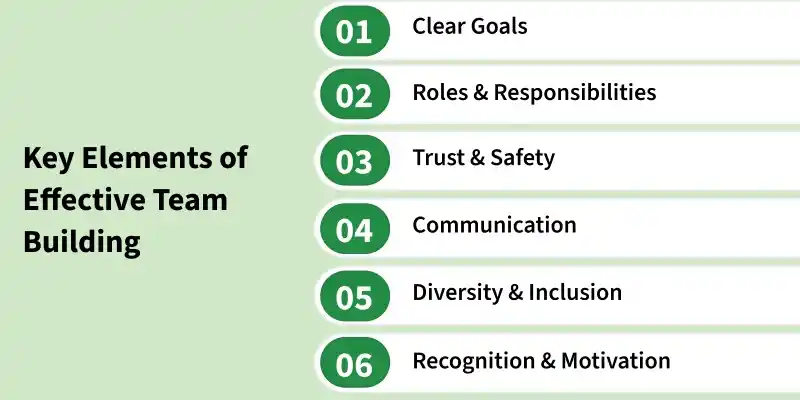
**Key Elements of Effective Team Building
Building a high-performing team requires more than just assembling skilled individuals, it involves creating a structured environment where clarity, trust, and collaboration can thrive. The following elements form the foundation of effective team building:
**Clear Goals and Shared Vision
- Align the team around the project’s purpose and success criteria
- Regularly connect daily tasks to the bigger picture
**Defined Roles and Responsibilities
- Use RACI Matrix to eliminate confusion
- Ensure every member understands their contribution and accountability
**Building Trust and Psychological Safety
- Encourage open dialogue without fear of judgment
- Lead by example with transparency and vulnerability
**Effective Communication
- Establish communication norms early
- Use a mix of synchronous and asynchronous channels
**Diversity and Inclusion
- Leverage different perspectives, skills, and backgrounds
- Create an inclusive environment where everyone feels valued
**Recognition and Motivation
- Celebrate both individual and team achievements
- Use intrinsic (purpose, autonomy) and extrinsic (rewards) motivators
**Practical Team Building Activities for Project Teams
Effective team building is not limited to strategy, it must be reinforced through consistent activities that strengthen relationships, improve communication, and build engagement. The following activities can be tailored based on team structure and work environment:
**For Remote/Hybrid Teams
- Virtual icebreakers and team-building games
- “Two Truths and a Lie” or “Show and Tell” sessions
- Collaborative online workshops using Miro or Mural
- Monthly virtual team lunches or coffee chats
**For In-Person or Hybrid Teams
- Team offsites and workshops
- Problem-solving escape rooms or outdoor activities
- Cross-functional knowledge sharing sessions
**Quick Daily/Weekly Activities
- Daily stand-ups with a personal check-in question
- Weekly “Wins and Learnings” round
- Peer recognition shout-outs in team channels
**Role of the Project Manager in Team Building
The project manager plays a central role in shaping team culture and performance.
**Key responsibilities include:
- Setting a positive and inclusive team environment
- Identifying and resolving conflicts early
- Coaching and mentoring team members
- Removing blockers and enabling productivity
- Balancing task execution with team well-being
- Adapting leadership style as the team evolves
Common Team Building Challenges and Solutions
| **Challenge | **Solution |
|---|---|
| Remote team disconnection | Regular video calls and informal interactions |
| Personality conflicts | Structured conflict resolution and shared goals |
| Low motivation | Connect work to purpose and recognize contributions |
| Skill gaps | Provide training and mentorship opportunities |
| High turnover | Foster belonging and offer growth opportunities |
**Measuring Team Building Effectiveness
To ensure team-building efforts are successful, track key performance indicators:
- Team engagement and satisfaction levels
- Quality of collaboration and communication
- Productivity metrics (e.g., delivery speed, efficiency)
- Retention rates during the project lifecycle
- Stakeholder feedback
- Participation in retrospectives and feedback sessions
**Best Practices for Sustained Team Success
- Invest early during the team formation stage
- Treat team building as an ongoing process
- Balance structured work with informal interactions
- Lead with empathy and emotional intelligence
- Document and revisit team norms regularly
- Celebrate milestones and achievements consistently