What is Project Management System? (original) (raw)
Last Updated : 23 Jul, 2025
A project management system is a software or application used to efficiently plan, carry out, oversee, and manage projects. Task scheduling, resource allocation, budget management, collaboration tools, and reporting capabilities are some of the elements that are usually included in order to optimize project processes and boost overall project success and efficiency.
In this, we will cover the overview of the project management system, its functionalities, and components, and will also cover the functionalities of project work system design. Let's discuss it one by one.
Table of Content
- What is Project Management System?
- What are Project Management Systems Used for?
- Essential features of Project Management System Software
- How to Determine Which Project Management System is right for you?
- Types of Project Management System
- Components of the Project Management System
- Project Work System Design
- Compare Top Project Management Systems
- For Managing your projects effectively
- Uses of Project Management System
- Conclusion: Project Management System
- Project Management System - FAQs
**What is Project Management System?
The Project Management System is defined as the system that states a project work system and project control system. Project management may now be defined because of the process of achieving project objectives through the normal organizational structure and over the specialties of the individuals concerned. Project management deals with a specific end objective to get the result, or it can be goal-oriented. To complete a task, a project manager must have the following key parameters. These are the following component given below which helps in the overall decision-making.
- Set Objectives
- Established Plans
- Organize resources
- Staff
- Set up controls
- Issue directives
- Motive personnel
- Apply innovation for alternative actions
- Remain flexible
What are Project Management Systems Used for?
A project management system is a tool that which used and supported by technology, that helps in operations. A project management tool can focus on one area of business, marketing, and so on from production to inventory and operations to IT. You may visualize like a Hub.
- **Planning and Scheduling: Task definition, resource allocation, deadline setting, and plan creation are all made easier with the use of project management systems. To create project timetables and schedules, they offer tools for making Gantt charts, work breakdown structures (WBS), and other planning documents.
- **Task Management: With the help of these tools, project managers may set goals for their teams, keep tabs on their progress, and keep an eye on due dates. To-do lists, job prioritization, and reminders to keep team members on track are common task management tools.
- **Resource Management: Materials, equipment, and human resources can all be managed with the use of project management systems. To guarantee that project requirements are effectively satisfied, they offer resources for allocating resources, monitoring resource usage, and optimizing resource utilization.
- **Cost management and budgeting: These tools support the tracking, management, and budgeting of project expenses. To make sure that projects remain within financial limitations, they offer tools for making budgets, keeping track of spending, and producing cost reports.
Essential features of Project Management System Software
Project Management System Software (PMSS) is designed to streamline and facilitate the management of projects from initiation to completion. Here are some essential features typically found in PMSS:
- **Task Management: Allows users to create, assign, prioritize, and track tasks within projects. This feature often includes the ability to set deadlines, dependencies, and subtasks.
- **Gantt Charts: Provides a visual representation of project timelines, tasks, and dependencies. Gantt charts help in scheduling, resource allocation, and identifying critical paths.
- **Resource Management: Enables allocation and tracking of resources such as human resources, equipment, and materials. It helps in optimizing resource utilization and avoiding overallocation.
- **Collaboration Tools: Includes features like real-time messaging, file sharing, and commenting to facilitate communication and collaboration among team members. Integration with communication platforms like Slack or Microsoft Teams is common.
- **Document Management: Allows for centralized storage, organization, and version control of project-related documents, such as requirements, designs, and reports.
How to Determine Which Project Management System is right for you?
To determine the right project management system, Evaluate the needs of your team, the complexity of the project, the required budget, and the scalability of the system to choose the best project management solution. When choosing a system, try running trials or getting advice from similar organisations. Examine the features, user interface, integrations, and customer service of the systems that are available.
**Types of Project Management System
There are the following types of Project Management System:
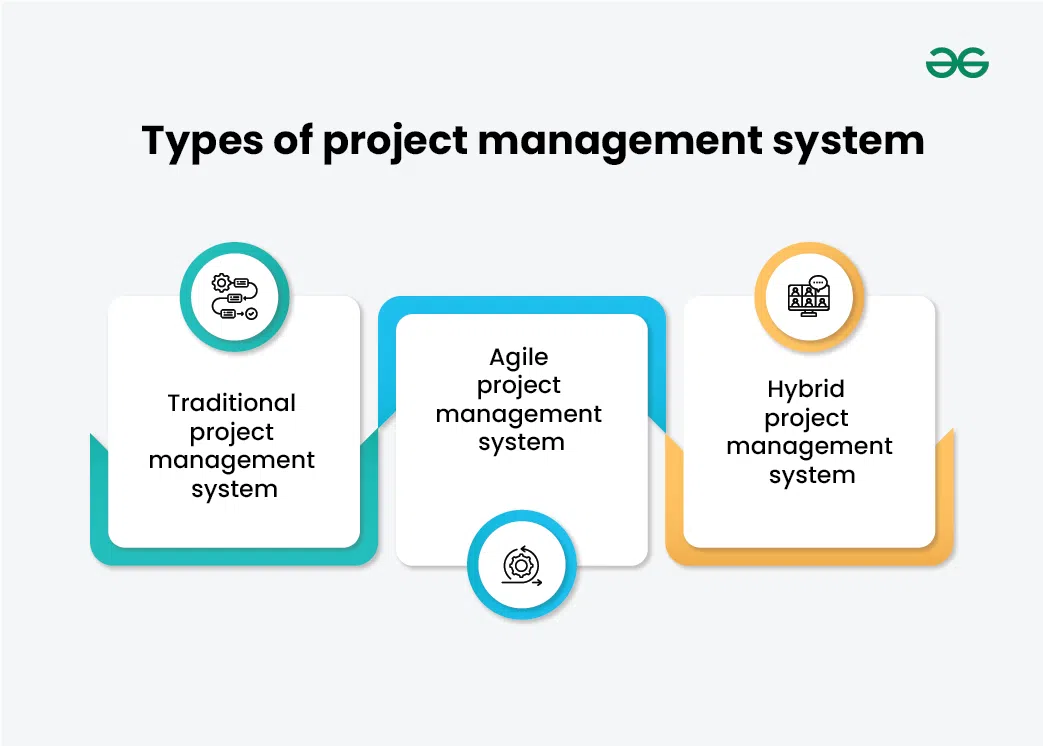
Types of Project Management System
**Traditional Project Management System
The Project Management System is defined as the system that states a project work system and project control system. Project management may now be defined because of the process of achieving project objectives through the normal organizational structure and over the specialties of the individuals concerned. Project management deals with a specific end objective to get the result, or it can be goal-oriented. To complete a task, a project manager must have the following key parameters
**Agile Project Management System
Agile Project Management is a revolutionary approach, that is aimed at continuously delivering solutions for the changing requirements of the project in a spiral way.
- It was established by the Agile Manifesto’s principles, calling for iterative and incremental development of the project into manageable sprints that create potentially shippable increments.
- Agile Project Management is the concept of being agile and agile method in the new challenges of advanced projects, concerning its community-oriented spirit, planning flexibility, and ongoing progress.
**Hybrid Project Management System
Hybrid Project Management involves the flexible application of a mixture of elements from various methodologies in project management, often combining traditional and agile practices. This makes it possible to customize the project management process for the specific needs of a particular project, exploiting strengths from varied approaches.
Characteristics of Hybrid Project Management:
- **Synthesis of Structure with Flexibility: Traditional approaches offer structure in terms of planning and execution while agile methodologies encourage flexibility by focusing on changing requirements. Hybrid Project Management combines these two to ensure that there is a clear direction while still being able to make changes as they are required.
- **Tailored Approach: There is no one-size-fits-all solution. It allows you to select the techniques that best fit your project’s unique requirements or goals.
- **Adaptability to Change: For instance, Hybrid Project Management recognizes that projects can meet unforeseen circumstances. This enables course corrections and variations in project scope or deliverables thus incorporating elements of agility.
Components of the Project Management System
Here, we will see the project management system which includes the following components as follows. These two components can very well be explained through the following figure as follows.

Project Management Components
**Project Work System:
In this, you will see the overview of the project work system. It is a system-modeling, through which a set of interrelated elements are created so that they can regulate and control themselves without external intervention.
**Example :
Contract systems, design systems, and project organization start with the development of a work breakdown structure. There is a technique that breaks down work into its components and simultaneously establishes connections between components online. To co-ordinate all subsystems and to ensure project management a project control system is also required.
**Project Control System:
In this, you will see the overview of the Project Control System. It is an analytical procedure and data-collecting system that is used to acknowledge and constructively define the time, cost, and outcome of the project which also helps in decision-making. The project control system also helps to face external and internal disorders.
**Project Work System Design
In this, you will see the functionalities while designing the project work system. Let's discuss it in detail.
- It allows cross-functional teams to redesign the work process in an environment characterized by both new and entrenched legacy information systems, multiple stakeholders, and a fast-changing technology regulatory and competitive environment. Early experience with design and tools to support such activities, while promising, raised several issues.
- In the course of analyzing a problem domain, design teams and their facilitators would generate enormous amounts of information, usually in the form of marked-up eased sheets, containing sessions, brainstorming activities, planning, goal-oriented activities, etc.
- In many cases, neither the paper-based nor computer methods recorded the rationale behind design or modeling decisions so only the memories of model builders or design team members were resources for the later call of the rationale.
- This proved to be a critical limitation. As the work redesigns were presented to multiple stakeholders at different points of the project life cycle, project team members were hard-pressed to recall and articulate all the dependencies and rationale for the design.
Compare Top Project Management Systems
Monday.com
Moday is a popular and cost Effective project management tools which provide the very useful benifits and supportive environments. The company benifits include the following include:
- 30+ column types
- 200+ templates
- 40+ additions per team or business
- 24/7 alltime supports
Teamwork
Teamwork is a another tool that provide measure uses likely to user satisfactions and the features include:
- Milestone projection and management
- Gantt charts
- Ease of reporting
- Proper Time tracking and timesheets
- Assemblance of Tasks with sub-tasks
- provide the different user permissions
Trello
Trello is providing the cleanest interface for the user that cleaness is attracting and easily operate the software development process. The main features of the Trello is:
- Tasks managed by prioritization
- Easy file and image sharing with clean UI
- Collaboration and communication features
- Unlimited task creation easily
- Clear kanban view
Basecamp
Basecamp is a polpular project management tools for multiple reasons including the similarity between like the social media interface with valuable features is:
- Application-based collaboration
- Message boards
- Inbuild-app collaboration functions
- Desktop notifications management
- Project performance
- Separate presentation for clients
Asana
Asana Gols is to be the provide the collaboration, storage and many more tracking the project the use of email client you will be able to use execute the follawing while using the Asana:
- Quick views of project dashboards
- Syncing with cross-functional timelines and roadmaps
- Free for up to 15 members
- Easy-to-track milestone
For Managing your projects effectively
- FigJam
- Jira
- Zoho Projects
**Uses of Project Management System
- The main function of project management states the functions a project manager is going to be required to perform.
- It has been recognized that teamwork is the key point for the successful implementation of a project.
- Active participation by each member of the project team is essential for the success of the project.
- To enable this, the development of systems and procedures is necessary.
- A project system is the total picture of various elements involved in the implementation of a project and is aimed at coordinating the role and work of the various elements concerned in the project****.**
- Project Management Tutorial
- Software Project Management (SPM) - Software Engineering
- Phases of Project Management Process
- What is Project Management?
Conclusion: Project Management System
The foundation for efficient project planning, execution, and control is a project management system. It offers a centralized platform with functions and capabilities to improve decision-making, promote collaboration, and quicken project operations. Organizations may increase project success rates, optimize project outcomes, and accomplish their strategic goals more quickly and effectively by utilizing a project management system.