Building a basic HTTP Server from scratch in Python (original) (raw)
Last Updated : 15 Mar, 2021
In this article, we are going to learn how to set up a simple and local HTTP server using Python. An HTTP server can be very useful for testing Android, PC, or Web apps locally during development. It can also be used to share files between two devices connected over the same LAN or WLAN network.
Installation:
On the terminal run the following statement:
python -m http.server
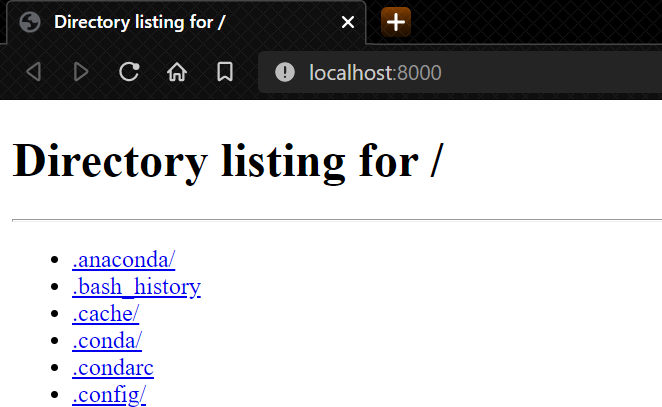
For accessing the server locally we need to visit http://localhost:8000/ or http://127.0.0.1:8000/ Here we can see all the directories of your local storage along with all the data. You can also access an HTML page, It will be rendered by your web browser as you access it.
Functions Used:
- BaseHTTPRequestHandler: It is used to handle the requests that arrive at the server. It doesn't handle the actual HTTP request but handles the Get and Post requests.
- HTTPServer(server_address,BASE_HTTP_REQUEST_HANDLER()): This is a function that is used for storing the port of the server as well as the name of the server.
Step-by-step Approach:
- We will make a class that handles the server requests.
- In that class, we are going to create a function that is used for GET_REQUESTS.
- In that function, we are going to write our HTML code for displaying it on the server.
- In the end, we are using the HTTPServer() function that is used to run our server.
Implementation:
Python3 `
importing all the functions
from http.server module
from http.server import *
creating a class for handling
basic Get and Post Requests
class GFG(BaseHTTPRequestHandler):
# creating a function for Get Request
def do_GET(self):

    # Success Response --> 200
    self.send_response(200)

    # Type of file that we are using for creating our
    # web server.
    self.send_header('content-type', 'text/html')
    self.end_headers()

    # what we write in this function it gets visible on our
    # web-server
    self.wfile.write('<h1>GFG - (GeeksForGeeks)</h1>'.encode())
this is the object which take port
number and the server-name
for running the server
port = HTTPServer(('', 5555), GFG)
this is used for running our
server as long as we wish
i.e. forever
port.serve_forever()
`
How to start our HTTP-Server:
Use the following command in the terminal
python file_name.py

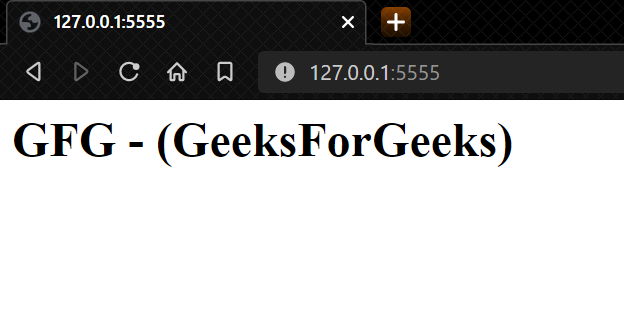
In the browser go to http://localhost:5555/ or http://127.0.0.1:5555/