Decorators in Python (original) (raw)
Decorators are flexible way to modify or extend behavior of functions or methods, without changing their actual code.
- A decorator is essentially a function that takes another function as an argument and returns a new function with enhanced functionality.
- They are often used in scenarios such as logging, authentication and memoization, allowing us to add additional functionality to existing functions or methods in a clean, reusable way.
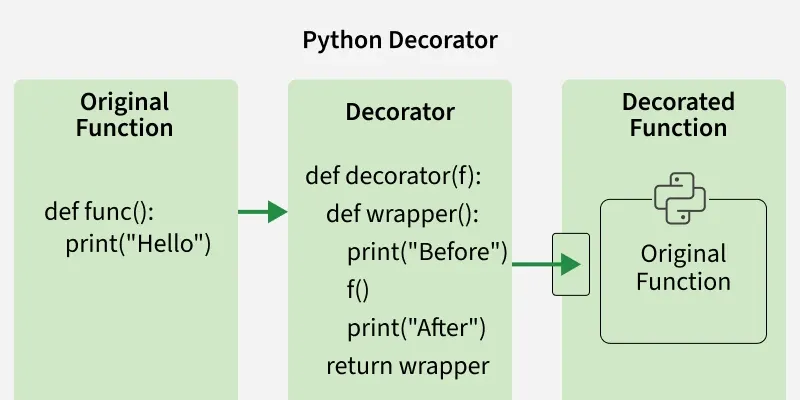
Python Decorators
**Example: Below is an example to demonstrate how decorator functions:
Python `
def decorator(func): def wrapper(): print("Before calling the function.") func() print("After calling the function.") return wrapper
@decorator def greet(): print("Hello, World!") greet()
`
Output
Before calling the function. Hello, World! After calling the function.
**Explanation:
- decorator takes the greet function as an argument.
- It returns a new function (wrapper) that first prints a message, calls greet() and then prints another message.
- @decorator syntax is a shorthand for greet = decorator(greet).
Decorator with Parameters
Decorators often need to work with functions that have arguments. We use *args and **kwargs so our wrapper can accept any number of arguments.
**Example: Let's see an example of a decorator that adds functionality before and after a function call.
Python `
def decorator_name(func): def wrapper(*args, **kwargs): print("Before execution") result = func(*args, **kwargs) print("After execution") return result return wrapper
@decorator_name def add(a, b): return a + b
print(add(5, 3))
`
Output
Before execution After execution 8
**Explanation:
- decorator_name(func) is the decorator function. It takes another function (func) as input.
- wrapper(*args, **kwargs) nested function that wraps func. *args collects positional arguments, **kwargs collects keyword arguments, so wrapper works with any function.
- @decorator_name equivalent to writing add = decorator_name(add) after the function definition.
Functions as First-Class Objects
Functions are first-class objects, meaning they can be treated like any other object (such as integers, strings or lists). This allows functions to be assigned to variables, passed as arguments, returned from other functions and stored in data structures, including decorators.
**Example: This code demonstrates all four properties of functions as first-class objects.
Python `
Assigning a function to a variable
def greet(n): return f"Hello, {n}!" say_hi = greet print(say_hi("Alex"))
Passing a function as an argument
def apply(f, v): return f(v) res = apply(say_hi, "Elon") print(res)
Returning a function from another function
def make_mult(f): def mult(x): return x * f return mult dbl = make_mult(2) print(dbl(5))
`
Output
Hello, Alex! Hello, Elon! 10
**Explanation:
- greet() is assigned to say_hi variable, which is used to print a greeting for "Alex".
- apply() takes a function and a value as arguments, applies function to value and returns the result.
- apply is demonstrated by passing say_hi and "Elon", printing a greeting for "Elon".
- make_mult() creates a multiplier function based on a given factor.
**Role of First-Class Functions in Decorators:
- Decorators take a function as input to modify or enhance its behavior.
- They return a new function that wraps the original, adding behavior before or after execution.
- The original function is replaced by decorated function when assigned to same name.
Higher-Order Functions
Higher-order functions are functions that either take other functions as input, return a function as output, or both. They allow functions to be treated like data, making code more flexible and reusable.
**Example: This code shows a higher-order function that takes another function as an argument and applies it to a given value.
Python `
def fun(f, x): return f(x)
def square(x): return x * x res = fun(square, 5) print(res)
`
**Explanation: fun is a higher-order function because it takes another function f as an argument and applies it to the value x.
Role of Higher-Order Functions in Decorators: Decorators are higher-order functions that take a function, modify it and return a new one with extended or altered behavior.
Types of Decorators
1. Function Decorators: used to wrap and enhance functions by adding extra behavior before or after the original function runs.
**Example: In this Example, a decorator prints a message before and after executing wrapped function.
Python `
def simple_decorator(func): def wrapper(): print(">>> Starting function") func() print(">>> Function finished") return wrapper
@simple_decorator def greet(): print("Hello, World!") greet()
`
Output
Starting function Hello, World! Function finished
**Explanation:
- simple_decorator(func) takes the function greet as an argument (func) and returns a new function (wrapper) that adds some functionality before and after calling original function.
- @simple_decorator is the decorator syntax. It applies simple_decorator to greet function.
- Calling greet() when greet() is called, it doesn't just execute original function but first runs added behavior from wrapper function.
2. Method Decorators: Special decorators used for methods inside a class. They work like function decorators but handle the self parameter for instance methods.
**Example: Here, a decorator prints a message before and after a method is executed, while correctly handling self argument.
Python `
def method_decorator(func): def wrapper(self, *args, **kwargs): print("Before method execution") res = func(self, *args, **kwargs) print("After method execution") return res return wrapper
class MyClass: @method_decorator def say_hello(self): print("Hello!") obj = MyClass() obj.say_hello()
`
Output
Before method execution Hello! After method execution
**Explanation:
- method_decorator(func) takes method (say_hello) as an argument (func). It returns a wrapper function that adds behavior before and after calling original method.
- wrapper(self, *args, **kwargs) must accept self because it is a method of an instance. self is instance of class and *args and **kwargs allow for other arguments to be passed if needed.
- @method_decorator applies method_decorator to say_hello method of MyClass.
- Calling obj.say_hello() say_hello method is now wrapped with additional behavior.
3. Class Decorators: used to modify or enhance behavior of a class. Like function decorators, class decorators are applied to class definition. They work by taking class as an argument and returning a modified version of class.
**Example: This code demonstrates a class decorator that adds a class_name attribute to a class, storing class’s name.
Python `
def fun(cls): cls.class_name = cls.name return cls
@fun class Person: pass print(Person.class_name)
`
**Explanation:
- fun(cls) adds a new attribute, class_name, to class cls. The value of class_name is set to the name of class (cls.__name__).
- @fun applies the fun decorator to the Person class.
- After decorator, Person.class_name stores the string "Person", which is printed as the output.
Built-in Decorators
1. @staticmethod: used to define a method that doesn't operate on an instance of class (i.e., it doesn't use self). Static methods are called on class itself, not on an instance of class.
**Example: This example shows how to define and use a @staticmethod inside a class.
Python `
class MathOperations: @staticmethod def add(x, y): return x + y
res = MathOperations.add(5, 3) print(res)
`
**Explanation:
- add is a static method defined with @staticmethod decorator.
- It can be called directly on class MathOperations without creating an instance.
2. @classmethod: used to define a method that operates on class itself (i.e., it uses cls). Class methods can access and modify class state that applies across all instances of class.
**Example: This code defines a class Employee with a class variable raise_amount and a class method set_raise_amount that updates this variable for entire class.
Python `
class Employee: raise_amount = 1.05 def init(self, name, salary): self.name = name self.salary = salary
@classmethod
def set_raise_amount(cls, amount):
    cls.raise_amount = amount
Employee.set_raise_amount(1.10) print(Employee.raise_amount)
`
**Explanation:
- set_raise_amount is a class method defined with @classmethod decorator.
- It can modify class variable raise_amount for class Employee and all its instances.
3. @property: used to define a method as a property, which allows to access it like an attribute. This is useful for encapsulating implementation of a method while still providing a simple interface.
**Example: This code defines a circle class demonstrating @property for controlled attribute access, allowing safe updates to radius.
Python `
class Circle: def init(self, radius): self._radius = radius
@property
def radius(self):
    return self._radius

@radius.setter
def radius(self, value):
    if value >= 0:
        self._radius = value
    else:
        raise ValueError("Radius cannot be negative")

@property
def area(self):
    return 3.14159 * (self._radius ** 2)
c = Circle(5)
print(c.radius)
print(c.area)
c.radius = 10
print(c.area)
`
**Explanation:
- radius and area are properties defined with @property decorator.
- radius property also has a setter method to allow modification with validation.
- These properties provide a way to access and modify private attributes while maintaining encapsulation.
Chaining Multiple Decorators
Chaining decorators means applying multiple decorators to same function. Each decorator wraps function in sequence, adding layered behavior.
**Example: This example shows how chaining decorators works by applying two decorators in different orders to see how output changes.
Python `
def decor1(func): def inner(): x = func() return x * x return inner
def decor(func): def inner(): x = func() return 2 * x return inner
@decor1 @decor def num(): return 10
@decor @decor1 def num2(): return 10
print(num()) print(num2())
`
**Explanation:
- In num(), decor runs first -> 10 becomes 20, then decor1 squares it -> 400.
- In num2(), decor1 runs first -> 10 becomes 100, then decor doubles it -> 200.
Application of Decorators
- Logging: Track function calls (e.g., @logger).
- Authentication: Restrict access in web apps (e.g., Flask/Django).
- Rate Limiting: Control API usage per user.
- Caching: Store results using functools.lru_cache.
- Retry Logic: Automatically retry failed network calls.