How to use a DataLoader in PyTorch? (original) (raw)
Last Updated : 23 Jul, 2025
Operating with large datasets requires loading them into memory all at once. In most cases, we face a memory outage due to the limited amount of memory available in the system. Also, the programs tend to run slowly due to heavy datasets loaded once. PyTorch offers a solution for parallelizing the data loading process with automatic batching by using DataLoader. Dataloader has been used to parallelize the data loading as this boosts up the speed and saves memory.
The dataloader constructor resides in the torch.utils.data package. It has various parameters among which the only mandatory argument to be passed is the dataset that has to be loaded, and the rest all are optional arguments.
Syntax:
DataLoader(dataset, shuffle=True, sampler=None, batch_size=32)
DataLoaders on Custom Datasets:
To implement dataloaders on a custom dataset we need to override the following two subclass functions:
- The _len_() function: returns the size of the dataset.
- The _getitem_() function: returns a sample of the given index from the dataset. Python3 `
importing the required libraries
import torch from torch.utils.data import Dataset from torch.utils.data import DataLoader
defining the Dataset class
class data_set(Dataset): def init(self): numbers = list(range(0, 100, 1)) self.data = numbers
def __len__(self):
    return len(self.data)

def __getitem__(self, index):
    return self.data[index]
dataset = data_set()
implementing dataloader on the dataset and printing per batch
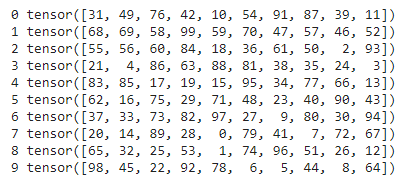
dataloader = DataLoader(dataset, batch_size=10, shuffle=True) for i, batch in enumerate(dataloader): print(i, batch)
`
Output:
DataLoaders on Built-in Datasets:
Python3 `
importing the required libraries
import torch from torch.utils.data import Dataset from torch.utils.data import DataLoader import seaborn as sns from torch.utils.data import TensorDataset
defining the dataset consisting of
two columns from iris dataset
iris = sns.load_dataset('iris') petal_length = torch.tensor(iris['petal_length']) petal_width = torch.tensor(iris['petal_width']) dataset = TensorDataset(petal_length, petal_width)
implementing dataloader on the dataset
and printing per batch
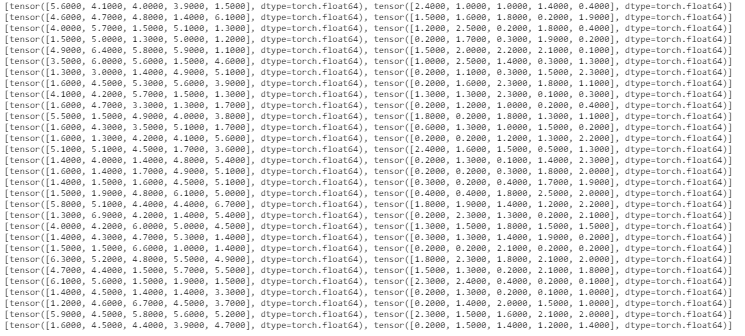
dataloader = DataLoader(dataset, batch_size=5, shuffle=True)
for i in dataloader: print(i)
`
Output: