Intersection() function Python (original) (raw)
Last Updated : 18 Apr, 2026
The set.intersection() method in Python returns a new set containing only the elements that are common to all given sets. It compares two or more sets and keeps only shared values. The original sets remain unchanged.
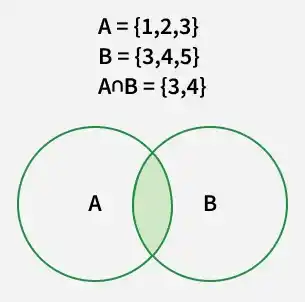
Intersection of two sets
**Example: In this example, common elements between two sets are found using intersection().
Python `
a = {1, 2, 3} b = {2, 3} print(a.intersection(b))
`
**Explanation: a.intersection(b) returns elements present in both sets, only 2 and 3 are common.
Syntax
set1.intersection(set2, set3, ...)
- **Parameters: One or more sets to compare. If no argument is given, it returns a copy of the original set.
- **Return Value: Returns a new set containing common elements.
Examples
**Example 1: In this example, the intersection of two and three sets is calculated.
Python `
a = {2, 4, 5, 6} b = {4, 6, 7, 8} c = {4, 6, 8}
print(a.intersection(b)) print(a.intersection(b, c))
`
**Explanation:
- a.intersection(b) returns common elements of a and b.
- a.intersection(b, c) returns elements common to all three sets.
**Example 2: Here, the & operator is used as a shortcut for intersection.
Python `
a = {2, 4, 5, 6} b = {4, 6, 7, 8} c = {1, 0, 12}
print(a & b) print(a & c) print(a & b & c)
`
**Explanation:
- a & b returns common elements of both sets.
- a & c returns set() because no elements match.
- a & b & c returns common elements among all three sets.
**Example 3: In this example, intersection() is compared with symmetric_difference().
Python `
a = {2, 4, 5, 6} b = {4, 6, 7, 8} print(a.intersection(b)) print(a.symmetric_difference(b))
`
Output
{4, 6} {2, 5, 7, 8}
**Explanation:
- a.intersection(b) returns common elements.
- a.symmetric_difference(b) returns elements not common in both sets.
- Intersection keeps shared values, while symmetric difference keeps non-shared values.