Introduction to Simulation Modeling in Python (original) (raw)
Last Updated : 2 May, 2026
Simulation Modeling is the process of creating a model of a real-world system to study its behavior and predict outcomes. It allows analysis of complex systems without direct experimentation, which can be costly or impractical. In Python, Simulation Modeling involves:
- Simulating real-world processes such as customer flow and system performance
- Generating and analyzing different input conditions to observe how the system behaves
Now, considering an example where you want to decide the number of employees needed for a pizza restaurant using simulation, where
- Orders change over time
- Different pizzas take different preparation times
- Customers arrive randomly
- Workload is not the same all day
Using simulation, we can test different staffing scenarios and observe how the system performs. This helps in choosing the optimal number of employees while balancing workload and cost.
Types of Simulation Models
A model is a replica of an original/real system. Simulation models can be broadly classified based on the presence of randomness.
- **Deterministic Model: Produces the same output for a given input (no randomness). For example: Calculating total cost of items in a cart
- **Stochastic Model: Involves randomness and may produce different outcomes. For example: Tossing a coin or simulating customer arrivals
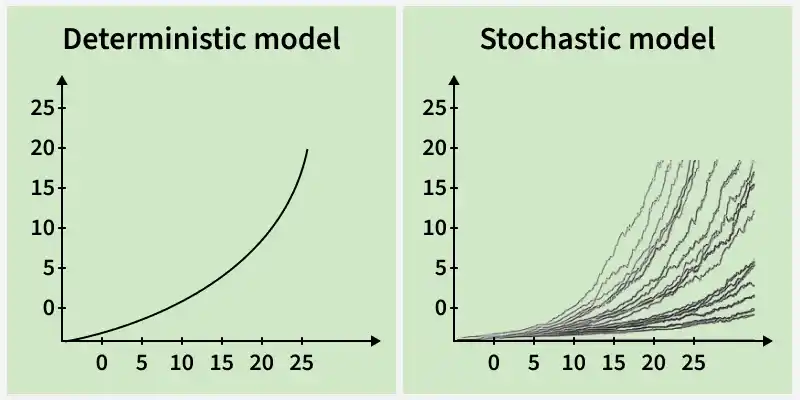
Deterministic VS Stochastic Model
Working
Simulation modeling works through the following steps:
- **Real World System: Starting with the actual pizza restaurant (customers, orders, employees).
- **Conceptual Model: Simplifies the system by defining how customers arrive, pizzas are prepared, and staff works.
- **Simulation Program: Converting the model into a Python program to simulate the process.
- **Verification: Checking if the program is working correctly.
- **Validation: Comparing the results with real-world behavior to ensure accuracy.
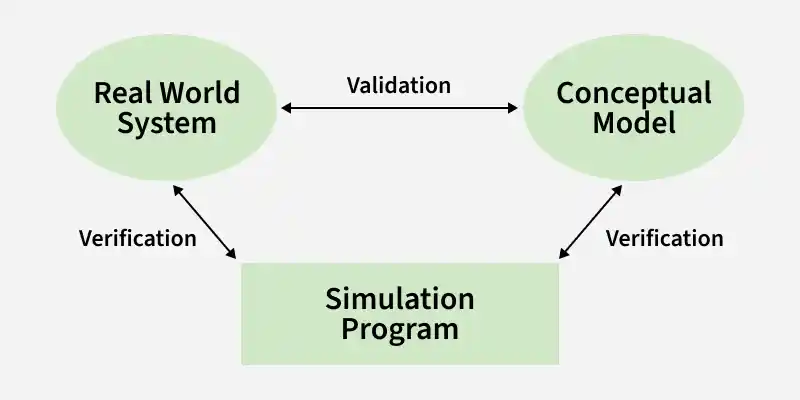
Working of Simulation Modeling
Simulation models are created to test and improve systems before implementation, helping optimize performance and reduce risks. One widely used method is Monte Carlo Simulation****.**
Monte Carlo Simulation
Monte Carlo simulation is a mathematical technique used to estimate the probability of different outcomes by repeatedly running a model using random values (random sampling).
For example, in the pizza restaurant scenario,
- Customers arrive at different times, so random values are used to represent this
- It helps estimating how many employees are needed
Implementation
**1. Importing Libraries
Importing libraries random and Matplotlib to generate random values and plot the graph.
Python `
import random import matplotlib.pyplot as plt
`
**2. Storing Results
Creating an empty list to store the number of employees required in each simulation
Python `
employees_needed = []
`
**3. Running the Simulation
Using random library to simulate customers and preparation time, and estimating employees required
Python `
for _ in range(1000): customers = random.randint(20, 100)
prep_time = random.randint(5, 10)


total_work = customers * prep_time


employees = total_work // 60 + 1

employees_needed.append(employees)
`
**4. Plotting the Graph
Using matplotlib to display the results as a histogram
Python `
plt.hist(employees_needed, bins=8, edgecolor='black') plt.xlabel("Employees Needed") plt.ylabel("No. of Simulations") plt.title("Pizza Restaurant Simulation")
plt.show()
`
**Output:
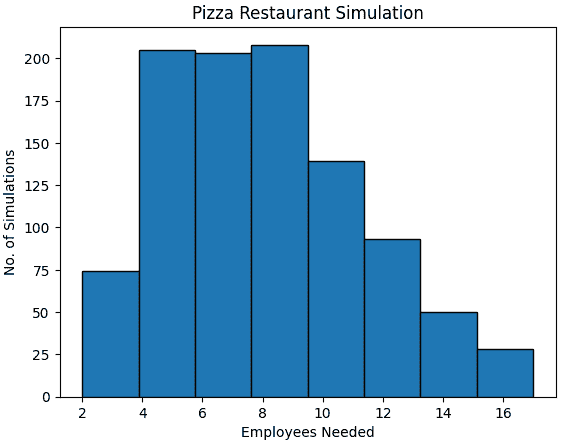
Distribution of employees required based on simulation runs.
From the above graph, we can observe how often different numbers of employees are required. The most frequent values indicate the most likely number of employees needed. This shows how simulation helps in making better decisions.
Advantages
- Reduces cost of real-world experimentation
- Handles complex and dynamic systems
- Allows testing of multiple scenarios
- Improves decision-making accuracy
- Provides visual and analytical insights
Disadvantages
- Results depend on model accuracy
- Can be computationally expensive
- Requires proper data and assumptions
- May oversimplify real-world systems
Applications
- Business process optimization
- Manufacturing and logistics systems
- Healthcare system modeling
- Financial risk analysis
- Network and traffic simulations
- Customer service and queue management