Method Overriding in Python (original) (raw)
Method overriding is an ability of any object-oriented programming language that allows a subclass or child class to provide a specific implementation of a method that is already provided by one of its super-classes or parent classes. When a method in a subclass has the same name, the same parameters or signature, and same return type(or sub-type) as a method in its super-class, then the method in the subclass is said to **override the method in the super-class.
**Prerequisite: Inheritance in Python
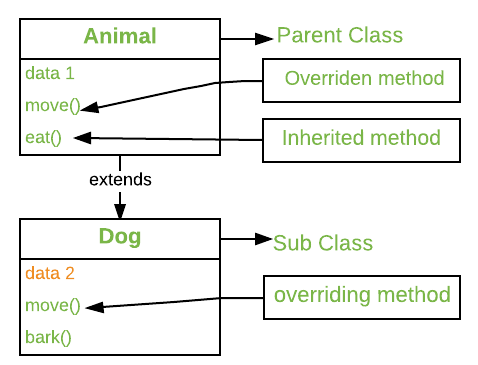
The version of a method that is executed will be determined by the object that is used to invoke it. If an object of a parent class is used to invoke the method, then the version in the parent class will be executed, but if an object of the subclass is used to invoke the method, then the version in the child class will be executed. In other words, it is the type of the object being referred to (not the type of the reference variable) that determines which version of an overridden method will be executed.
**Example:
super().__init__(): This ensures that the parent class's constructor is called, initializing any attributes defined in the parent class. It’s good practice to call the parent class constructor if it does important initialization.- **Method Override: The
Childclass overrides theshow()method of theParentclass, so whenshow()is called on an instance ofChild, it uses theChildclass’s implementation. Python `
Python program to demonstrate
Defining parent class
class Parent():
# Constructor
def __init__(self):
    self.value = "Inside Parent"

# Parent's show method
def show(self):
    print(self.value)
Defining child class
class Child(Parent):
# Constructor
def __init__(self):
    super().__init__()  # Call parent constructor
    self.value = "Inside Child"

# Child's show method
def show(self):
    print(self.value)
Driver's code
obj1 = Parent() obj2 = Child()
obj1.show() # Should print "Inside Parent" obj2.show() # Should print "Inside Child"
`
**Output:
Inside Parent
Inside Child
Method overriding with multiple and multilevel inheritance
**Multiple Inheritance: When a class is derived from more than one base class it is called multiple Inheritance.
**Example: Let's consider an example where we want to override a method of one parent class only.
Python `
Python program to demonstrate
Defining parent class 1
class Parent1():
# Parent's show method
def show(self):
    print("Inside Parent1")
Defining Parent class 2
class Parent2():
# Parent's show method
def display(self):
    print("Inside Parent2")
Defining child class
class Child(Parent1, Parent2):
# Child's show method
def show(self):
    print("Inside Child")
Driver's code
obj = Child()
obj.show() obj.display()
`
**Output:
Inside Child
Inside Parent2
**Multilevel Inheritance: When we have a child and grandchild relationship.
**Example: Let's consider an example where we want to override only one method of one of its parent classes.
Python `
Python program to demonstrate
Python program to demonstrate
overriding in multilevel inheritance
class Parent():
# Parent's show method
def display(self):
    print("Inside Parent")
Inherited or Sub class (Note Parent in bracket)
class Child(Parent):
# Child's show method
def show(self):
    print("Inside Child")
Inherited or Sub class (Note Child in bracket)
class GrandChild(Child):
# Child's show method
def show(self):
    print("Inside GrandChild")
Driver code
g = GrandChild() g.show() g.display()
`
**Output:
Inside GrandChild
Inside Parent
Calling the Parent's method within the overridden method
Parent class methods can also be called within the overridden methods. This can generally be achieved by two ways.
**Using Classname: Parent's class methods can be called by using the Parent classname.method inside the overridden method.
**Example:
Python `
Python program to demonstrate
calling the parent's class method
inside the overridden method
class Parent():
def show(self):
    print("Inside Parent")
class Child(Parent):
def show(self):

    # Calling the parent's class
    # method
    Parent.show(self)
    print("Inside Child")
Driver's code
obj = Child() obj.show()
`
**Output:
Inside Parent
Inside Child
**Using Super()
Python super() function provides us the facility to refer to the parent class explicitly. It is basically useful where we have to call superclass functions. It returns the proxy object that allows us to refer parent class by ‘super’.
**Example 1:
Python `
Python program to demonstrate
calling the parent's class method
inside the overridden method using
super()
class Parent():
def show(self):
    print("Inside Parent")
class Child(Parent):
def show(self):

    # Calling the parent's class
    # method
    super().show()
    print("Inside Child")
Driver's code
obj = Child() obj.show()
`
**Output:
Inside Parent
Inside Child
**Example 2:
Python `
Program to define the use of super()
function in multiple inheritance
class GFG1: def init(self): print('HEY !!!!!! GfG I am initialised(Class GEG1)')
def sub_GFG(self, b):
    print('Printing from class GFG1:', b)
class GFG2 inherits the GFG1
class GFG2(GFG1): def init(self): print('HEY !!!!!! GfG I am initialised(Class GEG2)') super().init()
def sub_GFG(self, b):
    print('Printing from class GFG2:', b)
    super().sub_GFG(b + 1)
class GFG3 inherits the GFG1 ang GFG2 both
class GFG3(GFG2): def init(self): print('HEY !!!!!! GfG I am initialised(Class GEG3)') super().init()
def sub_GFG(self, b):
    print('Printing from class GFG3:', b)
    super().sub_GFG(b + 1)
main function
if name == 'main':
# created the object gfg
gfg = GFG3()

# calling the function sub_GFG3() from class GHG3
# which inherits both GFG1 and GFG2 classes
gfg.sub_GFG(10)
`
**Output:
HEY !!!!!! GfG I am initialised(Class GEG3)
HEY !!!!!! GfG I am initialised(Class GEG2)
HEY !!!!!! GfG I am initialised(Class GEG1)
Printing from class GFG3: 10
Printing from class GFG2: 11
Printing from class GFG1: 12