Python NonCentral Chisquared Distribution in Statistics (original) (raw)
Python - Non-Central Chi-squared Distribution in Statistics
Last Updated : 10 Jan, 2020
scipy.stats.ncx2() is a non-central chi-squared continuous random variable. It is inherited from the of generic methods as an instance of the rv_continuous class. It completes the methods with details specific for this particular distribution. Parameters :
q : lower and upper tail probabilityx : quantilesloc : [optional]location parameter. Default = 0scale : [optional]scale parameter. Default = 1size : [tuple of ints, optional] shape or random variates.moments : [optional] composed of letters [‘mvsk’]; ‘m’ = mean, ‘v’ = variance, ‘s’ = Fisher’s skew and ‘k’ = Fisher’s kurtosis. (default = ‘mv’).Results : non-central chi-squared continuous random variable
Code #1 : Creating non-central chi-squared continuous random variable
Python3 1== `
importing library
from scipy.stats import ncx2
numargs = ncx2.numargs a, b = 4.32, 3.18 rv = ncx2(a, b)
print ("RV : \n", rv)
`
Output :
RV : scipy.stats._distn_infrastructure.rv_frozen object at 0x000002A9D6E0FE08
Code #2 : non-central chi-squared continuous variates and probability distribution
Python3 1== `
import numpy as np quantile = np.arange (0.01, 1, 0.1)
Random Variates
R = ncx2.rvs(a, b) print ("Random Variates : \n", R)
R = ncx2.pdf(a, b, quantile) print ("\nProbability Distribution : \n", R)
`
Output :
Random Variates : 1.452454339214702
Probability Distribution : [0.10195838 0.10369453 0.10528707 0.1067405 0.10805931 0.1092479 0.11031066 0.1112519 0.11207589 0.11278684]
Code #3 : Graphical Representation.
Python3 1== `
import numpy as np import matplotlib.pyplot as plt
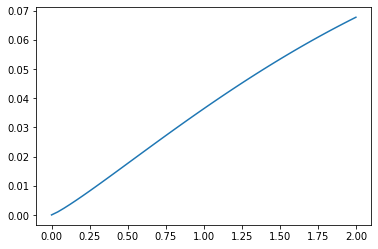
distribution = np.linspace(0, np.minimum(rv.dist.b, 3)) print("Distribution : \n", distribution)
plot = plt.plot(distribution, rv.pdf(distribution))
`
Output :
Distribution : [0. 0.04081633 0.08163265 0.12244898 0.16326531 0.20408163 0.24489796 0.28571429 0.32653061 0.36734694 0.40816327 0.44897959 0.48979592 0.53061224 0.57142857 0.6122449 0.65306122 0.69387755 0.73469388 0.7755102 0.81632653 0.85714286 0.89795918 0.93877551 0.97959184 1.02040816 1.06122449 1.10204082 1.14285714 1.18367347 1.2244898 1.26530612 1.30612245 1.34693878 1.3877551 1.42857143 1.46938776 1.51020408 1.55102041 1.59183673 1.63265306 1.67346939 1.71428571 1.75510204 1.79591837 1.83673469 1.87755102 1.91836735 1.95918367 2. ]
 Code #4 : Varying Positional Arguments
Python3 1== `
import matplotlib.pyplot as plt import numpy as np
x = np.linspace(0, 5, 100)
Varying positional arguments
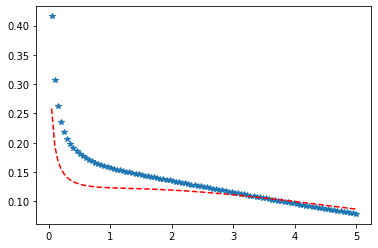
y1 = ncx2 .pdf(x, 1, 3) y2 = ncx2 .pdf(x, 1, 4) plt.plot(x, y1, "*", x, y2, "r--")
`
Output :