random.gammavariate() function in Python (original) (raw)
Last Updated : 26 May, 2020
random module is used to generate random numbers in Python. Not actually random, rather this is used to generate pseudo-random numbers. That implies that these randomly generated numbers can be determined.
random.gammavariate()
**gammavariate()** is an inbuilt method of the random module. It is used to return a random floating point number with gamma distribution.
Syntax : random.gammavariate(alpha, beta)Parameters :alpha : greater than 0 beta : greater than 0Returns : a random gamma distribution floating number
Example 1:
Python3 1== `
import the random module
import random
determining the values of the parameter
alpha = 100 beta = 2
using the gammavariate() method
print(random.gammavariate(alpha, beta))
`
Output :
4.647425239687329
Example 2: We can generate the number multiple times and plot a graph to observe the gamma distribution.
Python3 1== `
import the required libraries
import random import matplotlib.pyplot as plt
store the random numbers in a
list
nums = [] alpha = 9 beta = 0.5
for i in range(100): temp = random.gammavariate(alpha, beta) nums.append(temp)
plotting a graph
plt.plot(nums) plt.show()
`
Output : 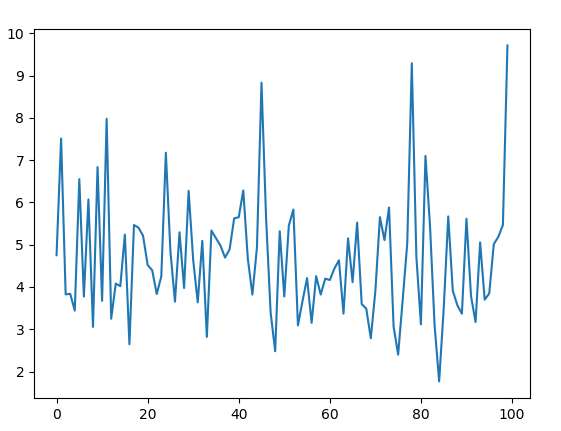 Example 3: We can create a histogram to observe the density of the gamma distribution.
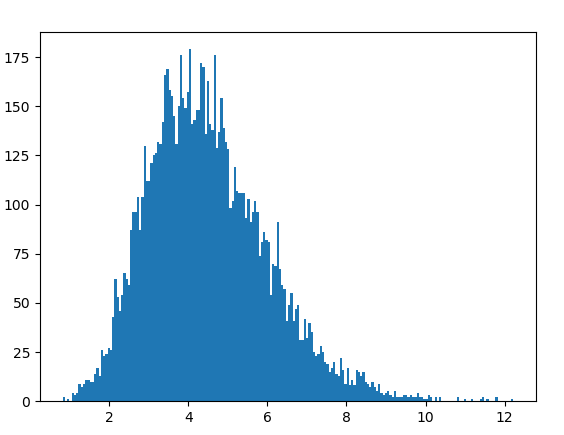
Python3 1== `
import the required libraries
import random import matplotlib.pyplot as plt
store the random numbers in a list
nums = [] alpha = 9 beta = 0.5
for i in range(10000): temp = random.gammavariate(alpha, beta) nums.append(temp)
plotting a graph
plt.hist(nums, bins = 200) plt.show()
`
Output :