random.triangular() method in Python (original) (raw)
Last Updated : 17 May, 2020
**triangular()** is an inbuilt method of the random module. It is used to return a random floating point number within a range with a bias towards one extreme.
Syntax : random.triangular(low, high, mode)**Parameters :**low : the lower limit of the random number high : the upper limit of the random number mode : additional bias; low < mode < high if the parameters are (10, 100, 20) then due to the bias, most of the random numbers generated will be closer to 10 as opposed to 100.Returns : a random floating number
Example 1:
Python3 1== `
import the random module
import random
determining the values of the parameters
low = 10 high = 100 mode = 20
using the triangular() method
print(random.triangular(low, high, mode))
`
Output :
22.614510550239572
Example 2: If we generate the number multiple times we can probably identify the bias.
Python3 1== `
import the random module
import random
determining the values of the parameters
low = 10 high = 100 mode = 20
running the triangular method with the
same parameters multiple times
for i in range(10): print(random.triangular(low, high, mode))
`
Output :
58.645768016894735 46.690692250503226 33.57590419190895 52.331804090351305 33.09451214875767 12.03845752596168 32.816080679206294 20.4739124559502 82.49208123077557 63.511062284733015
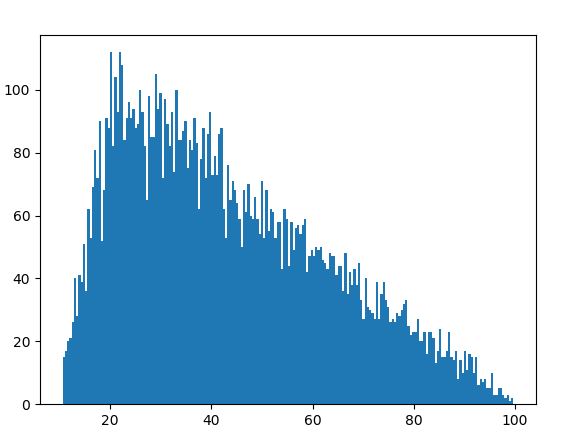
Example 3: We can visualize the triangular pattern by plotting a graph.
Python3 1== `
import the required libraries
import random import matplotlib.pyplot as plt
store the random numbers in a list
nums = [] low = 10 high = 100 mode = 20
for i in range(10000): temp = random.triangular(low, high, mode) nums.append(temp)
plotting a graph
plt.hist(nums, bins = 200) plt.show()
`
Output :