Reading and Writing JSON to a File in Python (original) (raw)
The full form of **JSON is Javascript Object Notation.
- It is a text-based data format used for storing and transferring data, especially in web applications.
- Python supports working with JSON through a built-in package called json. To use it, we import the json module in our Python script.
- JSON data is written as key-value pairs inside curly braces {}, which makes it very similar to Python dictionaries.
Reading JSON from a file using Python
Reading JSON in Python means retrieving JSON data from a file or string and converting it into Python objects like dictionaries or lists. This process is called deserialization. Python offers two main ways to read JSON data:
1. Using json.load()
The JSON package has **json.load() function that loads the JSON content from a JSON file into a dictionary. It takes one parameter:
**File pointer: A file pointer that points to a JSON file.
**Example: Read a JSON file and convert its contents to a Python dictionary.
Python `
import json
Read from file and parse JSON
with open("sample.json", "r") as f: data = json.load(f)
print(data) print(type(data))
`
**Output:

Output using json.load()
**Explanation: We open sample.json in read mode and use **json.load() to parse its content into a Python dictionary, which we then print along with its data type.
2. Using json.loads()
**json.loads() function is used to parse a JSON string and convert it into a Python object. It takes one parameter:
**JSON string: A valid JSON-formatted string.
**Example: Convert a JSON-formatted string into a Python dictionary.
Python `
import json json_str = '{"name": "Francis", "age": 25, "city": "New York"}' data = json.loads(json_str)
print(data) print(type(data))
`

Output using json.loads()
**Explanation: We define a JSON string and use json.loads() to parse it into a Python dictionary, then print the resulting object and its type.
Writing JSON to a file in Python
Writing data to a JSON file in Python involves converting Python objects like dictionaries into JSON format and saving them to a file. This process is called serialization. Let's explore two methods to write a JSON file in Python.
1. Using json.dumps()
The JSON package in Python has a function called json.dumps() that helps in converting a dictionary to a JSON object. It takes two parameters:
- **dictionary: the name of a dictionary which should be converted to a JSON object.
- **indent: defines the number of units for indentation
After converting the dictionary to a JSON object, simply write it to a file using the "write" function.
**Example: Convert a dictionary to a JSON string and write it to a file.
Python `
import json data = { "name": "sathiyajith", "rollno": 56, "cgpa": 8.6, "phone": "9976770500" }
json_str = json.dumps(data, indent=4) with open("sample.json", "w") as f: f.write(json_str)
`
**Output:
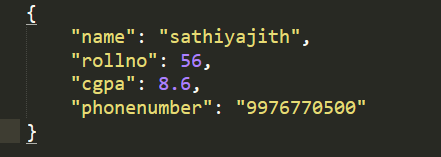
Output using json.dumps()
**Explanation: We create a dictionary, convert it to a JSON-formatted string using **json.dumps() with 4-space indentation and write it to sample.json using the **write() method.
2. Using json.dump()
Another way of writing JSON to a file is by using json.dump() method. The JSON package has "dump" function which directly writes the dictionary to a file in the form of JSON, without needing to convert it into an actual JSON object. It takes 2 parameters:
- **dictionary - the name of a dictionary which should be converted to a JSON object.
- **file pointer - pointer of the file opened in write or append mode.
**Example: Directly write a dictionary to a JSON file without converting it first.
Python `
import json data = { "name": "sathiyajith", "rollno": 56, "cgpa": 8.6, "phone": "9976770500" }
with open("sample.json", "w") as f: json.dump(data, f)
`
**Output
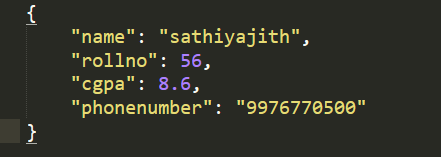
Output using json.dump()
**Explanation: We create a dictionary and use json.dump() to directly write it to **sample.json, skipping the need to manually convert it to a JSON string.
Python vs JSON Object Mapping
| PYTHON OBJECT | JSON OBJECT |
|---|---|
| Dict | object |
| list, tuple | array |
| str | string |
| int, long, float | numbers |
| True | true |
| False | false |
| None | null |