Recursion in Python (original) (raw)
Last Updated : 19 May, 2026
Recursion is a programming technique where a function calls itself either directly or indirectly to solve a problem. It is commonly used for:
- Breaking problems into smaller subproblems
- Mathematical calculations like factorial and Fibonacci
- Tree and graph traversal and Divide-and-conquer algorithms
Working of Recursion
A recursive function calls itself in its body. Let's see basic structure of recursive function:
def recursive_function(parameters):
if base_case_condition:
return base_result
else:
return recursive_function(modified_parameters)
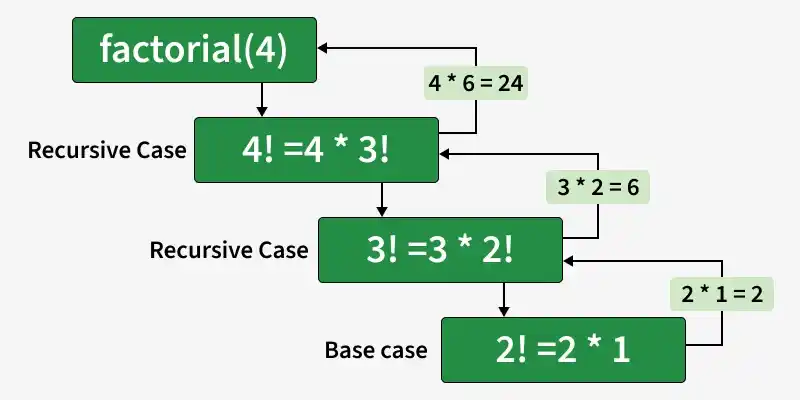
Recursion in Python
Recursive function contains two key parts:
- **Base Case: stopping condition that prevents infinite recursion.
- **Recursive Case: part of the function where it calls itself with modified parameters.
Examples
**Example 1: This code defines a recursive function to calculate factorial of a number, where function repeatedly calls itself with smaller values until it reaches the base case.
Python `
def factorial(n): if n == 0: # Base case return 1 else: # Recursive case return n * factorial(n - 1)
print(factorial(5))
`
**Explanation:
- Base Case: when n == 0, recursion stops and returns 1.
- Recursive Case: multiplies n with the factorial of n-1 until it reaches the base case.
**Example 2: This code defines a recursive function to calculate nth Fibonacci number, where each number is the sum of the two preceding ones, starting from 0 and 1.
Python `
def fibonacci(n): if n == 0: return 0 elif n == 1: return 1 else: return fibonacci(n-1) + fibonacci(n-2)
print(fibonacci(10))
`
**Explanation:
- Base Cases: if n == 0, the function returns 0. If n == 1, the function returns 1. These two cases are necessary to stop the recursion.
- Recursive Case: function calls itself twice with decrements of n (i.e., fibonacci(n-1) and fibonacci(n-2)), summing results of these calls.
Types of Recursion
Recursion can be broadly classified into two types: tail recursion and non-tail recursion. The main difference between them is related to what happens after recursive call.
- **Tail Recursion: The recursive call is the last thing the function does, so nothing happens after it returns. Some languages can optimize this to work like a loop, saving memory.
- **Non-Tail Recursion: The function does more work after the recursive call returns, so it can’t be optimized into a loop.
**Example: This code compares tail recursion and non-tail recursion using two versions of factorial function one with an accumulator (tail-recursive) and one with multiplication after recursive call (non-tail-recursive).
Python `
def tail_fact(n, acc=1): if n == 0: return acc else: return tail_fact(n-1, acc * n)
def nontail_fact(n): if n == 0: return 1 else: return n * nontail_fact(n-1)
print(tail_fact(5))
print(nontail_fact(5))
`
**Explanation:
- def tail_fact(n, acc=1): - Defines a tail-recursive factorial function with an accumulator acc to store intermediate results.
- if n == 0: return acc - Base case: when n reaches 0, return the accumulated result.
- return tail_fact(n-1, acc * n) - Tail-recursive call: multiplies acc by n before the call, so no extra work is left after recursion.
- def nontail_fact(n): - Defines a non-tail-recursive factorial function.
- if n == 0: return 1 - Base case: when n == 0, return 1 (factorial of 0 is 1).
- return n * nontail_fact(n-1) - Non-tail call: multiplication happens after the recursive call returns, so more work remains after recursion.
When to Avoid Recursion
- When the problem can be solved easily with loops.
- When recursion depth is large enough to risk a stack overflow.
- When performance is critical and function call overhead matters.
Recursion vs Iteration
Recursion and iteration are two common techniques used to repeat tasks in programming below table highlights the key differences between them:
| Feature | Recursion | Iteration |
|---|---|---|
| Method | A function calls itself to repeat the task | Uses loops (for, while) to repeat steps |
| Memory Use | Uses more memory due to function calls | Uses less memory |
| Performance | Usually slower because of function call overhead | Generally faster as it avoids repeated function calls |
| Best Used For | Problems like tree traversal or divide-and-conquer | Repeating steps in a sequence |
| Risk | May cause stack overflow if recursion is too deep | No stack overflow risk |